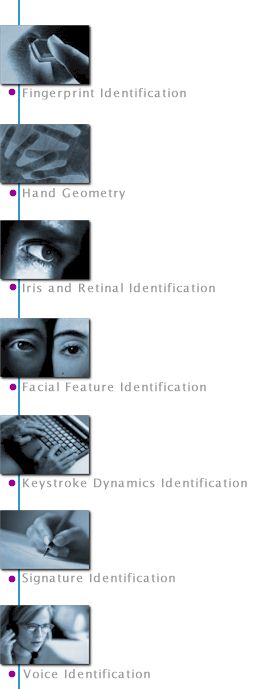
The future of biometric technologies is promising.
Biometric devices and applications continue to grow worldwide.
Biometric technologies will soon be the common way to gain access
into your personal computer system.
CardTech/SecurTech predicted that in 1998 the total expenditures
for biometrics was to reach $100 million. According to Erik
Bowman, an industry analyst at CardTech/SecurTech, located in
Bethesda, Maryland, of the $100 million, governments will spend
approximately $62 million and corporations $38 million. By
1999, as biometrics continues to grow and gain user acceptance,
total corporate spending for biometric hardware and software will
increase to $50 million (Millman,
H. 1998).
There are several other factors that will push the growth of
biometric technologies. A major inhibitor of the growth of
biometrics has been the cost to implement them. That is
beginning to change as computer hardware and software as well as
manufacturing prices fall in price. One can now go and
purchase a fingerprint imaging system for under $100 per seat.
Also, increased accuracy rates are and will play a big part in the
acceptance of biometric technologies. The development and
research into biometric error testing, false reject (false
non-match) and false accept (false match), has been of keen interest
to biometric developers. How well do biometrics keep the "bad
guys" out and let the "good guys" in will always be a question that
is asked when customers look to implement a biometric
technology. Both false match and false non-match error rates
continue to improve and it is the balance between the two that will
be critical when implementing a biometric technology. Finally,
new applications and new markets are expanding the deployment of
biometric technology. Biometric applications that were once
reserved for just military and other government applications are now
finding their way into our daily lives. Biometric
applications are surfacing in child day-care centers,
healthclubs, universities, and automated teller machines
(ATM's). The explosion of the Internet and Intranet's are also
fueling the presence of biometrics. As e-commerce continues to
develop as a mode of communication, many corporations and
individuals are becoming concerned with security issues. Ernst
& Young's 1997 survey of businesses found that nearly one in
four are staying away from the Internet because of worries about
security breeches (International
Computer Security Association, 1998).

The sales of biometrics is not the only factor that is
contributing to its growth. There are a number of new
technologies that are under development that are looking at other
physiological features for identification:
- Vein pattern identification
- much like retinal identification in that it uses infrared
light to produce an image of one's vein pattern in their face,
wrist, or hand. Advantage of this type of biometric
technology is that veins are relatively stable through one's
life and cannot be erased or tampered with.
- measures the shape (geometry) of the ear.
- body odor can be digitally recorded for
identification. A British company, Mastiff Electronic
Systems Ltd., is working on a system that uses your hand to
identify your body odor. The British company has developed
a sensor named Scentinel that is used to "capture" your body
odor. The product is still three years away from
commercial release and is still too expensive ($48,600) but
there is interest in its implementation from the British embassy
in Buenos Aires, Saudi Arabia's National Guard, and private
Indian and Japanese companies (Davis, A. 1997).
- Body salinity (salt) identification
- development in this area has been conducted by IBM and the
Massachusetts Institute of Technology (MIT). Their joint
product, The Personal Area Network (PAN), works by exploiting
the natural level of salinity, or salt, in the human body which
is accomplished by an electric field which passes a tiny
electrical current through the body (salt is an effective
conductor of electricity), on which data can be carried.
The electrical current that is used is in the order of a nanoamp
(one-billionth of an amp) which is less than the natural
currents already present in the body. Speeds equivalent to
a 2400-baud modem have been claimed, giving 400,000 bits per
second data transfer (Computer Business Review, 1998).
Applications of this kind of biometric technology could
include the interaction (data transfer) between communication
devices carried on the body including watches, mobile phones,
and pagers. Also, applications could include "waking up"
household appliances/devices as one enters a room.
- the "ultimate" biometric technology which would produce
proof-positive identification of an individual. This
technology is still not considered a "biometric" technology and
is years away from any kind of implementation. It is also
very intrusive for the user.
- Palm print identification
- uses the lines on one's palm to identify an
individual. Like fingerprint identification systems, palm
print systems measure ridges and minutiae points found on the
palm.
- "Electronic nose" identification
The field of biometrics is evolving.
Biometrics are now not just used to control physical access, but are
used in a variety of industries and circumstances. Biometric
technology is improving and falling in price as vendors increase
revenue. As a result, funding is becoming more widespread and
the development of biometrics is on the rise.
Latest News
in Palm Print Identification |