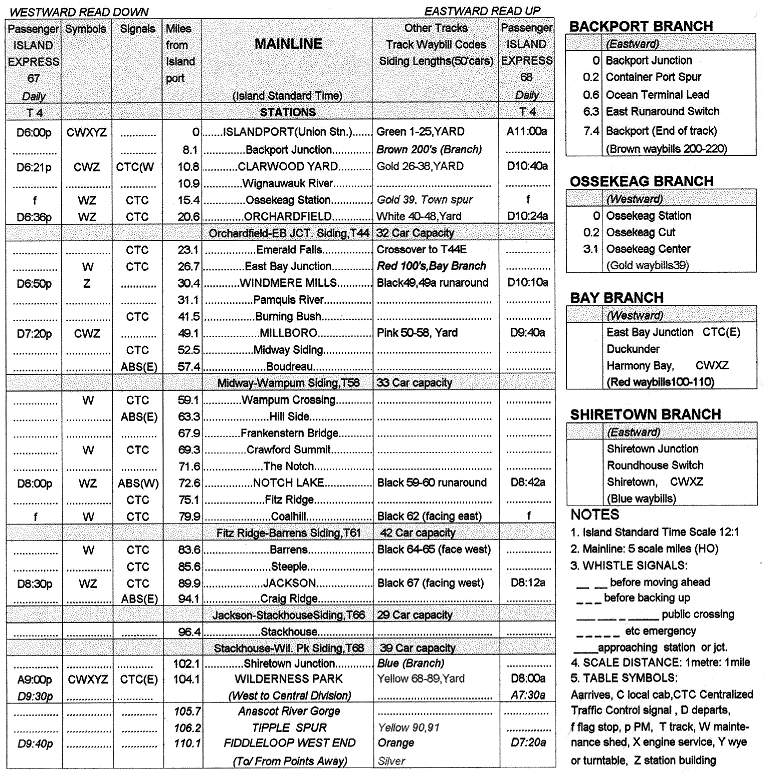
| Island Central Railway Saint John Division Time Table 32 Effective 0001 Atlantic Standard Time Sunday, April 1, 2001 For the information and Guidance of Operators and Visitors |
 |
 |
| GENERAL INSTRUCTIONS 1. The GENERAL CODE OF OPERATING RULES and current TIME TABLE govern the operation of the Island Central Railway. For prototypical operation crews should refer to them. 2. Operating crews should have a copy of the current TIME TABLE at hand when on duty. 3. Visitors and inexperienced crews are encouraged to operate with pilot assistance. 4. AUTHORITY TO OPERATE A TRAIN on the Saint John Division is held by the Dispatcher and conveyed to operating crews by written orders, radio transmissions and CTC signals. No operator should begin a run without receiving orders and CLEARANCE TO BEGIN from the Dispatcher. When a RUN IS COMPLETE the train crew must notify the Dispatcher. 5. BEFORE RECEIVING CLEARANCE to begin a run, the engineer must turn off the throttle unless the locomotives are idling. This may prevent a possible sudden locomotive movement. 6. No train should pass a CTC signaI unless the signal indicates it is OK to do so. 7. Tracks are identified by number or switch stand targets, fascia maps and nearby signs. 8. Turnouts to passing sidings, except Ononette, are remotely controlled by the Dispatcher. 9. ARISTOCRAFT RADIO CONTROL throttles are assigned to most trains, These units do not have pulse power but do have slight momentum built in. For best control the GREEN THROTTLE control and YELLOW RUNNING BRAKE should be pumped gradually. The RED emergency brake should be used only in real emergencies and to shut down the unit. TP-5 tethered pulse throttles and a Futaba pulse radio throttle can also be used with all mainline cabs. Rix tethered cabs are generally used by yard switching crews. 10. To start a rough starting locomotive smoothly without pulse, first put the unit in reverse of the intended direction and notch (pump) up the throttle until it is almost ready to move. Then press "forward" and pump the throttle slightly. If this doesn't work, try each step again. 11. To operate the DIESEL SOUND UNIT IDLE and constant brightness headlights, notch down the throttle only enough to stop the locomotive between moves. 12. Locomotive whistle and bell buttons are located at many locations on the fascia foreach engineer's use. 13. Smooth TRAIN HANDLING is essential for reliable train operations. Operators should avoid pushing long cuts of care of mixed length and weight through sharp curves, turnouts and irregular trackage. Minimal speed must also be used in such Iocations. 14. Manual turnouts on the mainline must always be left set for the main and against the diverging route after any use. Other passing siding switches must be left set against the diverging route. 15. The trackage system Is divided Into Insulated ELECTRICAL BLOCKS identified by YELLOW ties. Track power is routed thru turnouts, if any, from the points' end to the rest of each block. 16. "No power" through a turnout is most often immediately fixed by cleaning the contact points. 17. Cars should not be lifted off the track to uncouple. UNCOUPLING IS EASILY DONE by pushing the cars together and then using the coupler pick to pull the nearest air hose outward. While the hose is held out the car should be moved slightly apart by the locomotive or hand. 18. TRAIN INSPECTIONS should be done by operator before departures and after switching. If serious coupler height or other problems are noticed quick temporary solutions should be done by the operator on the spot and management informed when appropriate. 19. To determine which car to SETOUT OR PICKUP at a location, FOLLOW THESE STEPS: A. CHECK the train order or switchlist and your location to sea which waybilled car to handle. B. READ the COLOUR and NUMBER on the waybills (thumb tacks) on cars at the given location NOTE: READ THE WESTERN END ON ANY WAYBILL ONLY. IGNORE OTHER END! C. SETOUT, PICKUP, MOVE, PLACE ONLY CARS WHOSE WAYBILLS FIT THE ORDER. |
 |
|
|

|
 |