| Island Central Railway Fall Foliage Excursion |
 |
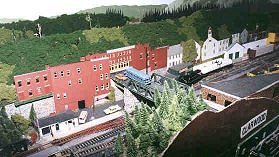
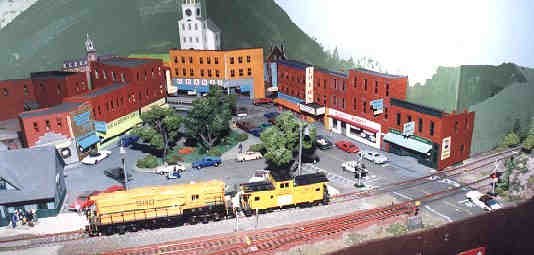
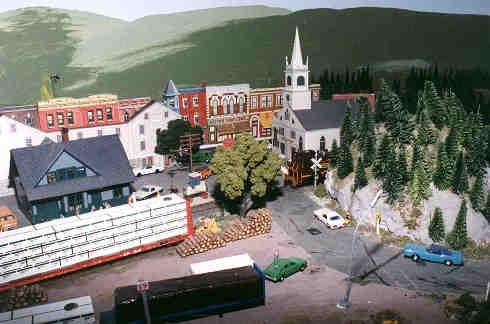
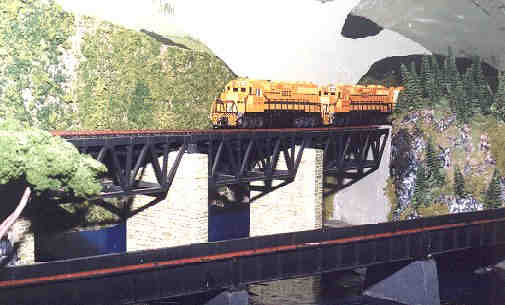
WELCOME ABOARD! We'll be leaving Union Station shortly at 9:30 a.m. I.D.T. Make yourself comfortable. All seats on the train recline. Find one with a great view and adjust the back for your comfort. We expect a full house today so please put your things in the luggage racks now to avoid having to rearrange as more travelers join us. After your ticket is checked, you are free to wander the train and visit the dining car located in the middle of the train. It is open to serve full down east breakfasts that you'll never forget. The maple syrup is real, the coffee freshly brewed, and the bread and muffins just out of the oven. For lighter fare visit the old mail car canteen at the front of the train. All Aboard! As the train pulls out of the station, notice the large round building to the left and the bridge like turntable in front of it. This historic facility has been updated and continues to serve the railroad as its major engine maintenance center. The locomotive on the turntable as we pass is one of four power freight locomotives, which arrived with a long container train earlier today. It is being turned, inspected and readied for the next assignment. On the right as we leave Saint John, notice the old cotton mill complex, now a flourishing university campus. The canal running from the mill buildings parallel to the railroad on your right once was the source of water power for the mill. As we approach Mill Creek, the canal will suddenly disappear under us and into the Creek. APPROACHING LANCASTER We're now approaching Lancaster and the east end of the railway's main freight car sorting yard. Notice the train slow up as the mainline crosses from the middle track from lslandport to the north track. The tracks coming in on the right are from the Ocean Terminal at West Saint John. This is one of the busiest spurs on the railway handling hundreds of import and export containers weekly as well as trainloads of export grain. Beyond the Junction we will be running parallel to Dever Road Yard and numerous customer sidings. APPROACHING DEVER ROAD STATION The double toot of the locomotive whistle and the braking of the train signal that we are arriving at Dever Road Station. This station is the Dever Road Yard operations center. At most any hour of the day or night you'll find one or two members of the Island Central switcher fleet busily working in the vicinity. Today, we're in luck. Looking to your right, you'll see numbers 53 and 58, both first generation ALCO S-2 class locomotives working together on a long cut of container cars recently loaded at the Ocean Port. These two units are vintage but due to recent overhauls and the expensive replacement of their original wheels they are as good as new. As we make our brief stop at Dever Road, if you're in the first coach please make room for those joining us. There are seats for all but none to spare today. If you are off to the dining car please leave something on your seat to reserve it. LEAVING DEVER ROAD STATION Two blasts of the whistle and we are on our way. Notice the almost continuous sound of the whistle as the locomotive quickly accelerates from the station, across the Wignauwauk River Bridge and into a curving rock cut. This is the warning for traffic on Highway One, which we are about to cross at grade in the middle of the cut. After crossing Route One we will be running through heavy woodland for about four miles before reemerging to follow the Nerepis River at Martinon. Before we reach Martinon there is time to learn a little about the train you are riding. Today's excursion is being hauled by one of the railways most powerful locomotives, number 857, a Century 424 manufactured by ALCO in the 1960's. Since this is a freight locomotive, it is being assisted by engine number 562, a GP-7 which is generating the comfortable steam heat which we are all enjoying this crisp fall morning. Behind the engines are five coaches, a fully equipped sit down dining car and a former mail and baggage car, which now houses the snack and souvenir concession. The coaches range from first generation Pullman Bradley lightweight cars of 1930's vintage to the stainless steel luxury coach of the late 1940's. APPROACHING MARTINON The two long blasts on the whistle signal our approach to the crossing at Martinon Station. Get ready for a quick glance at a Down East hamlet the way it was 40 years ago. LEAVING MARTINON As we pull away from our brief stop at Martinon, look to the right. Don't miss the old covered bridge, the waterfalls and vintage power dam just up river from it. The track leaving us to the right is by no means a relic of the past, dozens of modern coal cars move up that line each week to feed the regional thermal generating station at Sutherlands Spur. Having crossed the Whatever River, a tributary of the Nerepis, we now find ourselves running along the Nerepis River's edge for the next 5 miles to Grand Bay. Enjoy the colour and watch for anglers. This is a popular part of the river. Just before our arrival at Grand Bay station, the train will be stopping at a siding switch today in order to move into the siding out of the way of the eastbound Island Express. It is now waiting for us in Grand Bay. If you enjoy your excursion today, we're sure you'll find yourself travelling on the Island Express across the Island and to mainline points some time soon. Notice as we pass, the Island Express has luxury coach, lounge, dining, and sleeping cars as well as a very popular dome car. APPROACHING GRAND BAY The locomotive whistle is signaling our approach to Grand Bay and the River Street Crossing. Be ready for a panoramic view of the quintessential down east town center as we slow for the station, Dairy Queen, Home Hardware, Sobeys, the white wooden church, the whorehouse, and the town square are all in full view. Have your cash ready. As we leave Grand Bay, those of you who have just joined us may wish to visit the dining car in the middle of the train where full down east breakfasts are being served or visit the snack and souvenir car at the front of the train for lighter fare. As the train accelerates from the station the numbers of active sidings and freight cars placed in the yard indicate that Grand Bay is a thriving agricultural center. UPON LEAVING GRAND BAY STATION As we leave Grand Bay look to the right to glimpse the Emerald Falls as we cross the Emerald River, another tributary of the Nerepis. For the next seven miles the Nerepis River will never be far away on our left. The Trans Canada Highway is to our right in the hills above. Fewer and fewer signs of civilisation will be seen as we move further from Saint John, a secluded beach here, the railway junction to Gagetown there and continuous curves in the track as the train follows the contour of the Nerepis Valley gently gaining elevation with the river. APPROACHING WELSFORD We are now approaching Welsford, as you have by now guessed from the engineer's warning to cars on the village crossing. As we briefly stop at the station look for the oldest IRVEN garage on the route and the amazing Welsford General Store. Their slogan is "If we don't have it, you probably don't need it." UPON LEAVING WELSFORD As we leave Welsford, the train is crossing the Nerepis River on a three span bridge and leaving the River to continue its gentle climb from the sea. We will rejoin the Nerepis again only once and that will be near the summit of our trip. Notice the Trans Canada Highway bridge above us to the right. This is the last that we will see of Route One which now returns to the coast for the rest of its route. The best roads we will see from now on will be a few secondary feeder roads more or less connecting the interior with the coastal route. For the next 19 miles the train will be running through scenic woodlands, perfect for the foliage enthusiast, but don't use all of your film, the best is yet to come. If you run out of film, however, you'll find a good supply in the concessionaire store in the first car. As the train has been progressing along its route today, many of you have noticed the light signals beside the track. These signals are part of the CTC or centralized traffic control system used on the Island Central. When the locomotive approaches a signal,if it is green on top, he can safely proceed on the mainline. If it is red above green he will move the train into the siding track to let another train by. The Chief Dispatcher in lslandport keeps track of all trains on the line by radio and controls the signals to ensure the efficient and safe operation of many trains on the same division at one time. APPROACHING FREDERICTON JUNCTION The train is now beginning to slow for Fredericton Junction and again the warning whistle is sounding. Suddenly we will move from deep woods to the heart of town and then just as suddenly to woods again. Fredericton Junction, as you will see from both sides of the train is a thriving lumber Center and collection point for wood pulp for the big paper mill which we saw beside Union Station in Downtown Saint John. Notice the Weizles Shoe Store in Fredericton Junction. There may not be another substantial settlement for 50 miles by road but the people of Fredericton Junction have not neglected the finer things of life. UPON LEAVING FREDERICTON JUNCTION As our train is leaving Fredericton Junction you may notice that the engineer is eager to build up speed. He has nine miles of nearly straight and level track to the foot of Rooth Hill and would like to start up the hill at a speed of 50 miles per hour if he can. We'll be in the woods all the way. Look to your left as we pass Tracey and you will see the local eastbound way freight safely in the siding track. When we pass, it will return to the mainline and proceed to Fredericton Junction where there is much work waiting to be done today. APPROACHING VESPRA CROSSING The engineer is now sounding the warning for Vespra Crossing. Immediately beyond the crossing the big hill begins. The train will cross a curved trestle and for the next nine miles climbs Rooth Hill. As we climb, the train will gradually slow down, but don't worry, the railroad has never had to require its passengers to get out and push. As we ascend the hill the Pamquis Valley will open to the eye although the river will not be visible until near the summit. Have your cameras ready. APPROACHING SUGAR LOAF CURVE AND FRANKENSTERN BRIDGE The train is now about a mile from the summit. Around the next curve, Sugar Loaf curve, the sharpest on the mainline, we will be crossing the Nerepis River for the second and last time. This is Frankenstern Bridge, the high bridge. Get ready for pictures but don't look down. APPROACHING LAST SPIKE We have now left the Nerepis Valley and are running on a ledge high above Notch Creek. Here at Last Spike,the site of the last spike (!), we reach the high point as we leave the Nerepis watershed. In less than two miles the creek will have come up to meet us at Notch Lake. Take your pictures for the panoramic view is about to disappear. APPROACHING HARVEY STATION We are now approaching Harvey Station and the Notch. As we pass through the narrow notch between the hills we arrive at Harvey Station, surrounded by high hills. If you are leaving us today at Harvey Station, remember, we'll be back at 5:10 p.m. If you're returning with us, don't miss the train. As you will soon find out, accommodations are spartan in Harvey Station . UPON DEPARTING NOTCH LAKE STATION The engineer's whistle signals our departure from the Notch. There are only two ways out, a dirt road suitable for four wheeled drives and the railroad and that's the way the few residents like it. Soon we'll be running through the high woods at close to 50 miles per hour aim-ing for the next significant hamlet, Jackson, 19 miles away. On the way watch for the Shiretown Branch track on your right and a few miles past that, the Barrens storage tracks filled with vintage freight cars at an old mine site WHILE RUNNING THROUGH MAGAGUADAVIC SIDING Shortly, just before we pass Mink Lake, named for a local fur bearing animal, the train will slightly reduce speed as we cross the great fill, a broad curve in the track that was once a long curved trestle. From there the train will gradually slow down for a brief stop at Newcomb. The hamlet of Newcomb can be see down the hill on the left as we approach. This is still four-wheel drive country. UPON LEAVING NEWCOMB FOR McADAM As we leave Newcomb, we have 14 miles to go to McAdam, our destination. We should be in McAdam in about 20 minutes. The train will be leaving McAdam to return to Saint John at 4:30 p.m. Please make sure that you are back at the station in plenty of time to board. You will find a variety of food services in McAdam village within easy walking distance of the station. There is also a photo shop operated by the world famous photographer Bob Boudreau. The Anascot Mountain Resort shuttle bus will be operating continuously between the station and the Anascot Mountain Resort and chair lift. Those of you who wish to observe the rail operations in McAdam are welcome to do so but at a safe distance. The yard in McAdam is an active facility. Please do not cross the tracks except at official crossings and do not walk between or on the tracks. This afternoon a local freight from Edmundston is expected to arrive and freights for Gagetown and Edmundston are scheduled to depart. The way freight from Dever Road may arrive just before our departure. Full dinner will be served in the dining car upon departure at 4:30 p.m Enjoy your visit to McAdam. Please wait until the train has come to a full stop before taking your belongings down from the luggage racks. Thank you. |
|
| Island Central Railway Fall Foliage Excursion |
 |
 |
 |
 |

|