PFDs
PFDs must be Coast Guard approved, in good and serviceable condition, and the appropriate size for the intended user. Accessibility Wearable PFDs must be readily accessible.
You must be able to put them on in a reasonable amount of time in an emergency (vessel sinking, on fire, etc.). They should not be stowed in plastic bags, in locked or closed compartments or have other gear stowed on top of them. The best PFD is the one you will wear. Though not required, a PFD should be worn at all times when the vessel is underway. A wearable PFD may save your life, but only if you wear it.
Throwable devices must be immediately available for use.
Inflatable PFDs
Inflatable PFDs may be more comfortable to wear.
The best PFD is the one you will wear.
Inflatable PFDs require the user to pay careful attention to the condition of the device.
Inflatable PFDs must have a full cylinder and all status indicators on the inflator must be green, or the device is NOT serviceable, and does NOT satisfy the requirement to carry PFDs.
Coast Guard Approved Inflatable PFDs are authorized only on recreational boats by a person at least 16 years of age.
Child PFD requirements
Some states require that children wear PFDs applies to children of specific ages applies to certain sizes of boats applies to specific boating operations Check with your state boating safety officials.
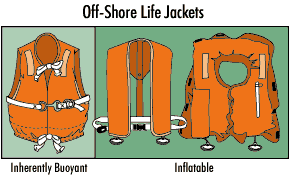
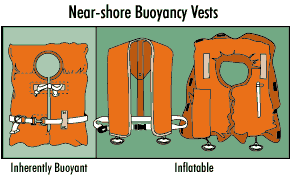
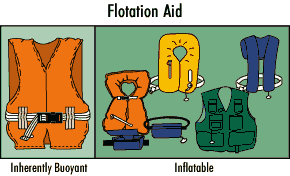
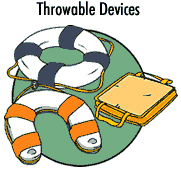
The Coast Guard recommends and many states require wearing PFDs: For water skiing and other towed activities (use a PFD marked for water skiing). While operating personal watercraft (PWC) (use a PFD marked for water skiing or PWC use). During white water boating activities. While sailboarding (under Federal law, sailboards are not "boats"). Check with your state boating safety officials.
Federal law does not require PFDs on racing shells, rowing sculls and racing kayaks. State laws vary. Check with your state boating safety officials.
If you are boating in an area under the jurisdiction of the Army Corps of Engineers, or a federal, state, or local park authority, other rules may apply.
Remember, PFDs will keep you from sinking, but not necessarily from drowning Select a properly sized PFD to insure a safe and proper fit. Test your PFD by wearing it in shallow water or guarded swimming pool to see how it will float you. Coast Guard Auxiliary U.S. Power Squadrons Vessel Safety Check (VSC) Requirements for PFDs
All boats must be equipped with a wearable PFD for each person on board. Boats 16 feet and over are required to have a minimum of two PFDs on board, one wearable PFD (Type I, II, III, or V) and one throwable (Type IV). In addition, a wearable PFD is required for each person on board.