|
 |
 |
 |
 |
 |
 |
 |
 |
 |
 |
 |
 |
 |
 |
 |
 |
 |
 |
 |
 |
 |
 |
 |
 |
 |
 |
|
|
LOUISIANA FACES MANY CHALLENGES THAT STAND TO SHAPE OUR ECONOMIC AND ENVIRONMENTAL FUTURE, AS WELL AS THREATEN THE LIVELIHOODS OF THE PEOPLE OF THIS GREAT STATE. OUR ABILITY TO OVERCOME THESE CHALLENGES WITH SOUND POLICY AND PROJECTS WILL DETERMINE OUR SUCCESS. |
|
|
|
For this reason, several major initiatives are now underway in an attempt to fulfill our needs for improved infrastructure systems, hurricane evacuation routes, coastal protection and restoration, and economic diversification. While these issues are currently being furthered independently by concemed individuals, groups and agencies, our greatest opportunity for success may be in combining these initiatives and transforming them into a feasible economic and environmental vision for the state of Louisiana. We call this the Louisiana Environment and Economic Resources Concept. (LEERC).
LEERC is a blend of economic and environmental interests that we believe requires a new word to describe. That word is �environomic,� depicting a comprehensive mixture of environmental and economic opportunity for restoring an extremely significant part of coastal Louisiana, while providing a world-class intermodal system. The concept includes the following multi-modal initiatives: |
|
|
|
*A Proposed New International and Commercial Airport.
*An Access Corridor to Support Outer-Continental Shelf Oil and Gas Production.
*Hurricane Evacuation Routes.
*Coastal Protection and Restoration as Proposed by the State�s Coast 2050 Plan.
*Container Port. |
|
|
|
INTERNATIONAL AND COMMERCIAL AIRPORT |
|
|
|
The Louisiana Airport Authority is planning a major multi-modal air transportation center near the Mississippi River between New Orleans and Baton Rouge. This proposed transportation hub and distribution center on 25,000 acres is being touted as an effective means to efficiently move goods and people through a comprehensive transportation network.
Geography makes Louisiana uniquely situated to become a major international transportation hub. especially for growing markets in nearby Latin America. The Mississippi River, the busiest river in the world, provides water commerce access from the proposed airport to two-thirds of the continental United States and around the globe. In addition, the inclusion of superior rail and highway transportation, would further strengthen the airport�s position as a world-class aviation facility
THE INTERNATIONAL AND COMMERCIAL AIRPORT IS A VITAL LINK IN LEERD: |
|
|
|
IT PROVIDES AN IMPORTANT AVIATION LINK TO OTHER COUNTRIES, PARTICULARLY CENTRAL AND SOUTH AMERICA. INCREASING COMMERCIAL AIRLINE AND CARGO TRAFFIC INTO LOUISIANA.
IT PROVIDES A SIGNIFiCANT INTERMODAL LINK BETWEEN AIR TRANSPORTATION AND MARINE. RAIL AND HIGHWAY TRANSPORT. IN THIS WAY, TIME-SENSITIVE CARGO COULD BE TRANSFERRED WUICKLY WITHIN LOUISIANA AND BEYOND. |
|
|
|
SUPPORT OUTER-CONTINENTAL AND GAS |
|
|
|
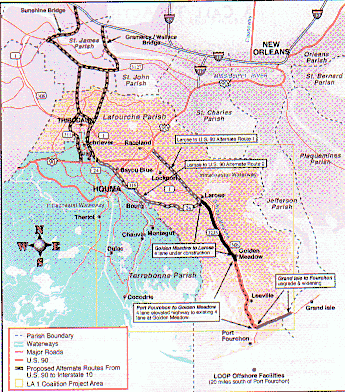
The LA 1 Coalition is planning a major highway connecting U.S. 90 to the Gulf of Mexico at Port Fourchon, to facilitate the development of this nation�s largest domestic oil and gas find ever in the deep-water Gulf. Environmental impact studies for the project are nearing completion.
The new highway would not only provide direct access to this nation�s domestic oil and gas activity, it would also provide a hurricane evacuation route for thousands of south Louisiana residents and offshore workers, as well as access to this state�s only inhabited barrier island. In addition, the highway would support LOOP, the $850 million Louisiana Offshore Oil Port that handles 13 percent of the nation�s foreign oil and an ever-increasing share of domestic oil. Its connection by pipeline to 35 percent of U.S refining capacity is extremely critical to this nation�s energy supply. |
|
|
|
HURRICANE EVACUATION |
|
|
|
Anyone who lives or works south of Interstate 10 can tell you how difficult it can be to evacuate to the north in the event of a hurricane approaching the eastern Louisiana coast. For this reason, the state Department of Transportation and Development is currently studying placement of a hurricane evacuation corridor connecting U.S. 90 to LA. Highway 3127 midway between the Sunshine Bridge and the Gramercy-Wallace Bridge, and then on to 1-10. But, as demonstrated in LEERC, this new hurricane evacuation route could have multiple benefits: |
|
|
|
 |
|
|
*Provide a safe, efficient means of evacuation for residents of South Louisiana in the event of a storm.
*Provide a direct highway connection between the Mississippi River; the proposed airport complex and the Gulf of Mexico. |
|
|
|
|
|
|
COASTAL PROTECTION AND RESTORATIDN |
|
|
|
Land loss is perhaps the single greatest environmental threat to Louisiana. Without a proper and speedy solution, the state as we know it is at stake, not to mention centuries-old cultures and livelihoods. A major initiative now underway to battle land loss in Louisiana is the Coast 2050 Plan, a comprehensive coastal restoration plan administered by the state Department of Natural Resources.
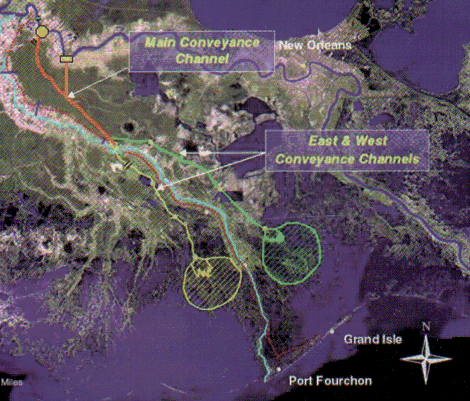
An integral component of Coast 2050 is a major conveyance channel connecting the Mississippi River to the Barataria and Terrebonne basins. This channel, patterned after the Wax Lake Outlet, would provide a number of environmental and economic benefits to the state as identified in LEERC. |
|
|
|
THIRD BRANCH OF MISSISSIPPI RIVER (CONVEYANCE CHANNEL) REGIONAL BENEFITS |
|
|
|
 |
|
|
Two Sustainable Subdelta Ecosystems
Dependable Potable Water Supply
Transportation and Economic Development Corridor
By- Pass Historic District
Introduction of River Water, Sediment, Nutrients to Wetlands
Reduction of Mississippi River Flood Elevations |
|
|
|
|
|
|
Reduction of Mississippi R. Maintenance Dredging
Reduction of Annoxic Conditions in Gulf |
|
|
|
CONTAINER PORT |
|
|
|
While Louisiana faces constant environmental threats along its coastline, it is the coastline that has produced some of the state�s strongest and most prosperous industries. Oil and gas production, fisheries and shipbuilding have flourished in South Louisiana for decades, and our ports have become more important in the process.
The final ongoing initiative and major piece of the LEERC proposal is based on our shipping strengths, specifically the Millennium Port, a project to make Louisiana a major player in the Gulf of Mexico container trade by accommodating large ships on or near our coast. This concept initiated by the Port of New Orleans is now being pursued by the Louisiana Millennium Port Authority.
Several sites are now being studied as possible locations for this container port, one of which is Port Fourchon. It is this location that would provide the most positive benefits to the state and the regional inter-modal plan we call LEERC.
THE BENEFITS OF DEVELOPING A CONTAINER PORT IN 5OUTH LOUISIANA ARE NUMEROUS |
|
|
|
ECONOMIC DIVERSIFICATION WITH THE CREATION OF AN INDUSTRY CENTERED AROUND CARGO TRADE, PRIMARILY WITH THE GROWING ECONOMIES OF LATIN AMERICA.
JOBS CREATION AND THE SECONDARY ECONOMIC IMPACTS JOBS CONTRIBUTE TO A REGION.
INCREASED PRIVATE AND PUBLIC INVESTMENT IN LOUISIANA. |
|
|
|
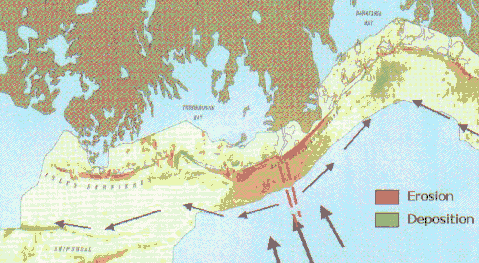
There is environmental and economic efficiency in adding a container port component to the energy support role of Port Fourchon. Port Fourchon is located in an area where coastal currents diverge. Therefore, maintenance dredging costs of the entrance channel should be relatively low and dredging material could be used to rebuild the Timbalier Island chain. Port Fourchon is located only 6.5 miles from the 50-foot contour. With navigational capabilities to the proposed airport and an improved highway system leading to I-10, Port Fourchon would be an integral part of the total intermodal complex of south Louisiana and a logical site for a container port. |
|
|
|
 |
|
|
|
 |
|
|
GEOGRAPHICALLY, PORT FOURCHON SITS IN AN IDEAL LOCATION TO SUPPORT A DEEPER CHANNEL.
OFFSHORE CURRENTS COME INTO THE FOURCHON BEACHHEAD AND SPLIT, THUS REDUCING THE SAND TRANSFER AVAILABLE TO SILT THE CHANNEL.
U.S. GEOLOGICAL SURVEY STUDIES CONFIRM THAT THE SEA FLOOR IS ACTUALLY DEEPENING IN THE PORT FOURCHON VICINITY. |
|
|
|
|
|
|
All of the major initiatives mentioned here have a common geographical tie, the Mississippi River region between Baton Rouge and New Orleans. What if we could combine these initiatives so that each would reinforce the other�s potential of being achieved?
The "Environomic" concept offers Louisiana this opportunity. The LEERC plan identifies a corridor that would allow all of these initiatives to play off of each other, and when combined, provide a world-class land, sea and air multi-modal system, as well as comprehensive coastal protection to help sustain southeastern Louisiana. This system also offers greater connectivity to the tremendous inland port system in this state, reducing the overburdened highway system by using waterways, our greatest natural asset. Details of LEERC include implementation of the following projects: |
|
|
|
1. Extending the existing LOOP shipping lane to Port Fourchon, requiring only 6.5 miles of dredging from the 50' contour to the Port.
2. Development of a ship-to-barge terminal at Port Fourchon, utilizing existing waterways (Houma Navigation Canal, Bayou Lafourche, Barataria Waterway) for access to the Intracoastal Waterway.
3. From the Intracoastal, one leg of the conveyance channel would be made navigable to the Mississippi River providing a barge connection to the Mississippi River 50 miles shorter than the existing route.
4. Connecting the conveyance-navigation canal, international airport, intermodal hub and the North-South Hurricane Evacuation Corridor in a way that each compliments the other. |
|
|
|
What will this "Environomic" concept cost? A total price tag could reasonably reach $8 billion, an amount equal to public funds now being used for restoration efforts in the Florida Everglades. The environmental and economic significance of the Barataria and Terrebonne basins dwarfs that of the Everglades. The real question that we ask ourselves should be, "What is it worth to save this nation�s largest estuary while creating a world-class intermodal system to carry this state through the new millennium?" LEERC could spell our answer. |
|
|
|
ESTIMATED PROJECT COSTS |
|
|
|
INTERNATIONAL AIRPORT $1.5 BILLION
HIGHWAY AND RAIL CONNECTORS $1.5 BILLION
PORT CONSTRUCTION $1.5 BILLION
CONVEYANCE CHANNEL $1.5 BILLION
ENVIRONMENTAL RESTORATION $1.0 BILLION
INLAND WATERWAY CONNECTORS $1.0 BILLION
TOTAL COST $8 BILLION |

|
|
|
 |
|