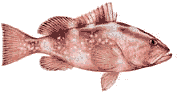
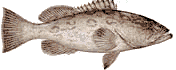
Grouper are usually caught offshore, but the younger individuals live in sea grass beds Occasionally anglers catch legal sized fish in the deeper holes of the backwaters. Groupers live close to the bottom and always associate with some type of submerged structure.
There are a number of grouper species caught in Louisiana waters. The gag and red groupers and the jewfish are the most widely distributed species. Most of the other species - Nassau, Red Hind, Rock Hind, Black, Yellowfin and Scamp live in and around the reefs of Louisiana, and the offshore oil platforms.
Grouper fishing is primarily an offshore fishery. Drifting a bait a foot or so off the bottom is the typical technique used by recreational anglers. Slow trolling a bait or lure over hard bottom also produces fish. Standard boat tackle with 20 to 40 pound test line and a 40-80 pond test leader is employed so that anglers have a chance to turn the fish's head away from an underwater ledge or piece of manmade structure and bring it to the surface.
Grouper will eat anything just about anything that comes their way. A live pinfish, piece of squid, or chunk of fresh cut bait are proven baits when drifting or at anchor. When trolling anglers use deep diving saltwater plugs or jigs. Jigs can also work when worked vertically while drifting or at anchor.
Groupers don't move real far for a meal. They prefer to wait for the meal to come close to where they are and that is usually only a foot or two from some place of refuge. When you feel a fish bite, set the hook as soon as you think the fish has the hook and reel in as much line as you can as quickly as possible. Monofilament line stretches up to 28% and that give the fish enough line to duck back into its place of refuge. What you want to do is prevent this by turning the fish's head up towards the surface. There is a trend among veteran grouper anglers to use one of the new braided or fused lines when fishing for grouper. With nearly no stretch, you have a better chance of turning the fish's head before it can get under a manmade structure, a condition in which the fish almost always wins and the angler looses.
Unlike other "resort" communities, Grand Isle hasn't chosen to go modern. It possess an unpretentious mystique that is as warm and comfortable as South Louisiana hospitality. That is why generations of sport-fishermen return year after to bask the sun and bathe in the gentle surf. They keep coming back to fish, either on shore or off shore where the big ones wait to feed, either near the giant rigs or in open water, or the back bay.
At Grand Isle, shell collectors prowl the beach by day while at night the flickering glow of lanterns illuminate beach as nocturnal fishermen reap a harvest of flounder feeding along the shore line.
The history of Grand Isle is filled with pirate lore. Treasure hunters have searched in vain for gold and silver that is said to have been buried somewhere on Grand Isle.