Ramadhan 1425H sighting in Nigeria.
All the analysis below is for Port Harcourt, Nigeria although the conclusion is valid for the whole of Africa at least.
| Date | Moon above horizon? (Moonset after sunset?) | Age of new moon | Perhaps possible to see the moon? | From visibility calculation criteria? (historical observation by astronomers) |
| Wed, 13/10/2004 | NO! | |||
| Thu, 14/10/2004 | YES | 14 h 28m | YES | NO |
| Fri, 15/10/2004 | YES | 38.5h | YES | YES |
The moon was claimed to have been seen in Nigeria on Wed, 13/10/2004. However, Ramadhan fasting should began earliest on Saturday, 16/10/2004 as the moon could not have been sighted until Fri, 15/10/2004.
Please go through the analysis below to find out how the conclusion is reached.
MOON POSITION WITH RESPECT TO THE HORIZON AT SUNSET
The effort to sight the moon for Ramadhan was made on Wednesday, 13th October2004.
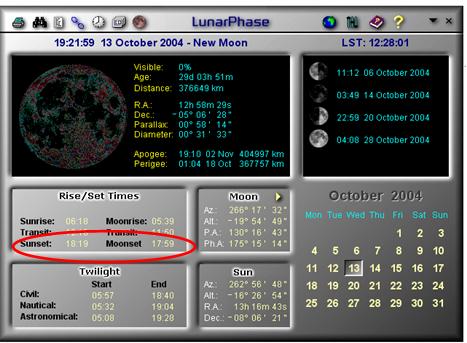
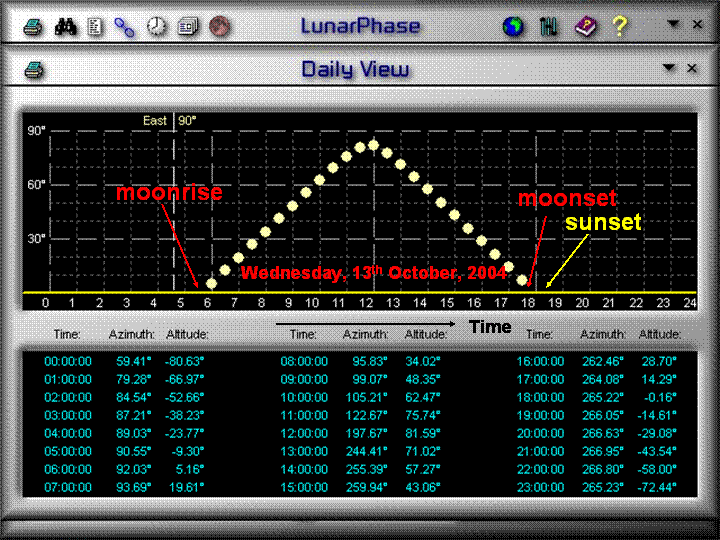
Astronomical calculation shows that it is actually impossible to sight the hilal for ramadhan that night since the moonsets at 5.59 pm that day, long before the sunsets at 6.19 pm that day as indicated in the screenshot below. In other words, there was no moon to be seen!
The moon projection that day is as shown below where x-axis is time and y-axis is the altitude which also shows that the moon sets before the sun.
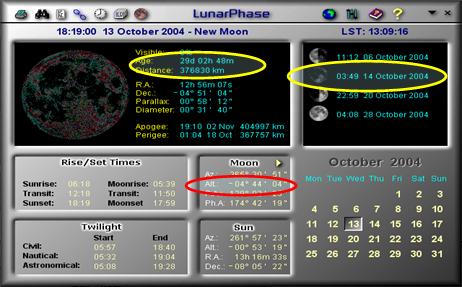
As seen in the screenshot below (red ovals), during sunset, the moon was actually 4 degrees below the horizon during sunset.
AGE OF THE NEW MOON
But that's only part of the problem. For a crescent (hilal) to form, a new moon has to be formed first. But during sunset on 13th October, the age of the moon is 29days. The new moon is calculated not to form until Thursday, 14th October 2004, 3.49 am. Bear in mind that even with an approximate calculation method, the error is only +/- 2 minutes.
It has been shown above that the moon was below the horizon at sunset, but even if it was above the horizon (which it wasn't) , the possibility of seeing a hilal is nil as the moon had not formed yet. Perhaps the hilal of the old moon, but not the new moon. Even so, calculation indicates 0% visibility at that time.
WHEN WAS RAMADHAN SUPPOSE TO BEGIN THEN? FRIDAY (14th October 2004)?
Logically, if the new moon forms early morning on Thursday, perhaps we should be able to see the hilal on that evening and start fasting on Friday?
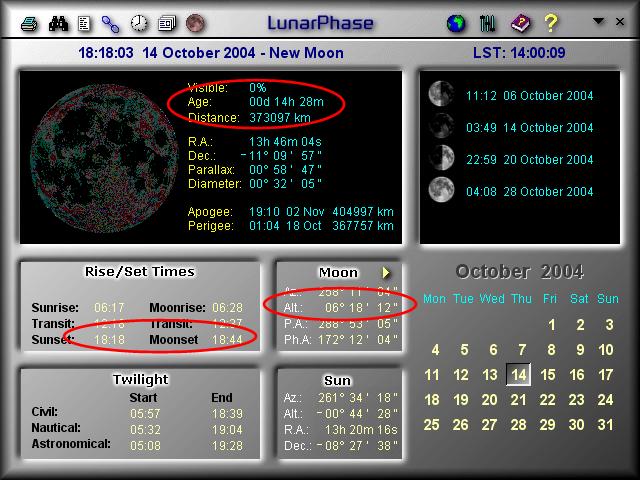
During sunset, the age of the new moon is 14 hours. This is really within the limit of naked eye visibility. According to Khalid Shaukat, the earliest time one is able to see the crescent with naked eyes is after 16 hours of new moon conjunction and 11 hours with a telescope. Other astronomers carry similar figures as well. So yes, this satisfies the MINIMUM time one is able to see the moon. However, other factors also come into play. Sometimes the new moon cannot be seen with naked eyes until after 23 hours!
How about the position of the moon at sunset? The moon was 6 degrees above the horizon. That is not much, but at least it is above the horizon.
However, the moonset time was 6.44 pm whilst the sunsets at 6.18 pm. This gives only a maximum 26 minutes of viewing and with the glare of the sun and the moon just slightly above the horizon, adding to that the moon was quite young (14 hours), the likelihood of being able to see the moon was very small if any.
How do we take this further? Will it be possible or not possible to sight the moon?
VISIBILITY CALCULATION METHOD
Various astronomists have made observations on when one will/will not be able to see the new moon and relating it to factors such as the position of the moon and the sun. The MoonCalc 6.0 software allows one to obtain this possibility. In its engine, a user can try up to 13 different methods. The default method in this software is by Yallop, which according to Khalid Shaukat have been proven to be correct every month since 1993. By using the MoonCalc 6.0 software, the Yallop method indicates that the moon will not be visible; at sunset, or at the theoretical best time or when the sun is already 5 degrees below the horizon (see screenshot below)
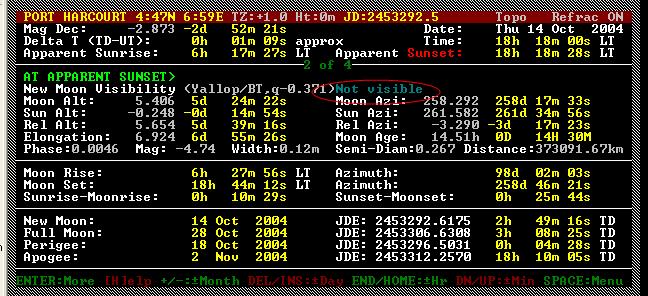
data/graphics/map from MoonCalc 6.0 by Dr. Monzur Ahmed
According to this method and few other methods I tried, (Ibn Tariq, Ilyas A, Ilyas C, Shaukat, South African Astronomical Observatory,Fotheringham,Royal Greenwich Observatory 67, Maunder, Indian,Bruin), the moon would not have been visible on 14th October 2004 in Port Harcourt, Nigeria.
Observations of all these astronomists which probably span almost century of data indicates that the moon would not have been sighted on that night. Even with optical aid, i.e. telescope and good preparation, sighting would not have been possible based on historical records.
The visibility map below taken from MoonCalc 6.0 shows that the Africa region and everywhere to the East would not have been able to see the moon even with telescope on Thursday 14th October (coloured area indicates visibility, outer edge indicates visibility with optical aid, region A indicates easy visibility with naked eyes). No countries to the east of Africa would have been able to see the hilal on Thursday, 14th Oct 2004 after sunset.
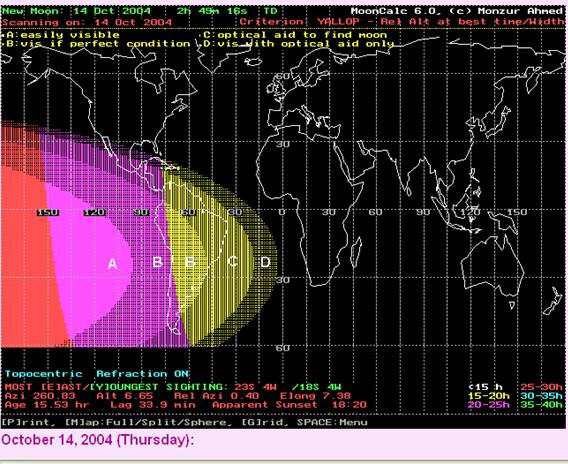
data/graphics/map from MoonCalc 6.0 by Dr. Monzur Ahmed
CONCLUSION
Ramadhan 1425H should began on Saturday (16th October in Nigeria). By sunset Friday 15th October, the moon was already more than a day old (38.5 hours and 16 degrees above horizon in Port Harcourt, Nigeria) and should be easily visible with the naked eye in clear sky
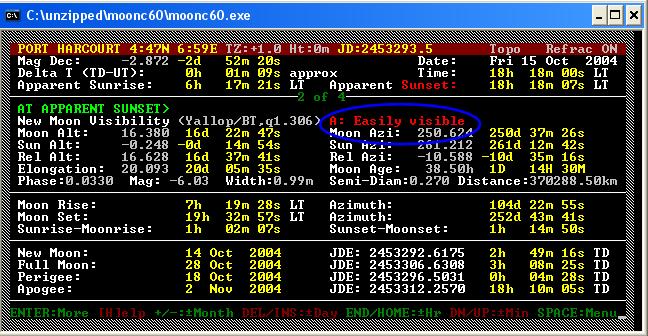
data/graphics/map from MoonCalc 6.0 by Dr. Monzur Ahmed
---------------------------------------------------------------------------------------------------------------------------------------------
Editor's Note: Two software was used for this analysis, MoonCalc 6.0 (freeware) and LunarPhase V2.62 (shareware). Both software came with the same calculated moon position, age, moonset, sunset, etc.