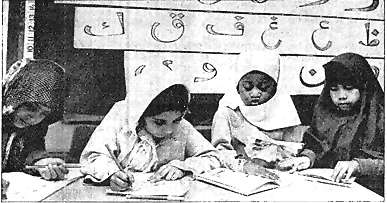
| Fundamentalist Moslems in Britain are carrying out acts of violence and inciting one another to murder in pursuit of their demands for “blasphemy” protection, for the banning of a work of fiction that refers disrespectfully to Moslem history, for the public funding of separate Moslem schools, and for the legal recognition of the Islamic personal law. | Whereas
the American immigration ideal has historically been the metaphorical
"melting-pot" — immigrant families to the United States being
only too anxious that their children should learn the English language and
integrate with their neighbours — the immigration ideal in Britain is
that of "pluralism," multi-culture, and multi-lingualism. It is
this misguided, mythic ideal that, in response to the most vociferous of
the immigration community leaders, is the one generally promulgated by
many "progressive" British people, including politicians of
every party. Most of them fail to realize that what they are advocating is
appeasement of the patriarchal fundamentalists of these communities,
leaving those under their thumbs to their oppression — the effect being
to deny to their young people brought up in Britain the chance to become
truly British and to deny to their women the normal civil rights enjoyed
by British women. Britain, with a total population of some 56 million, now has over a million Moslems, mostly from immigration within the last quarter of a century. Some were refugee families from former British colonies in East Africa in the 1960s, more came from the Middle East, and many more from the Indian subcontinent. Their British homes are largely concentrated in a few localities, including the Brick Lane area of London's East End and Southall in Middlesex, to the west of London — these two names being telescoped in Salman Rushdie's fictional Brickhall. There are also large pockets of Moslem concentration in the industrial cities of the Midlands (especially Birmingham and Leicester) and the North (especially Bradford). |
| Resistance to change Upwards of a thousand years ago, Islam was far less objectionable and more civilized than Christianity; but whereas Christianity has, on the whole, gradually become more humane, Islam has tended to stand still, and has thus been left behind. This is partly because Mohammed (570-632) laid it down that, to avoid the sort of corruption that had beset Judaism and Christianity, his new religion must never accept any change of any kind. And to this day, the true Moslem continues to obey this injunction and resist anything new in social mores. This intransigent attitude has, according to the Indian writer K. K. Joshi (in an article reprinted by the International Humanist and Ethical Union in their Humanist Outlook, February 1989), been reinforced in India during the past two centuries: Unfortunately, the Moslem community kept itself aloof
from the main currents of the nineteenth-century Indian renaissance. From
the very beginning they were distrustful of the "new learning"
that came to India in the wake of British conquest. Instead of opting for
western liberal education, which the Hindus accepted with enthusiasm, the
Moslems preferred to stick to their old traditional learning that was
imparted in "madarsas" and "makhtabs." The result was
an all-round stagnation of the Moslem community. Imbued with all the fervour of fundamentalist religion, this extremism is a component of a sort of tribalism — rather like the gang loyalty of football hooligans to their particular football club — its function being that of a cohesive tribal force against the wider community. So it appeals particularly to those who feel marginalized by society at large and psychologically alienated from it. Death threats The
publisher of The Satanic Verses, Penguin Books — which,
ironically enough, is also the main publisher in Britain of the Koran —
has also received death threats, the book has been publicly burned by
Moslem mobs in Britain, many booksellers and libraries have responded to
threats of arson and personal attack by withdrawing the book, and some of
these threats have now been put into practice.
|
|
|
Imagine:
getting it on with J.C.
|
Moslem girls attending traditional single-sex religious schools may miss many of the educational opportunities which are taken for granted by other young English-women
The public funding of ghetto schools — and therefore
their proliferation — would, however, be harmful not only to the girls and
women of the ghetto but to the whole fabric of our society, as is made clear in
a letter from the National Secular Society, which, bearing the signatures of
twenty-three public figures in Britain, appeared in a national newspaper, the
Guardian, on July 9, 1986:
We the under-signed are very concerned about a
dangerously divisive factor in our educational system — that is, the large
number of voluntary-aided denominational schools that segregate children
according to their religious background. The social divisiveness this causes is
seen at its worst in Northern Ireland.
Voluntary-aided denominational schools have so far been confined almost entirely
to Anglican, Roman Catholic, and a few Jewish schools, but we are now seeing the
beginning of a proliferation to include other religions.
In April this year, a recommendation from a local authority (Brent) that a
fundamentalist Islamic primary school in its area be allowed public funding, in
line with denominational schools in the Judaeo-Christian tradition, was sent to
the Minister of State for Education. Whatever the decision in this particular
case, it cannot be long, in the name of racial and credal equality, before a
separate Moslem (or Sikh or Hindu or other religious) school is granted
voluntary-aided status, thereby encouraging a general upsurge of immigrant
denominational schools.
This may seem superficially, a progressive step ... ; but in fact it would mean
for many children (especially the girls) of immigrant families almost total
isolation from the host community and from ideas at variance with those of the
home background. This would not only be a disaster for these youngsters
personally, it would also inevitably build up for future generations a greater
degree of animosity and violence than we have seen even in Northern Ireland.
There, children are segregated on grounds of religious background only; in this
case there would be the additional divisive factors of race, skin colour and
sex. And besides driving a wedge between immigrant families and the host
community, separate religious schools would import to Britain some of the
religion-based bitterness and strife that exist on the Indian subcontinent.
In the name of equity, however, it is manifestly impossible for the state to
refuse Moslems and Sikhs the same right as Christians and Jews to
state-subsidised schools of their own.
How, then, can this looming social tragedy be averted, without blatant
discrimination? Only by Parliament legislating without delay for steps to be
taken gradually to phase out subsidies to denominational schools of every kind.
...
We cannot deny, however, that a parliamentary decision to phase out subsidies to
denominational schools will need considerable political courage, since it will
inevitably lose votes. It therefore demands an all-party determination to grasp
the nettle.
Principle
of tolerance
What the British race-relationites are, in effect, blindly proposing, is to hand
over the moderates in each ethnic community to the tyranny of its
fundamentalists. And limits must surely be placed on the tolerance of
intolerance.
Though I am as concerned as anybody about the right of minority groups to pursue
their own chosen life-style — and, indeed, see this as a positive contribution
to the varied general culture — I am also concerned about the rights of
minorities within those minority groups, and of the smallest minority of
all: the individual. Moreover, the individual is not only the smallest, but also
often the most oppressed, of all minorities — especially, in patriarchal
groups, the women and girls.
If families settle permanently in Britain, surely they should be willing for
their children to grow up as part of it? The demand of their religious leaders
for their own religious schools to be subsidized out of the public purse and for
education to be conducted in their home languages is designed to prevent their
children from integrating with the wider community.
Fundamentalist Moslems are fond of quoting the principle of tolerance in their
own favor — but in countries where they themselves are in power, Moslems do
not accept that principle. Nor, though vociferous in its demands for parity with
Christianity in Britain, does fundamentalist Islam accord parity of rights to
non-Moslems in Moslem countries. Even foreigners visiting those countries may be
judicially flogged if caught with a glass of wine. Indeed, Moslems declare that
any compromise is impossible for them, since the Islamic laws were laid down by
Allah himself, not by men.
They also declare that Islam is not merely a religion; like communism, it
pervades the whole of life. This means that their political and economic, as
well as their religious, demands must share the sanction of religious liberty as
they see it — and this bestows on them the god-given right to demand that the
English law should assimilate the Islamic personal law (on legal polygamy, easy
divorce for men but not women, inheritance, and so on), and uphold it in English
law courts for Moslem citizens. In India, where this Moslem personal law
prevails, the law courts have to administer a special code of justice for
Moslems and even have to take account of differences in law between one Islamic
sect and another. The result is not only chaos in the courts; more importantly,
the civil rights of individuals are handed over to fundamentalist religious
leaders and social compartmentalization is crystallized. This means a permanent
denial of common citizenship and leads to inter-group strife.
Apart from the courageous Muslim Truthseekers Group (supported by the Indian
Secular Society in western India), moderate Moslems on the Indian subcontinent
have rarely put up any fight against their fundamentalists, so most of the
Moslems who are now settled in Britain have no tradition of standing up to them
and simply allow the fundamentalists to speak on their behalf.
One of the leading fundamentalist Moslem spokesmen in Britain has said that it
is inconsistent to allow people to follow different religions whilst forcing
them to accept British values enshrined in the laws of the country. But the laws
of a country, while designed to facilitate as far as possible the peaceful
coexistence of different cultures within that country, must surely, in the name
of justice, apply to all — even if some groups would prefer them to be
otherwise.
For that very reason, it is important that the National Secular Society is seen
to be campaigning constantly against the Christian blasphemy law and Christian
voluntary-aided schools at the same time as campaigning against the extention of
these privileges to non-Christians.
Political response
It is heartening that the ruling Conservative Party has begun to warn the
Moselems against extremist demands — for instance, on July 4, Mr. John Patten
(the minister of state at the Home Office responsible for race relations) stated
that the government felt it would be unwise to extend the blasphemy law to Islam
("to rule otherwise would be to chip away at the fundamental freedom on
which our democracy is built").
A few Conservative back-benchers have gone against the Party line and backed the
Moslem demands — but as they themselves tend to expound Christian
fundamentalism, maintaining that everyone who disagrees with their theology is
in error, their motive in wishing to sponsor the perpetuation of such error
through their taxes is obviously more like that of the South African National
Party's aim of ethnic "separate development" than genuine fellow
feeling with the Moslem community or respect for their creed.
The Labour Party, though generally the more progressive of the two major parties
in Britain, is split right down the middle on the issue of separate Moslem
schools. On the one hand are those to whom sound educational principles and
equal opportunities for girls are the most important factors in this debate; on
the other hand are those (unfortunately including the Party's national spokesmen
on education — who could well be in office in another two years) to whom the
overriding factor is "race relations" — which, in practice,
inevitably means good relations with the most vociferous extremists in an ethnic
group.
The Moslem vote has hitherto been almost entirely Labour and, in several
marginal constituencies, Labour MPs would have lost their seats in the last
general election without the Moslem vote. But one or two of those most likely to
lose their seats in that eventuality have nevertheless been brave enough to come
out in favour of principle rather than expediency. The remainder, however, have
taken the opposite view — and have unfortunately secured the support of the
national Labour Party.
Even so, it does not satisfy the Moslem fundamentalists. Early this year, Moslem
leaders announced that steps would be taken to set up a separate Moslem
political party. This threat was implemented in mid-September, when the Islamic
Party of Britain was founded — its agenda to include state-funded Moslem
schools and extension of the blasphemy law, with the legalisation of Moslem
personal law a longer-term aim. Some Moslems, however, are opposed to having
their own separate political party, since it cannot possibly gain parliamentary
power in the foreseeable future and, by diverting Moslem votes from the Labour
Party, will only weaken Moslem influence within that party.
Giving in
Giving in to fundamentalist demands is like giving in to blackmail or terrorism:
the next demand is even bolder. So the more legal concessions that
fundamentalist Moslems obtain, the more they demand.
Thus, Moslem demands in Britain at the present time — the demand for blasphemy
protection, for publicly funded separate Moslem schools, for the banning of a
work of fiction that refers disrespectfully to Moslem history, and for the
assimilation of Moslem personal law into the law of the country — would most
likely have been less extreme and persistent had not their fundamentalist
religious leaders got away with demands, in the past two decades, for exemption
from various laws. For instance, the animal slaughter laws, which demand the
pre-stunning of animals killed for meat, are not only waived in favor of both
orthodox Jewish and Moslem religious methods of slaughter, both of which forbid
pre-stunning (each of these religions denying that their particular slaughter
method is cruel, but agreeing that the other one is!), but our legislators and
civil servants have acceded to the demand to have halal meat served daily
in all state schools that have a substantial number of Moslem children — as
though there were no acceptable alternatives, such as vegetarian dishes, packed
lunches, and meat meals at home.
So
where is it all going to end? We could eventually have Moslem religious leaders
in Britain demanding the freedom to follow the Koranic penal code within their
own community. In the name of freedom of religion, they must surely be allowed
to chop off the hands of any members of their community caught stealing, to flog
those caught drinking alcohol, and publicly to stone to death any of their women
caught in adultery?
Violence on the streets
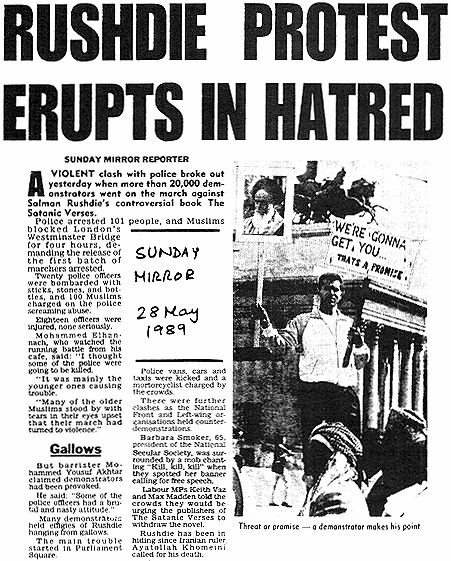
A large Moslem demonstration took place in central London on May 27, mainly to
demand the extension to Islam of such protection under the blasphemy law and to
demand the withdrawal of The Satanic Verses.
Though disagreeing with these demands, secular humanists would naturally uphold
the right of anyone to demonstrate peaceably in support of them: however, not
only was the Moslem demonstration far from peaceful; the blasphemy issue was
largely lost in violent incitement to murder. No attempt was made by the Moslem
leaders themselves or by the agencies of law and order in this country to
prevent the parade from setting off from Hyde Park with model gallows from which
swung effigies of Salman Rushdie, with placards and banners calling (in
obedience to the late Khomeini and other overseas religious leaders) for
Rushdie's murder, with such homespun slogans as "DEVIL RUSHDIE WANTED DEAD
OR ALIVE," "RUSHDIE MUST BE CHOPPED UP," "WE'RE GONNA GET
YOU — THAT'S A PROMISE," and with thousands of demonstrators raising
clenched fists and yelling "kill, kill, kill!"
Those guilty of this incitement to murder were apparently not told, either by
the organizers or by the police, that this was prohibited on the demonstration,
nor were any arrests made on a charge of incitement. Even the 101 demonstrators
arrested later for physical violence against the police were released without
charge — presumably on Home Office orders designed to prevent further
violence. Nevertheless, having thus flouted with impunity British laws and
customs and sensibilities, Moslem fanatics have proceeded to carry out further
acts of violence (such as arson), and have continued their monstrous demands for
the banning of The Satanic Verses and death to its author.
Many Moslems in this country are, of course, appalled and ashamed by all this,
and realize that nothing is more likely to cause real racist hostility against
their whole community; but their voices are hardly heard above those of the
religious leaders and the rabble behind them. The race-relationites have
therefore started saying that Salman Rushdie should have known better than to
write such an "offensive" book and that the publishers ought to
withdraw it. To be consistent, they would also have to decry the original
publication of Paine's Age of Reason, Shelley's Queen Mab, Ibsen's
Ghosts, and Darwin's Descent of Man, which were no less offensive
to the fundamentalists of their day.
The organizers of the demonstration later tried to disclaim responsibility
for the violence, blaming it on a few hotheaded youngsters; but the organizers
had done nothing to ensure that it would be a peaceful demonstration, and the
"few" hotheads could be numbered by the thousand.
Since the Moslem leaders are apparently either unable or unwilling to control
their fanatical supporters, they should surely be refused any public open-air
demonstrations in the future; while archbishops and politicians should be
willing to allow the same robustness of debate on religion as on any other
controversy — that is, short of incitement to violence.
Counter-demonstration
At secular humanist meetings during the few weeks before the demonstration, I
had asked for volunteers to mount a counter-demonstration; but response was
negligible. I therefore arranged to join in with a new protest group, set up
mainly by some brave Asian women calling themselves Women Against
Fundamentalism. In the event, I happened to miss them, but met by chance
secularist friends Nicolas Walter and his wife Christine, standing on the route
of the so-called march (which proved to be more of a stampede), opposite Hyde
Park Corner.
Although there were only the three of us, we represented, in our memberships,
the whole of the British Atheist movement — primarily, however, the National
Secular Society, the Rationalist Press Association, the Free Speech Movement,
and the Campaign against Blasphemy Law (set up jointly by the National Secular
Society and the Rationalist Press Association at the time of the Gay News
blasphemy trial in 1977). We had brought homemade banners — mine proclaiming
"FREE SPEECH," and the Walters' "FREE SPEECH FOR ALL"
We had deliberately rejected the idea of more provocative slogans, such as
"Religion Breeds Intolerance" — but our studied moderation made no
difference. As soon as they caught sight of our banners, demonstrators rushed at
us, grabbed and ripped up the banners, and proceeded to push, punch, and kick
us. Nicolas was knocked to the ground, but by backing up the steps of the
Wellington monument I managed to remain standing. Fortunately, a few people
(including some middle-aged Moslems) came to our rescue. The press also helped,
by coming up for statements — whereupon our attackers began grabbing and
tearing the reporters' notebooks; and someone with a radio mike began
interviewing me. One of the men still jostling me, having previously kicked me
on the leg, now added insult to injury by pinching my buttock. I turned on him
with a trenchant "Don't do that!" — which, I learnt later, was heard
by thousands of listeners to the London Broadcasting Company's news report. The
picket of the Women Against Fundamentalism had taken the precaution of obtaining
special police protection and so avoided a similar physical assault.
Some humanists have since told me that counter-demonstrations are not the way to
deal with the situation: they seem to think it is enough to preach to the
converted in urbane humanist meetings. But if we can no longer go on the streets
of our capital city to defend freedom of expression, Britain is back in the
eighteenth century — the cross merely replaced by the equally bloody crescent.
Episcopal appeasement
Among the messages of support for the demonstration read out on a public-address
system in Hyde Park while the faithful were gathering there was one that
purported to come from Dr. Runcie, the archbishop of Canterbury. Afterwards I
wrote to him, asking why he had said nothing since to dissociate himself from
the violent nature of the demonstration, and his secretary for public affairs
(John Lyttle) replied, denying that the archbishop had sent the organizers any
such message. However, with this reply (which, incidentally, accused me of being
"extraordinarily bigoted") was enclosed a copy of a statement made by
the archbishop three months earlier, in which he had tried to appease the Moslem
would-be murderers by saying,
Only the utterly insensitive can fail to see that the publication of Salman Rushdie's book has deeply offended Moslems both here and throughout the world.
It was apparently this statement that was read out in Hyde Park — but in the context of the demonstration it sounded like a new message written for the occasion. As far as I know, however, there has been no public retraction of the archbishop's seeming support for the demonstration.