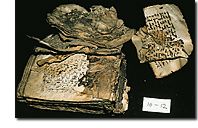
as they were found in 1972.
Photograph by Ursula Dreibholz
What is the Koran
|
| Yemeni Koran Fragments, as they were found in 1972. Photograph by Ursula Dreibholz |
The Bible is none other than the voice of Him that sitteth upon the Throne! Every Book of it, every Chapter of it, every Verse of it, every word of it, every syllable of it ... every letter of it, is the direct utterance of the Most High!Not all the Christians think this way about the Bible, however, and in fact, as the Encyclopaedia of Islam (1981) points out, "the closest analogue in Christian belief to the role of the Kur'an in Muslim belief is not the Bible, but Christ." If Christ is the Word of God made flesh, the Koran is the Word of God made text, and questioning its sanctity or authority is thus considered an outright attack on Islam -- as Salman Rushdie knows all too well.
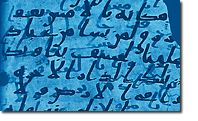 |
| A page from perhaps the world's oldest extant Koran, from before 750 A.D. Ultraviolet light reveals even earlier Koranic writing underneath. Photograph by Gerd-R. Puin. |
The Orientalist enterprise of Qur'anic studies, whatever its other merits and services, was a project born of spite, bred in frustration and nourished by vengeance: the spite of the powerful for the powerless, the frustration of the "rational" towards the "superstitious" and the vengeance of the "orthodox" against the "non-conformist." At the greatest hour of his worldly-triumph, the Western man, coordinating the powers of the State, Church and Academia, launched his most determined assault on the citadel of Muslim faith. All the aberrant streaks of his arrogant personality -- its reckless rationalism, its world-domineering phantasy and its sectarian fanaticism -- joined in an unholy conspiracy to dislodge the Muslim Scripture from its firmly entrenched position as the epitome of historic authenticity and moral unassailability. The ultimate trophy that the Western man sought by his dare-devil venture was the Muslim mind itself. In order to rid the West forever of the "problem" of Islam, he reasoned, Muslim consciousness must be made to despair of the cognitive certainty of the Divine message revealed to the Prophet. Only a Muslim confounded of the historical authenticity or doctrinal autonomy of the Qur'anic revelation would abdicate his universal mission and hence pose no challenge to the global domination of the West. Such, at least, seems to have been the tacit, if not the explicit, rationale of the Orientalist assault on the Qur'an.Despite such resistance, Western researchers with a variety of academic and theological interests press on, applying modern techniques of textual and historical criticism to the study of the Koran. That a substantial body of this scholarship now exists is indicated by the recent decision of the European firm Brill Publishers -- a long-established publisher of such major works as The Encyclopaedia of Islam and The Dead Sea Scrolls Study Edition -- to commission the first-ever Encyclopaedia of the Qur'an. Jane McAuliffe, a professor of Islamic studies at the University of Toronto, and the general editor of the encyclopedia, hopes that it will function as a "rough analogue" to biblical encyclopedias and will be "a turn-of-the-millennium summative work for the state of Koranic scholarship." Articles for the first part of the encyclopedia are currently being edited and prepared for publication later this year.
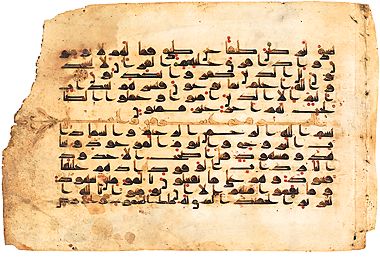 |
| From the Yemeni Hoard: probably a ninth- or
tenth-century Koran. Photograph by Gerd-R. Puin. |
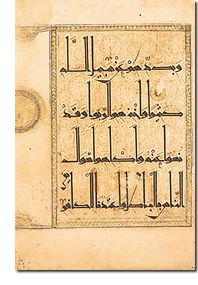 |
| A page from an eleventh- or twelfth-century Persian Koran. Courtesy of the Arthur M. Sackler Museum, Harvard University Art Museums, Fund for the Acquisition of Islamic Art. |
The Biblical redactors offer us sections of the Israelite tradition at different stages of crystallization, and their testimonies can accordingly be profitably compared and weighed against each other. But the Muslim tradition was the outcome, not of a slow crystallization, but of an explosion; the first compilers were not redactors, but collectors of debris whose works are strikingly devoid of overall unity; and no particular illuminations ensue from their comparison.Not surprisingly, given the explosive expansion of early Islam and the passage of time between the religion's birth and the first systematic documenting of its history, Muhammad's world and the worlds of the historians who subsequently wrote about him were dramatically different. During Islam's first century alone a provincial band of pagan desert tribesmen became the guardians of a vast international empire of institutional monotheism that teemed with unprecedented literary and scientific activity. Many contemporary historians argue that one cannot expect Islam's stories about its own origins -- particularly given the oral tradition of the early centuries -- to have survived this tremendous social transformation intact. Nor can one expect a Muslim historian writing in ninth- or tenth-century Iraq to have discarded his social and intellectual background (and theological convictions) in order accurately to describe a deeply unfamiliar seventh-century Arabian context. R. Stephen Humphreys, writing in Islamic History: A Framework for Inquiry (1988), concisely summed up the issue that historians confront in studying early Islam.
If our goal is to comprehend the way in which Muslims of the late 2nd/8th and 3rd/9th centuries [Islamic calendar / Christian calendar] understood the origins of their society, then we are very well off indeed. But if our aim is to find out "what really happened," in terms of reliably documented answers to modern questions about the earliest decades of Islamic society, then we are in trouble.The person who more than anyone else has shaken up Koranic studies in the past few decades is John Wansbrough, formerly of the University of London's School of Oriental and African Studies. Puin is "re-reading him now" as he prepares to analyze the Yemeni fragments. Patricia Crone says that she and Michael Cook "did not say much about the Koran in Hagarism that was not based on Wansbrough." Other scholars are less admiring, referring to Wansbrough's work as "drastically wrongheaded," "ferociously opaque," and a "colossal self-deception." But like it or not, anybody engaged in the critical study of the Koran today must contend with Wansbrough's two main works -- Quranic Studies: Sources and Methods of Scriptural Interpretation (1977) and The Sectarian Milieu: Content and Composition of Islamic Salvation History (1978).
attribution of several, partially overlapping, collections of logia (exhibiting a distinctly Mosaic imprint) to the image of a Biblical prophet (modified by the material of the Muhammadan evangelium into an Arabian man of God) with a traditional message of salvation (modified by the influence of Rabbinic Judaism into the unmediated and finally immutable word of God).Wansbrough's arcane theories have been contagious in certain scholarly circles, but many Muslims understandably have found them deeply offensive. S. Parvez Manzoor, for example, has described the Koranic studies of Wansbrough and others as "a naked discourse of power" and "an outburst of psychopathic vandalism." But not even Manzoor argues for a retreat from the critical enterprise of Koranic studies; instead he urges Muslims to defeat the Western revisionists on the "epistemological battlefield," admitting that "sooner or later [we Muslims] will have to approach the Koran from methodological assumptions and parameters that are radically at odds with the ones consecrated by our tradition."