
Major Languages of the Community: As the Muslims come from all over the world, they speak almost all the languages of the world. However, all of them can at least read Arabic, because Arabic is the language of the Qur'an and Muslims recite verses from the Qur'an in their prayers.
Customs and Traditions Widely Celebrated: Muslims celebrate two major holidays-Eid-ul Fitr and Eid-ul Adha. The month of Ramadhan is a month of dawn-to-dusk fasting, avoiding food, drink, and other sensual pleasures. This is also the month of the tradition of giving charities to the less fortunate of the society-the obligatory payment of Zakatul Maal (poor dues) of 2.5 percent of accumulated wealth, obligatory payment of
Eid-ul Adha is the second celebration-it is a celebration of sacrifice of
Culture: The Islamic concept of culture conforms to its Sociological counterpart-culture is what people are. For the Muslims, culture is a representation of the real life, rather than an artificial rendering of it. Thus, depictions of life in art, music, literature, clothes, food, and drink reflect the Muslim culture. A Muslim is guided by the limits of Halal (Permissible) and Haram (Prohibitted) in every aspect of living. The main code of conduct here is adherence to modesty and avoidance of sensuality. The cultural heritage of the Muslims of New England is rooted in this code.
Music and Art: Abiding by the limits, Muslim music shuns indulgence into sensual depictions of life, promotes spirituality, and seeks inner peace and happiness by praising the infinity of God's creative power and authority, the vastness of the universe, and the unity of humanity. Islamic art finds its expression in the exquisite art of calligraphy, lavish application of domes and minarets in architecture, and use of geometric shapes in multitudes. While the art of calligraphy reflects the Muslim artists' absolute devotion to excellence in details, the domes in architecture evokes the feeling of vastness in the minds of those entering the building, and the minarets points to the supreme infinity. Muslim artists' fascination to play with millions of miniscule shapes of geometric figures directs one's attention to the unity in diversity of humanity, more so of all of God's creation. For information on music, videos, and movies, click on:
www.astrolabepictures.com and www.soundvision.com.
Tajmahal and Alhamra Palace, two of the wonders of the world, and Persian rugs are examples of exquisite Muslim art. Visit www.islamicart.com for Islamic art and architecture.
Literature: Muslims were the first to develop the art of publishing books in bound forms. The works of Rumi, Jaami, Saadi, Ghazzali, Abu Cena, and Ibne Khaldoun are well known for their contributions to world civilization. For Muslim contributions to science and literature, check: http://users.erols.com/zenithco/ and http://islam.org/science/islamsci.htm.
The concept of Genie, Aladdin, flying carpet, Ali Baba, etc., commonly known in the western world, are characters conceived by the Muslim authors. Information on books and audio and video productions on Muslim culture can be found at: www.astrolabepictures.com, www.soundvision.com, and www.ibtsonline.com.
Food and Drink: Muslims eat Halal food and drink Halal drink. The meat of animals slaughtered in the name of God is Halal. However, pork, carrion, flesh of carnivorous animals, and blood are Haram. In New England, there are many Halal meat stores and some Halal restaurants cater to the needs of the Muslim community. Rhode Island has two Halal meat stores-Halal-To-Go on Cranston Street in Providence and Jerusalem Meat Market (supplying both Halal and Kosher meat) on Pontiac Avenue in Cranston. The Kabab-To-Go on Park Avenue in Cranston serves both Halal and Kosher foods.
Alcoholic beverages are Haram for Muslims. Thus, Muslims have developed various non-alcoholic cold drinks using different kinds of fruit flavors, mostly tropical fruits, and hot drinks, such as coffee (name derived from the Arabic word 'Kahwa'). Using dates to break the fast during the month of Ramadhan is a tradition of Prophet Muhammad (pbuh) Muslims practice throughout the world. For more information and recipes on food and drink, check: www.jamiat.org.za/hguideline.html and www.eat-halal.com.
Apparels: Modesty is the guiding principle of dressing for the Muslims, both men and women. In addition to protecting the body from the elements of nature, the purpose of dressing is to maintain the privacy and decency of human body. Thus, Muslim dress is meant to cover specified body parts, not to reveal them. Sensual and revealing clothes are forbidden for Muslim men and women. However, the use of veil some Muslim women are seen to practice is not truly Islamic-Islam does not require women to cover their faces, hands, and feet. Within the limits of the permissible, Muslim men and women can wear any kind of dresses they like. This offers an excellent show of diversity in dressing in any Muslim gathering in this country. Samples of Muslim apparels can be viewed at: www.coverup.org.
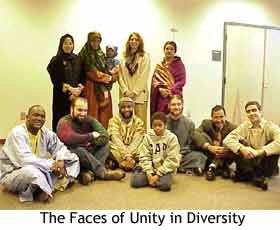
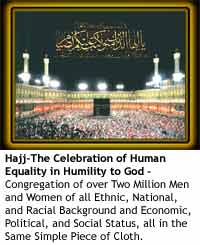
General: One frequently asked question about Muslim heritage is that how can the Muslims have a common heritage when they come from dissimilar ethnic, national, and racial background, speaking different languages, using different dressing patterns, and having different food habits? To answer this question, one has to understand the concept of Islam-unlike other religions Islam is not only a religion, but also a way of life. The system of beliefs and practices in Islam moulds the conduct of its adherents in real life, both spiritual and secular, and thereby determines their individual, family, social, economic, and political behavior. One important aspect of Islamic faith is the belief in the Unity (Oneness) of God, the unity of the universe, the unity of the solar system, the unity of the planet earth, and finally, the unity of humankind. This common set of beliefs and practices keeps the Muslims united in equality in their conduct and behavior as a single entity, thus providing the foundation for a common heritage for the whole community. However, within the broad limits of these beliefs and practices, Islam not only permits the maintenance of diverse cultural traits, it also encourages and fosters their development. The Islamic code of conduct with respect to dress can provide an illustration-while Muslims are required to cover their specified body parts, they can cover them with any kind or pattern of clothes. Similarly, while abiding by the limits of permissible and forbidden, Muslims can prepare and eat any kind of foods they want to
Thus, it can be concluded that the Muslim community is a celebration of unity in diversity-unity forged by the commonality of faith and practice and diversity of social and cultural differences permitted and even encouraged and fostered around the fabric of unity. In this sense, the Muslim community is not a melting pot of soup, but a great bowl of salad depicting the mixture of various ingredients that maintain their separate individual identities while enriching the quality of the salad.