THE POWER OF FAKE OR FAKE IS MORE By Slobodan Mijuskovic
Ingrid Bergman: I don't feel like that, I don't think I
can give you that kind of emotion.
Alfred Hitchcock: Ingrid - Fake It.
"There are many such stories" or do let's
talk about something else
In one of the countless reviews of Vertigo,
the inevitable subject of obsession was stated in the following manner:
that film is not a study of obsession, but the obsession itself. In other
words, the phenomenon of obsession/obsessivness is present in it not as an
outside object of thematization or "investigation", but as the film's own
intrinsic characteristic. Therefore, it does not investigate this
phenomenon but "produces" it, i.e. instigates obsessivness. Such
inversion, perhaps unusual and open to a variety of readings, gives me an
opportunity and excuse to unassumingly support this idea about the
obsessiveness of Vertigo. Of course, I have no doubt that my
experience is in any way singular and original: there are many such
stories.
Therefore, I do confess that I belong to not quite small informal
"brotherhood" of those for whom this film, precisely this film and not
some other, is the true and permanent obsession. Already in the early
sixties, when I saw it for the first time in a stifling and dusty
provincial cinema, I plummeted into the vertiginous vortex of Vertigo,
entangled into that intoxicating
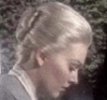
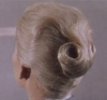
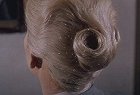
spiral in Madeleine Elster's hair which, like the spiraling water in
the Psycho famous shower scene, takes one into the deep of
seduction without return, of loss and vanishing. The story is more than a
stereotype. Out of a sincere and pure teenage gaze, out of that kind of
reception, which, certainly, lacks every distance of experience, knowledge
and rationality, arose the fact that - another confession - I had simply,
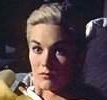
genuinely and forcefully fallen in love with Kim Novak. I should actually
say in Madeleine (quite relevant distinction), as I could not exactly
remember Miss Novak by her other, not at all bad, films I had seen at that
time (such as Middle of the Night or Pal Joey), and where
she looked more than perfect. What happens next: In one of the then
popular film magazines, I found the address of a new Hollywood star and
sent her a letter with only one sentence, polite and shy request for a
photograph. After a while, when all my hopes were, as it should be in such
stories, lost - two black and white photographs arrived, both signed. The
bigger one, postcard size, though more square shaped, was a portrait from
which I remember, apart from mystical and cold gaze, a version of
Hitchcock's model of a mystery woman, a loose white sweater with large
roll collar. On the other, much smaller and rectangular, Kim Novak was
sitting in a two-piece bathing suit, leaning on one arm, with legs
slightly stretched out. Signatures (only
KIM, in letters conspicuously large for that size photos) appeared to
me genuine, authentic, "handwritten", because they were not identical,
although my gang at the time ironically said that they must be stamped by
some guy in charge who, like a post office employee, routinely bangs the
photographs before they are mailed to the fans' addresses. All right, I
did not think that Kim Novak had actually received my letter, signed with
blue felt tip pen her only two photos, put them in envelope and walked to
the nearest post office to send them personally by registered mail.
However, this "dilemma" cannot be resolved now, nor was it possible many
years ago, because the photographs were lost long time back, which
presented a harsh blow to my early teenage life. However, in place of the
missing "original" which was once in my hand, here is a substitute:
the same photograph, only top and bottom a bit cropped, and - of
course - unsigned.
As far as the initial motive of obsession is concerned, this film, beside
many other things, certainly is a kind of a study of obsession, no matter
how much the term study, particularly when rigidly applied, might be not
quite appropriate for film medium. Because in that case the very study of
an obsession would be, or could become, the subject of the obsession -
which is one of the possible astonishing outcomes of the film. Thus, the
point of explaining this film's obsessive effect and, even more, why it is
my own (personal) or anybody's obsession remains in principle problematic.
Besides, many things cannot be explained, and there is a lot that should
not be explained. I can only offer you a hazy remembrance, not doubting
its unreliability, that the sources and motives of this obsession were not
(only) of organic, hormonal nature, that all this did not start just
because of the teenage crush of a provincial schoolboy. Anyway, I had soon
forgotten Kim Novak, but not Madeleine, and certainly not the film, which
has remained - this is my last confession - the obsession even when I am
watching other things in it and not just the female protagonist of leading
roles. However, perhaps the "explanation" could be found in a sentence
from the film: There's something in you... Even Scottie could not
explain to Judy what it is in her, and just when it seemed that he would
try, he said something else: color of your hair... We should better
try to talk about something else.
"You
were the copy" or Scottie the modernist
In the last third of the
film, after he had seen in the mirror the Carlotta Valdes' necklace
around the neck of Judy Barton, Scottie Ferguson's detective light
bulb instantly lit: he reconstructed the core of the whole story and
concluded that Madeleine was actually the copy. He himself uses this
word in an emotional and dramatic monologue on the stairs of the San
Juan Batista mission: You were the copy!
The copy, of course, presumes the original in relation to which it is a
copy. There exists, therefore, another Madeleine, one should say the real
one, the original - but the one we do not see. Except in a short sequence
at the top of the bell tower (note that it is shown in a flashback as the
fragment of Judy Barton's recollection), the original is visually missing
from the film, omitted. It is present in a verbal/conceptual form, as a
significant part of the narrative, it is talked about, something is found
out about it, for instance that it lives in the country and rarely comes
to town, but that is all. Thus Madeleine is the copy of the absent, and
therefore in a certain way non-existent original. On the other hand, one
could say that there are actually
two originals with the same name: one is the "real" Madeleine, Gavin
Elster's wife, whose appearance and personality remain unknown; the other
is Madeleine who becomes Scottie's obsession, a character, personage
invented and created by Elster. However, she does not imitate the "real"
Madeleine but just nominally plays her part. The only thing they have in
common is the name, there is some physical resemblance of their visible
features, but they completely differ in the essence, otherwise the whole
project would not be necessary. That is why Madeleine is, simultaneously,
an authentic creation, a kind of an artistic, artificial construct (albeit
of flesh and blood), sophisticated project of deception and seduction, the
copy who "acts" the nonexistent prototype and in an inexplicable way gains
the aura of the original itself, becomes unique in the perverse game of
simulation of the nonexistent model. The copy without the original - this
contradictory (?) relation finds its "denouement" in the inversion whose
outcome is that the copy becomes the original. Madeleine is a being of (at
least) double nature, she is the one and the other, original and copy,
reality and representation, reality and illusion, truth and lie. It is a
being of multiple and fluid identity, visible and invisible at the same
time. It is therefore difficult to say in what or in whom had really
Scottie fallen in love with, and what actually is that "obscure object" of
his desire. In such dualism every answer is the right one.
If she had already existed as a representation/image/icon, if she actually
never really lived, one should say that Madeleine also could not have
died. She actually just vanishes, becomes invisible, and it happens twice
(same as she was "born"/became two times), almost in the same way and at
the same place. But the second vanishing was at the same time Judy
Barton's death, the death of the body in which Madeleine "lived". Although
fictitious, these two "deaths" are more than real for Scottie, they are
the obstacles on the way of the materialization of the illusion, the
realization of utopia. Yes, Madeleine is like a modernist utopia:
precisely because it is not realized, it retains the aura of a work of
art, the singularity, authenticity, untouchability, unrepeatability of the
original/copy which is the product of the creation/imitation project.
And really, if we do not view Scottie's behavior after the discovery of
the "deception" only from the psychological standpoint, one could then say
that it displays the symptoms of the mental, intellectual and cultural
structure of a modernist hurt by the knowledge that he held the copy for
the original, that he was seduced by the enchanting, irresistible
attraction and mystery of a false image. What is actually hurt is his
axiological and ethical foundation of a modernist, and he now selfishly
wants to restore and strengthen his modernist "health" although now the
illusion, the very same one that was previously the utmost actual reality,
is once again in front of him. Between empty "health" and full "illness",
he chooses the first. Why did he need to release himself from the past
(another modernist dogma) and not accept the reappearance of the object of
his obsession? Why did he reject pleasure of the enslavement to the
illusion when the miracle had already happened? Why was he bothered by the
deception when he did touch, as the result of that vile act, the complete
fulfillment, the sublime experience of the perfection? Scottie is,
unfortunately, the believer in the modernist myth of the original, and
therefore unable to grasp that the copy can be much more than the
original. You were the copy, you were the counterfeit... he yells
on the wooden stairway at the bell tower of the San Juan Batista mission,
annoyed and hurt by the knowledge that he was the object of a manipulation
which had placed him, nevertheless, into the exclusive position of the
chosen one. Not feeling that he was actually privileged by this choice, he
wants back to the ground, into reality, he wants to be free and healthy.
His victorious cry I made it is actually the defeat, the downfall,
the end of an authentic life in the unreal world of the perfection.
Really frightening is the thought that Madeleine is only, not by her
appearance, but by her every gesture, movement, by every spoken word,
gaze, embrace or kiss, just a part of the plan of the cunning and ruthless
businessman to murder his wife. Her very personage, character, is actually
the concept, the idea materialized in something which surpasses the
demands of the realization of such banal, pragmatic project. However,
Madeleine is quite often compared or equated with a work of art, although
her creator, her author Gavin Elster, certainly did not conceptualize his
creation in terms of creativity. However, the creative act had occurred at
another place, it happened in a zone which is outside conscious intention
and control of the "author", in the mental, psychical and emotional
investment or projection of the (inner) "observer", actually the active
participant in the event. Scottie's perception of this character creates
around it the aura of a work of art, imbues it with uniqueness and
authenticity of an aesthetic object. Without Scottie, i.e. without
reception and interpretation, Madeleine is just a common object, more or
less successful product of a non-aesthetic and non-artistic operation. It
turns out that the road to (perfect) crime goes through art, and that
crime always involves both the author and the observer. Scottie is thus
also an actor in the murder; he is not innocent, although the court did
not find him guilty. He did nothing is heard from the mouth of the
arrogant representative of justice, and one cannot be guilty for the deed
not committed. Thus speaks the logic of the law. Nevertheless, Scottie did
everything. He is the real murderer, but at the same time the suicide. The
deliverance from the past he staved for persistently took him straight to
death, together with Judy Barton. That is why in the last sequence of the
film, on the edge of the bell tower, actually stands an unusual corpse, the
man who had conquered the fear of heights and vertigo, but lost his own
identity that he had found in the image/icon named Madeleine. What he had
not lost, the only thing that remains, is the wandering: Only one is a
wanderer. Two together are always going somewhere.
But there is nothing worse for a modernist than the discovery that he had
identified himself with the copy, an imitation, a forgery, that the fake
had become the object of his obsessive desire, that he was exalted in
front of a false image. Therefore, the murder of this image is quite
logical and expected outcome. The illogical and unexpected is the suicide.
However, does he really know at all that he had murdered himself?
"One and Three..." or Kim, Madeleine,
Judy
It is not inappropriate to ask how many
personages/characters Kim Novak plays in this film. The construction of
the story and the plot produces certain shifts in apparently simple
position of an actor playing two parts. There appears an additional
element, simultaneous presence and interpenetration of the visible and
invisible parts/characters/identities. When playing Madeleine (in the
first part of the film) Novak at the same time plays Judy, i.e. she is
playing Madeleine as that character - within the film's narrative - plays
Judy. In the second part of the film Novak plays Judy, first in her
authentic character and appearance, and afterwards "dressed" in the
Madeleine's appearance. However, Novak is then playing only Judy, not also
simultaneously the (invisible) Judy who plays Madeleine, i.e. Judy then
does not play Madeleine although she looks as Madeleine did. Moreover, one
could say that Novak as Judy/Madeleine in a way also plays Carlotta
Valdes, the character which haunts Madeleine and is reflected in her
psychological and physical behavior. Although Madeleine knows nothing
about Carlotta, this woman actually "lives" in her: absently gazing at the
annual rings on the stump of the sequoia, pointing at the place/time
where/when Carlotta was born and died, Madeleine says: Somewhere in here I was born. And there I died. Finally, to the
woman at the reception desk of the MacKittrick Hotel the person who
occasionally uses one of the rooms is not called Madeleine (shadowed by
Scottie), but Carlotta Valdes (regardless of the fact whether the
receptionist really believes it, or was told to say so as a part of the
plan).
The concept of a personage within the personage, or a character within the character
corresponds in a way to the particular realization of the concept painting
within a painting in the history of modern art. As in some Magritte's
cycles, for instance in paintings such as "La
condition humaine I" (1933), "Les deux mysteres" (1966), "La cascade"
(1961), "Le soir qui tombe" (1964), etc., the spectator is facing the
interpenetrations, overlapping and superimpositions of reality and
representation, reality and illusion, truth and lie, i.e. Judy and
Madeleine. If, for instance, watching the first part of the film you try
to keep thinking that Madeleine is a fake, a false image, a simulation of
a personage behind which are Elster/Judy, it would not be easy to maintain
this thought all the time and thus release yourself from the veracity and
seductiveness of the illusion, truthfulness of the lie. The quality of the
illusion, the common general quality of the media of painting and film in
both these cases is not merely a means, but is transported into the
dimension of the explicit representation and thematization, i.e. it
becomes transparent, separately signified as the fundamental element of
the visual and semantic plot that confuses and seduces the viewer.
On the other hand, such structure with elements
Judy-Madeleine-Carlotta could be referring to the components of the
Kosuthian conceptualist relation "one
and three" (object/reality - representation/illusion - concept/word),
but Hitchcock, of course, same as Magritte, does not take road of
analytical/tautological simplifications and reductions which end in a
certain glorification of the idea, i.e. the notional/conceptual/verbal at
the expense of the pictorial/visual. On the contrary, Hitchcock, together
with his surrealist colleague, glorifies the image/representation using to
the full its ambivalence, multiplicity of meanings, illusiveness and
falsity. The representation is above the notion and the object, the image
precedes the word.
As in Magritte's paintings, the realistic viewer will quickly notice in
Vertigo a number of "mistakes" or "lapses". For instance, it is more
than unconvincing that Scottie could have been saved when he was
on the edge of the abyss, completely helplessly holding onto the
ripped drainpipe. Another example: while Scottie is trying to pull
Madeleine out of the San Francisco Bay, she (although "unconscious" or
"half-conscious") in one moment, as if quite willingly, puts her arm
around his neck; later, in her savior's apartment, when the ringing of the
phone starts her from the "half-sleep" (wherein she repeats the words of
Carlotta Valdes: Have you seen my child?), Madeleine appears
properly made up (?). One more example: When Scottie follows Madeleine for
the first time, she visits three places, the flower shop, cemetery and the
museum. Although these visits are sequential, scrutinized by Scottie's
attentive detective eye, the observer (more observant than Scottie?!) will
notice a detail which can hardly have a rational, realistic explanation:
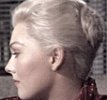
Madeleine does not have the same coiffure at all these places, i.e. in the
museum there will suddenly appear in her hair the characteristic spiral
which was not present at two previous places. Hitchcockian explanation of
this detail, like the one about Scottie's rescue from the roof gutter,
might be that Madeleine had in the meantime dropped at the hairdresser or
had changed her coiffure in the museum's rest room, or something in that
vein, but we were not shown this because it would be uninteresting. In
addition, what about the mole, so conspicuous on the left cheek of the
girl from Kansas, which is absent on Madeleine's white face? It might be
real, it might be false, just a cosmetic device?
Whatever it is, whatever plot twist or explanation
we might deduce from this conundrum, the conclusion will not correspond to
Scottie's well-known rationalist-positivist sentence by which he tried to
return Madeleine to reality: You see, there's an answer to everything!
The knowledge about that, about the absence of the answer, is disturbing,
perhaps even painful. The balance of the answer and explanation is
necessarily elusive, same as Scottie's balancing of the cane game (the
first shot after the policeman's fall from the roof!) necessarily ends in
failure, accompanied by the cry of pain caused by the uncomfortable
therapeutic corset around his chest. Finally, should we even mention
the alogical change of background during the famous 360-degree kiss?
If, as they say, film or art should not be compared to reality, then it
particularly applies to this film. Forgoing such comparison, at least in
this case, benefits the reality, because truly "what is a being when
compared to this art", or what is reality beside this illusion, what is
the truth beside this lie...!
"You can see her there" or images and
words
The mystery in this film begins with the images, not
with words. As does the seduction of the viewer. True, in the first shot
of the film, in the fascinating
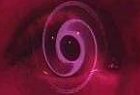
opening credits sequence designed by Saul Bass, the shot is a close up
of the mouth of an unknown woman, but camera at once moves to the eyes
(they are looking left-right), and then closes on the right pupil out of
whose depth and darkness emerges the fetishist spiral. We are thus
immediately introduced into the world of the eye, gaze and seeing, the
world where the film takes place and about which it narrates.
The whole Gavin Elster's story, full of strange and
inexplicable details about his wife's behavior, certainly has an
intriguing, but not quite convincing effect to initiate all by itself the
energy of the mysterious. Scottie therefore reacts rather indifferently,
appears sullen, he even cannot or does not want to suppress the gestures
which evidently show that the story somewhat bores him. Elster also feels
or knows this, and therefore proposes at the end of their conversation
that Scottie comes to the restaurant Ernie's in order to see Madeleine:
You can see her there. Behind these words is the belief in the (super)
power of the image, Elster expects of the image to challenge the
indifference of his college friend. And so it does, Scottie has felt that
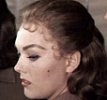
frightening, hypnotic power the moment Madeleine stopped behind his back,
when from the corner of his eye he saw for the first time her
profile (and sensed the rustle of her dress). Even this indirect gaze
from periphery of the eye, which does not give a clear image, was
sufficient to infect him with the virus of mystery and obsession. Next
fifteen anthological minutes of the film, without words, only by image
(and sound), intensify the mystery to the full. Scottie's gaze (together
with the viewer's) now follows the movements of the mysterious figure in a
gray suit, twice captured by her hypnotic and "deadly" profile. After the
shopping for flowers, visits to the cemetery and the museum, where she
sits motionless in front of the (another) mysterious image, the woman in gray enters
the hotel and appears at the window of the room which will just a few
moments later be empty. Inexplicable for the retired detective, same as
for the viewer, she disappears like a phantom. However, for the woman at
the hotel reception desk nothing unusual happened because the mysterious
person had never entered the hotel.
If after this first experience Scottie still retains certain detachment,
Madeleine's second appearance incarcerates him definitively in the jaws of
obsession. In his own apartment, after he had managed to stop her suicide
(during that incident he could first touch Madeleine and see her face so
close to feel her breath), he is left at the mercy of
the hypnotic energy of the image, of the discouraging radiation of a
sublime aesthetic object, the unique masterpiece.
Everything mysterious, enigmatic, magic, hypnotic and obsessive in this
film primarily generates out of its pictorial/visual (and musical)
texture, out of the formal-linguistic structure. Besides, Hitchcock
himself had emphasized that in Vertigo he cared less for the story
and more for the integral visual impact and effect. What seduces,
mesmerizes and anaesthetizes in this film is its visual design,
construction and composition of the shots, montage of the pictorial
fragments; rhythms of the movements and flux of the images in the ambience
of the musical background; energy of the color and light as the basic, not
just aesthetical but primarily symbolic units, striking domination of the
curved and bent lines, cyclic, recurrent and spiral motion, etc., etc...
Verbal and narrative levels only support (although quite efficiently) the
magic of the image. Let's be frank, if Madeleine did not look the way she
does, if her face, gaze, walk, movements, clothes..., did not speak louder
than her words (Hitchcockian assumption of "the perfect woman of
mystery"), she would be followed about the steep San Francisco streets by
some other man, though with the same name. It would just be a retired
detective only interested in the efficiently done and paid work he
reluctantly accepted. It might be enough for the efficient realization of
the Elster's plan, but in that case some other, but not this film, would
be made.
At the end, the mystery in this film disappears with the sobering
intrusion of words at the moment of the last kiss, as if it foreshadowed
that everything still might be as before: I hear voices, says the
nun in the final sequence on the bell tower, appearing out of the darkness
like the harbinger of death, and frightened Judy/Madeleine, backing a few
steps, falls into the abyss of reality. These last - but not final -
spoken words in the film definitely cut already quite thin thread of
mystery, lift the veil of the fiction and illusion behind which emerges
the transparent, prosaic, sinister and ugly face of reality.
"This is my second chance" or Recurrence
The manifestations of recurrence, desire, wish,
compulsion or instinct for repetition are more that conspicuous in
Vertigo. This motive, mentioned and discussed in several analytical
texts, does represent the fundamental element in the formal and narrative
construction of the film, main support of its semantic and symbolic
exposition, primary component of the psychological constitution and
function of the characters. The concept of recurrence is incorporated
already into the main visual symbol of the film (spiral-spiraling/cyclic
movement: the animations in the title sequence and in Scottie's dream,
Madeleine's coiffure, rings on the cut sequoia, the bell tower staircase,
the bouquet, the chair on which Scottie demonstrates his deliverance of
vertigo "theory", the chandelier in MacKittrick Hotel which markedly
captures Scottie's gaze, Elster's swivel chair, the large round decorative
plate on the wall of Scottie's apartment...), all enhanced by the Bernard
Hermann's spiraling musical themes.
Mozart's music at the beginning of the film (while
Scottie and Madge talk in her apartment) is repeated in the hospital
sequence; Madeleine and Scottie, together or separately, several times
visit the same places;
Madge paraphrases the portrait of Carlotta Valdes replacing her face
with her own; in the repeated
symbolic appearance at the (hotel) window we first see Madeleine and
then also Judy; the image reflected/repeated in the mirror appears several times: at
the Ernie's Restaurant, at the flower shop, at the fashion shop, at the
Empire Hotel; Madeleine appears and disappears twice; Scottie repeats
Madeleine by forcing Judy to change her hair color, coiffure, clothes,
shoes; death of Madeleine is the result of her obsessive wish to repeat
her great grandmother's death, etc., etc...; finally, the very idea of the
copy presumes the repetition as its fundamental constituent. Finally, the
desire for repetition is itself repeated in the specific form, outside the
film, in the desire to repeat its viewing.
It is a common phrase to say apropos Vertigo that it is a film
which must be seen several times. Why? Superficially, there is nothing
unusual about it; everyone would say that it is a thing to do with every
above average film. But why is not the same demand repeated, at least not
so conspicuously, for many other brilliant films? As if Vertigo
possesses even something above extraordinary, something beyond
masterpiece, actually something quite different - which has nothing in
common with the rigid hierarchy on the axiological level. This film,
therefore, requires several viewings not (only) because of its quality,
but for something unique in itself, in its structure, its intrinsic
pattern: There's something in you!?
On the one hand, the film cannot be adequately perceived in one viewing
due to its multilayered model of construction where all the levels
(visual/pictorial, narrative/verbal, symbolic/semantic, auditive, etc...)
are equal and equivalent, i.e. its constitutive elements are not organized
by the hierarchic principle of subordination, there is no dominant and
subordinate, no central and peripheral, primary, secondary and marginal.
That is why in one viewing the simultaneous perception/s simply cannot
"grasp" and absorb all levels of this unique and polysemanthic emission.
Moreover, the additional difficulty is created by another, perhaps really
unique quality of this film: the inevitability of more than intense, i.e.
not just ordinary, emotional participation and investment of the viewer,
impossibility of watching it "cold headedly", exclusively rationally and
intellectually. As Norman Holland says, on a rational level I know that I
am watching a fake, fiction, something false/untrue, unreal, but at the
same time I feel (different level) as if everything was real/true because
I am involved and want to know what will happen next, I care about it, I
am concerned. The emotional and exalted state amortizes the efficiency of
rational and intellectual perception, as if during the watching of the
film it falls into some kind of anaesthetized stupor and awakes only
later, when the fiction in front of our eyes had ended.
Perhaps all these are commonplace, perhaps this is the matter of
solipsist, subjective projections and mystifications, but it is not the
end: all this is repeated with every new viewing. The plot is known, there
is no secret, no uncertainty and apprehension, one knows what will happen,
but still is involved, or, to be colloquial and more precise, one is
"hooked". Like Holland, when I watch the film I wonder about the numerous
details of the story, why it had to happen the way it did, could it not
have been different, and so on. Of course, same as that author, I know
that all these questions are pointless, but again, like him, I think this
after seeing the film, not while I am watching it. From the perspective of
intellectual reception this film could, same as any other, exhaust itself,
and then one could say: good, I have missed nothing, I have absorbed all
its levels according to my learning and abilities, thought out everything
that concerns medium, language and such like, I have read a lot that is
written from all possible theoretical standpoints, I have finished with
the moving and copying into that "file" and now I have to close it and put
in the "received" folder, like something locked and whole with no more
space left. However, the emotional file seems to be permanently open for
repeated new/old re-readings.
When he was making his films Hitchcock certainly had no intention to make
masterpieces (unpretentiousness is one of his most valuable traits). But
they did get made, it seems he "lapsed" several times, perhaps especially
with Vertigo, although he almost obsessively tried to keep
everything under control. There were some problems with this film, he
(fortunately!) could not get Vera Miles, who he wanted first, for the role
of Madeleine/Judy, he was not very satisfied with some things Kim Novak
did (?), etc... At the end, it appears that he did not think he made
something special. Neither did the critics. First reviews, more than
reserved, mostly concluded merely with the cataloguing of another
typically Hitchcockian thriller, only this time with rather slow rhythm
and too long exposition. When after a while people begin to think and
write differently, simultaneously was emphasized the need for several
viewings. However, I felt this need right at the start, though from other
motives, and by this time I have done it so many times that I could with
no hesitation challenge every "Vertigonist". And of course, I was promptly
prepared for that characteristic common sense, therefore incoherent and
senseless claim, that it is the best film of all times. And so, in my
infantilism, naivety, unawareness and ignorance, spellbound by
the wondrous icon of Madeleine in white coat and black gloves, I
intuited the subsequent radical reevaluation of this film that brought it
into the top ten group of all official polls among the various categories
of film professionals. Do I need any credit for this? Oh, no... there
are many such stories.