ISIS MOON TEMPLE
HOLY HIGH ALTAR OF ASET


PAGE 6

Set was furious and threatened to kill one god each day until the tribunal voted in favor of Him. He also refused any more discussion on the matter unless Aset was barred from the tribunal. To please Set, Ra removed the tribunal to an island, giving Anti the ferryman instructions that Aset was not to cross. Aset would not give up however, so She disguised Herself as an old woman and bribed Anti into letting Her cross. Once there She shapechanged into a beautiful young maiden and inticed Set away from the meeting. She then told Set that She was a widow who had a young son whose inheritance was stolen by a foreigner. Set, being besotted by the disguised Aset, replied that the son was the rightful heir. At that, Set realized the rightful judgement came from His own mouth, and in anger He returned to the tribunal to tell them what happened. The gods then had no choice but to rule in favor of Heru. Set would not accept the ruling however and demanded a trial by combat with Heru. First they each changed into a hippopotamus and dove into the Nile to see who could hold their breath the longest. Aset began to worry about Her Son and threw a magickal spear into the water, accidentally hitting Heru with it. Heru came out and asked Aset remove the spear, then He returned to the water. Aset again threw the spear and this time hit Set with it. Set appealed to Aset to remove the spear and She did. Heru, in recognition of His Mothers aid and Her compassion to Set, removed her earthly crown. Together with Ra and Thoth, Heru honored His mother. Thoth replaced the earthly crown of Aset with the horns of a cow with a disk between them.
During the battle, after Heru had torn off Set's male member, Thoth was called upon to heal Set's manhood with His saliva. Set then retaliated by creeping up to the sleeping Heru and gouging out His eyes. Hathor stepped in and healed Horus. During this time, it was Thoth's responsibility to see that balance was kept. Eventually Ra tired of the affair and demanded that the tribunal settle the dispute in favor if Aset's son. Heru was declared the rightful ruler of both upper and lower Egypt. Heru declared Thoth His grand vizier and when He later resigned, accepted Thoth as His heir. Everyone was satisfied with the verdict except Set. He would repeatedly cause trouble, prompting Aset to plead to the tribunal to do something about him. They did not exile Him like Aset would have liked, but instead gave Him the desert and all foreign lands as his domain.
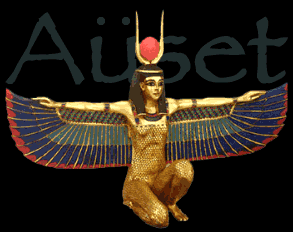
Aset is the Great Mother, Moon Goddess, Giver of Life and the Goddess Supreme. In Her role as Tait, She weaves the threads of the Tat or Knot of Fate. She is mostly identified with Demeter, Hera and Selene, being that She is ruler of the Moon, agriculture and protector of marriage. There were festivals in the spring and autumn to honor Her, but Her most prominent celebration was the Night of the Teardrop in June. It is a night to remember the losses of Aset and Her eternal mourning for Asar. It has been said that the priestesses of Aset could control the weather simply by braiding and releasing their hair. It is also said that the art of making magickal knots and blowing on them was taught to the humans by Aset and that along with her husband Asar, She taught humans to spin flax, grind corn, weave cloth and cure disease. She was the patron of marriage, the moon, divination, motherhood, agriculture, protection, reincarnation, initiation, fertility, magick, purification and domestic life. The Sacred Cow, the Buckle of Aset and the Sistrum were sacred symbols to Aset. She is commonly portrayed with protective winged arms and the moon perched upon Her head. Aset is a sacred part of the Ancient Egyptian Holy Trinity along with Asar (the Divine Father) and Heru (the Divine Son).
Aset and serpents share a long history. In the beginning, the word for "deity" was composed of the name of the god or goddess and the small image of a snake, a cobra. There is some speculation that the pharaohs of Egypt were ritually sacrificed at the end of their term, and that the Sed festival, or jubilee, was originally the moment of truth for the pharaoh, who would celebrate his reign and then accept the bite of a poisonous asp. While direct evidence for this practice is scanty now, it is interesting that Cleopatra chose this method to end her own life when she believed that it was futile for her to attempt to continue her rule of Egypt. Cleopatra, no matter how we interpret her in modern times, was a rarity among the Ptolemaic rulers. She studied ancient Egyptian and was proud to be a Priestess of Aset. There is some evidence that the Priesthood of Aset made a bargain with Julius Caesar to support Cleopatra's claim to the throne of Egypt. She could have known something about the practice of ritual royal suicide in previous times. In myth, there is an echo of this practice in the story of Aset and Ra. In this story, Ra is old, so decrepit that as He goes on His daily travels, His spittle dribbles onto the ground. The needs of humankind are neglected; the universe itself is fraying a bit due to the inability of the solar power to maintain order. Aset, a Magician, a Wise Woman, is distressed by this state of affairs. She looks at the neglected fields, scorched by accident by Ra. She looks at the dried bed of the Nile, evaporated by Ra in a frenzy of heat. She looks at the parched, sunburned skin of the human people of earth, the dried-up breasts of mothers whose babes cried unsatisfied, at the dehydrated animals, dying in their tracks as they quested for water. She looks at the rainclouds far away whose moisture would not even reach the ground before it was burned away by Ra's mad power. With one word, He can set all right again. But He will not speak the word. His bones are old, He likes the heat. His eyes are growing dim, and He needs his own great blaze of light to let Him see. He will not speak the word.