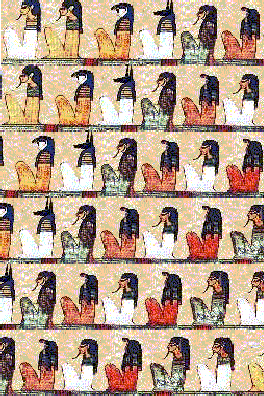
~THE NETERU OF KEMET~
AMUN was the chief god of Thebes (modern Luxor). He was depicted as a man, ram or ram-headed man. Amun shared the creation qualities and the ram iconography (with its fertility associations) of the god, Min (Min-Amun). Amun assimilated the solar power of Re (Amun-Re) and perhaps the role of taking the sun on its nightly journey through the underworld. His consort was Mut, and their offspring was Khonshu, the moon god.
ANUBIS was a jackal god who, as patron of embalmers, protected the dead. He was the product of the union of Osiris and Nepthys (pretending to be Isis) and aided these goddesses in the mummification of Osiris.
APIS was a living bull and was worshipped as a god, unlike other gods who had animal manifestations.
BASTET was originally a fearsome lion goddess and later became known as a benign and nurturing cat. She is the goddess of joy, beauty and playfulness. Her cult had solar connections with the eye of Re. Bastet also personified the eastern cardinal point.
BES was a grotesque, short and stout figure with leonine ears and ruff, exaggerated mask like negroid facial features and extended tongue. He was a domestic deity protected sleepers, children, women in childbirth and also women from the jealousies of other women.
HATHOR was a mother goddess, associated with a celestial cow. Her head-dress included bovine horns and a sun disk. Hathor whose name literally means "house of Horus" nurtured Horus incarnate as king of Egypt. Hathor was also the mistress of joy, dance, music and love.
HEQET was a female frog-headed deity affiliated with midwifery.
HORUS was the falcon deity born of Osiris and Isis. Horus vanquished his murdurous uncle Seth. According to the mythos, (besides murdering Osiris) Seth tore out the eye of Horus, but it was restored by Thoth. The healthy eye of Horus was also considered to be the eye of the sun. Called the udjat or wedjat-eye, it was believed to ward off evil. The living Egyptian pharoah was regarded as Horus incarnate. When the pharoah died, he became Osiris. Horus was often shown in art as a child with a side-lock and finger to his mouth.
ISIS was mother of Horus and the wife/sister of Osiris. Her emblem was the royal throne, which she wears as a crown. This pictogram was also the hieroglyph that spells her name. Through her mourning for her murdered husband, Isis became associated with the dead. She and her sister, Nepthys, together with Neith and Selket were the foursome who protected the dead and were often represented on the corners of coffins and on funerary shrines. Isis' mothering qualities were assimilated with those of the wet nurse/mother goddess, Hathor.
KHEPER, the scarab beetle, pushed the early-morning sun across the sky and so the scarab hieroglyph is also the ancient Egyptian word for the verb " to come into being."
MAAT personified the concept of world order, justice and correctness. She sat on the prow of the solar barque to keep it on course as it crossed the sky. Her head dress was the single ostrich feather. Together with Thoth, Maat grants precision and skill.
MERETSEGER, a snake goddess with and undulating tail, was a personification of the Theban necropolis where she dwelt. As such, she protected both the dead and the professional necropolis workers who built the tombs and lived in quarters nearby.
MIN was represented as a man enveloped in a sheath, meant to be an early heiroglyph of the body. Min's raised right arm held the royal flail and his lowered left arm held his erect phallus, emphasizing his predominant fertility aspect. He was also associated with Amun (Min-Amun).
MUT was the divine consort of the god, Amun, later assimilated with man Sekhmet.
NEFERTEM, whose name means "Atum is beautiful," was a creator god and personification of the lotus blossum on the nose of the sun god, Re. He was also associated with salves and sweet smelling oils. Nefertem, was also the sun of the Ptah and Sekhmet and became a ferocious defender of the dead and was accorded an important place at their judgment. But he is usually shown as a man, sometimes as a lion with a large lotus on his head.
NEPHTHYS, sister of Isis, Osiris and both sister and consort to Seth, saved Osiris' body from putrefaction and was thus one of the four protective goddesses of the dead. She is mother of Anubis and the dark twin of Isis.
NUT was a sky goddess, often depicted as a women who's body is studed with stars or as a great celestial cow. She was impregnated by the earth god Geb and gave birth to the sun or solar barque each night. She was also the sycamore tree goddess who provided comfort to the dead and their Bas.
OSIRIS, husband to Isis and father of Horus, was tricked and murdered by his brother, Seth and according to later tradition, was dismembered and scattered throughout Egypt. Osiris was the funerary king and "Foremost of the Westerners" because he ruled over the WEst where the Egyptians buried their dead. (The west was symbolic of the Land of the Dead.) He was represented as a royal mummy holding a crook, for its pastoral associations, and a flail, perhaps a ruler's fly whisk (symbol of authority). Osiris also had fertility associations based on his connection with the generation of plant life and growing grain.
PTAH was a creation deity and patron of craftsmen. He wore mummy wrappings and the close fitting cap and straight beard of craftsmen and smiths. Creation was thought to occur through the word of Ptah, whose cult center was at Memphis. Ptah and his consort, Sekhmet, were the parents of Nefertem. He was also associated with Sokar and Osiris, gods of the Underworld, and later he was considered to be the father of the Apis bull and of the skilled Imhotep.
RE was the sun god who was also worshipped when he perched on the double mound of the horizon as Re-Harakhty.
The FOUR SONS OF HORUS are sometimes described as the funerary deities, or genii (sing, genius). Their names are Imsety (imsti), Hapy (hpy, not to be confused with the Nile river god, Hapi), Duamutef and Kebehsenuef. All references we have to these deities are funerary in context, and it appears that no cults ever honored them.
SEKER protected the spirits of the dead passing through the Underworld en route to the afterlife. He was worshiped in Memphis as a form of Ptah or as part of the compound deities Ptah-seker or Ptah-seker-Osiri. Seker was usually depicted as having the head of a hawk, and shrouded as a mummy, similar to Ptah.
SEKHMET, �the mighty one,� was the lioness-headed goddess worshipped as part of the Memphite triad with her consort Ptah. She was the fiery eye of Ra created by him as a form of divine retribution in order to punish his enermies. At the same time she was thought of as a creatrix, healer and peaceful protectress of the righteous. She is closely linked with the beautiful Hathor and the playful Bast.
SELKET, a scorpion-goddess, depicted as a beautiful woman with a scorpion poised on her head. With Isis, Nepthys and Neith she is one of the 4 tutelary guardian goddesses. Although could send death to the wicked, she was also petitioned to cure the poison of the scorpion�s sting. She protects the pathway in the netherworld (binding demons that would otherwise threaten Ra), and helped to protect Isis from Set.
SERAPIS (in thePtolemaic period) was a conflation of Osiris and Apis. To the Alexandrian Egyptians, Greeks and Romans he was the god of the afterlife, fertility and the consort of Isis.
SET (Seth/Sutech) In predynastic times, Set was the patron deity of Lower Egypt, and represented the fierce storms of the desert which the Egyptians sought to appease. However, when Upper Egypt conquered Lower Egypt and ushered in the First Dynasty, Set became known as the evil enemy of Horus (Upper Egypt's dynastic god). He is depicted as a strange composite man/animal. The Set beast is black, and has been described as canine or donkey-like. Set was the brother of Osiris, Isis, and Nephthys (as well as her husband) and according to some versions of the myths he is also father of Anubis.
SHU was the god of the atmosphere and wind, son of Ra, brother and husband of Tefnut and father of Geb and Nut. His attribute is an ostrich feather. He is generally shown standing on top of the recumbent Geb, holding up the sky goddess Nut, much as Atlas held up the world in Greek myth.
SOBEK, the crocodile-god, was a fourfold deity who represented the four elemental gods (Ra of fire, Shu of air, Geb of earth, and Osiris of water). In the Book of the Dead, Sobek assists in the birth of Horus; he fetches Isis and Nephthys to protect the deceased; and he aids in the destruction of Set. He is a guardian of Pharoah, yet his worship was in part a form of appeasement to his kind, the fierce Nile crocodile.
TEFNUT was the goddess of moisture and clouds, daughter of Ra, sister and wife of Shu, mother of Geb and Nut. Depicted as a woman with the head of a lioness, (her sacred animal). The name "Tefnut" probably derives from the root teftef, signifying "to spit, to moisten" and the root nu meaning "waters, sky."
THOTH, the wise and scholarly god, was either one of the first beings self generated or a son of Ra (depending on which myth you follow). He was depicted as a man with the head of an ibis bird, and carried a reed and scrolls upon which he recorded all things. He was shown as attendant in almost all major scenes involving the gods, but especially at the judgment of the deceased. He was considered a god of the moon, medicine, magic, gambling and the inventor of writing. Like the Greek Hermes, he served as messenger of the gods.
TAWERET: (Ta-urt) An anthropomorphic hippopotamus goddess who was responsible for fertility and protecting women in childbirth (similar to Bes). She carried a torch and an ankh--symbols of magical protection.
WADJET (the green one) was the cobra goddess of Buto. Her symbol was the uraeus (cobra head-dress). She was the protective goddess of Lower Egypt, her counterpart being the vulture goddess Nekhbet of Upper Egypt. Together they embodied the two crowns of the country and were part of the royal insignia. They also represented the mythical mothers of the king.