
EDUC 508 Spring 2003
Try Out: Vocabulary Development-Frayer Model
Name of Strategy: Frayer Model
Purpose for using the strategy: The Frayer model is used by the students to help organize and make associations with new vocabulary or concepts. In this try-out students will use it to establish a working knowledge of living things.
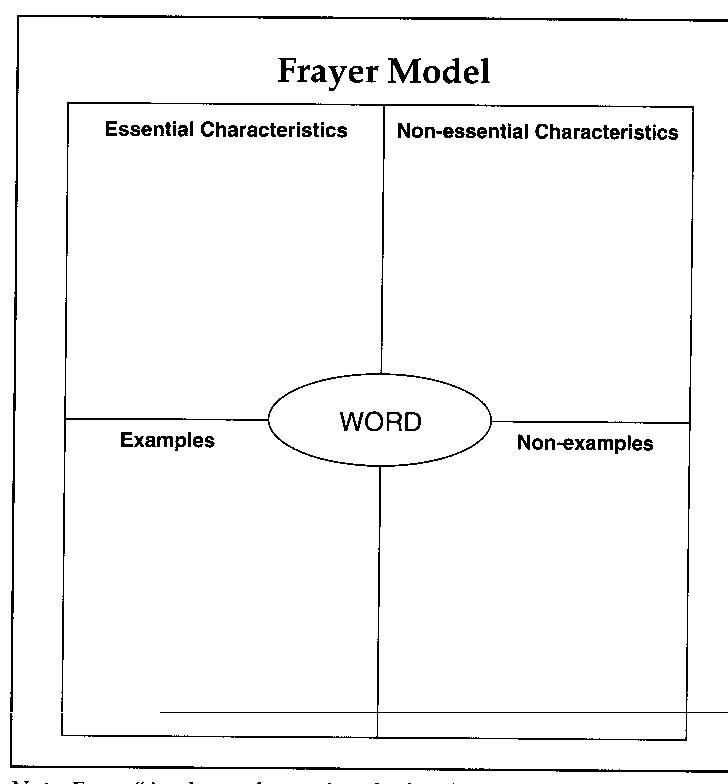
Sequence of instruction: In this exercise students will make associations with new words or concepts. The four sections of the model give the students options to associate with life experiences, compare to other words and most importantly contrast. When starting a unit on the living world, middle school science students could use this effectively to decipher what makes up a living thing, as well as identify things that have living characteristics but are not classified as living. There are many acceptable responses, and as this exercise is intended to broaden understanding of the concept, any association that helps the student is a positive one. Each box is labeled with a different application for the word or concept and will be filled in by the student to help them describe and define it. This activity is simple, and can be used before, during, or after a reading, by giving the students the model and letting them fill it out. This would work nicely as bell work before a lesson with a new topic. Models preprinted in sets with different words can introduce multiple concepts that can be shared as a class.
The two models given are similar, but can be used with different levels or grades, and to push for deeper thought. The second model asking for essential or non-essential characteristics is perfect for defining a concept while the first model will be more effective with defining a single word.
Words and concepts to be defined in class: Living thing, Non-Living thing, Life Characteristics, Viruses and why they seem to be alive but are not.
Grade Level: Sixth grade
Printed Material for this Stratagy: W. Lucretia, G. (1986). Life Science. U.S.A. Holt, Rinehart and Winston, Publishers pages 31-33
Content area, and why it is appropriate: This try-pout I intend to use with sixth grade science class. It can be used with any vocabulary introduced to students, and can be adapted to any grade level.
Frayer Model
Self Reflection
This strategy struck me as very pertinent to all types of learners, and I could easily relate. Everyone, to one degree or another learns by making associations. In the sciences especially, many concepts are abstract but related to concrete ideas that are happening all around the student. Making their own associations will help them relate the material as well as remember it. The Connecticut Common Core of Teaching states that in planning to apply knowledge, Teachers should create learning tasks that make material meaningful to students. I feel that when a student defines a concept in their own words through their own experiences, the information becomes meaningful on a more personal level, and is much easier to comprehend.
References:
Billmeyer, R. & Barton, M.L. (1998). Teaching reading in the content area: If not me then who? Aurora, Colorado, McREL.
Vacca, R.T. & Vacca J.L. (2002). Content area reading: Literacy and learning across the curriculum. Boston, Allyn and Bacon.