|
|
|
|
|
|
|
|
|
|
|
| A not-to-brief but much abridged autobiography? | ||||||||||
| Quite a lot has happened in my life that has had an impact in my latest change in vocational direction. I did not always want to be a teacher; in fact I never would have thought this would be the decision I would make that would change my life in so many positive ways.� I feel I have made the right move, and this is only reinforced by my friends and family who were so relieved when I decided to go back to school and pursue a career in a field I apparently fit into so nicely.� | ||||||||||
| Paul Matthew Jones was born in Hartford Hospital, December 31st, 1975.� Apparently the State of Connecticut has a tradition of sending the mother of the first newborn in the state a lovely package of baby needs as a token of thanks for procreating in this beautiful state.� Unfortunately, I was the last baby born in 1975, not the first in 1976.� Unsure whether to be angrier at the state for making this mistake or for asking for the presents back, my mother returned the goods complete with used diapers to Governor Grasso.� My first act in protest of bureaucracy. | ||||||||||
| My parents raised my brother and I in Enfield, CT.�� Enfield was great place to grow up, not to big, yet big enough to instill proper fear into a young man, small enough where his mother will let him trounce around unchecked.�� Throughout my school years I kept busy with sports and found time to work on a local dairy sometimes seven days a week. My brother and I didn't have to work growing up, but we were forced into it by a sinister combination of guilt and going without.�� If one experience has had a lasting impact on me as a person, it is my time spent on Smith Dairy Farm.�� I was a great student, and an accomplished athlete, but ask me at sixteen what I was and I answered "dairy farmer."�� So much could happen at any minute on a farm, it seemed like a grand experiment to me, a work in progress, or a complex machine I was a part of.� An adolescent mind has a way of putting things in perspective, and to me two hours before school with sixty head left to milk, no one thing seemed to important.� I loved working and I knew I MUST find something to do that I loved.� | ||||||||||
| When I decided to go to college, it was more for lack of a better idea.� I couldn't be a farm hand forever, so I figured a degree in science of some sort would be the next best thing.� I attended Westfield State College for one year.� I did great in school, wrecked my knee and didn't make the football team, and promptly threw in the towel.� The next three years I held more jobs than I could count, from making pizzas to garbage man, while taking classes part-time at Westfield State.� I became an accomplished coach for high school and town baseball and football teams.� But the moment I felt the town's borders closing in on me, and ran out of good fishing holes, I knew I was ready to go back to school full time. | ||||||||||
| I first heard of Unity College in Maine from my mother.� Being from Maine, she heard from her cousin that there is a college that focuses entirely on environmental studies and the students lived in tents.� The tent rumor didn't pan out but the campus is an old chicken farm, with the farmhouse an administration building, and the coops restored into dormitories.� It was perfect!� | ||||||||||
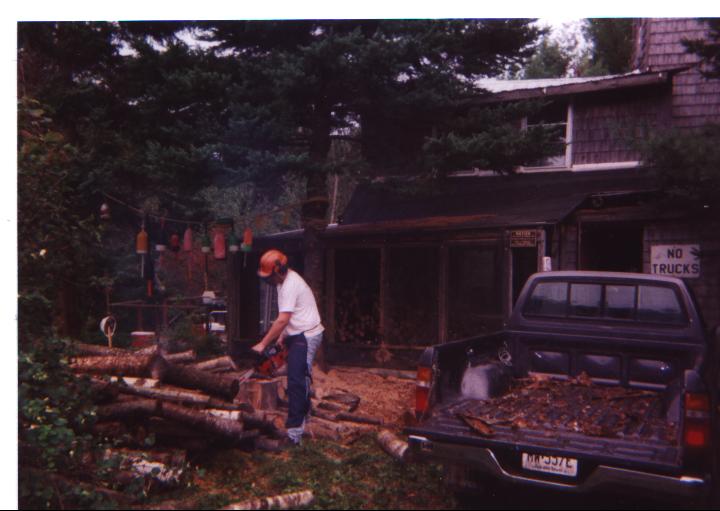
| Unity quickly turned into home.� I loved my classes, made great friends and found a comfortable niche.� In this small community work was tough to come by, but I was lucky to get a job in the cafeteria.� I got to work with friends, get a paycheck, and get a free meal plan, all while learning how to cook from one of the finest institutional cooks south of the Canadian border.� I still am a fine cook and can whip up a vegan entry for fifty without even thinking twice.� I didn't know it at the time but the free meal plan turned out to be the most valuable perk.� As Unity thrived on alternative education, views, and practices of all sorts, it also catered to alternative ways of life.� After my first semester, a couple of buddies and I decided we weren't cut out for city life (Unity population 648) and moved into a rundown hunting cabin about twelve miles off paved road and on the wrong side of a running stream.� Power and running water are over rated anyway, and who really needs a phone. The free meal plan would prove it's worth. | ||||||||||
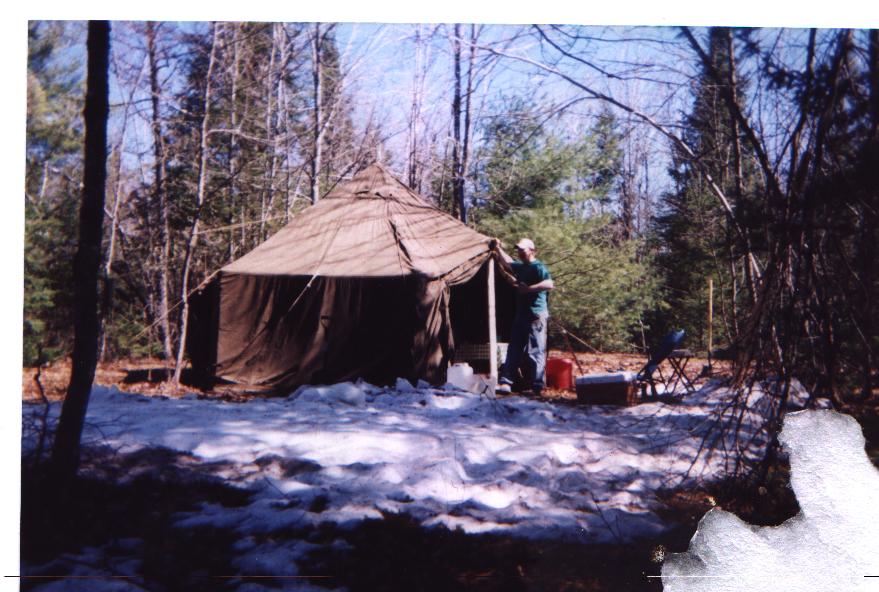
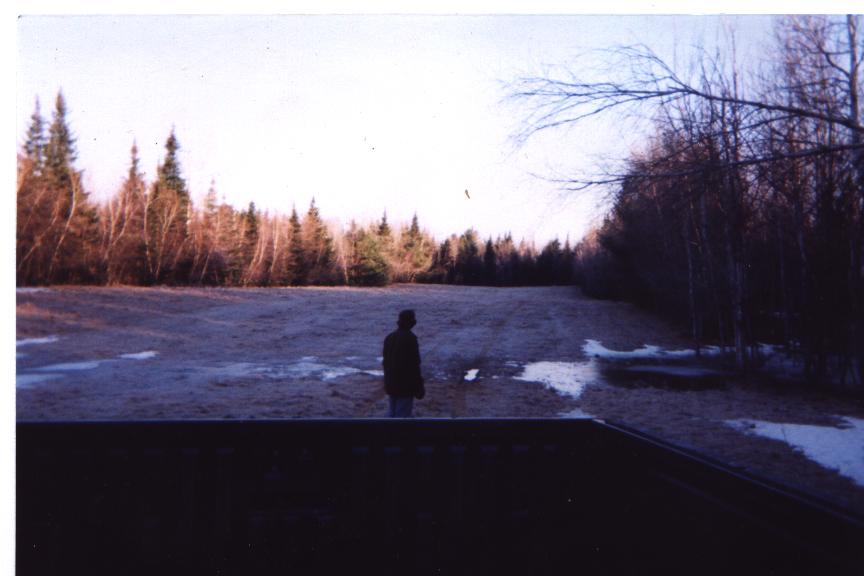
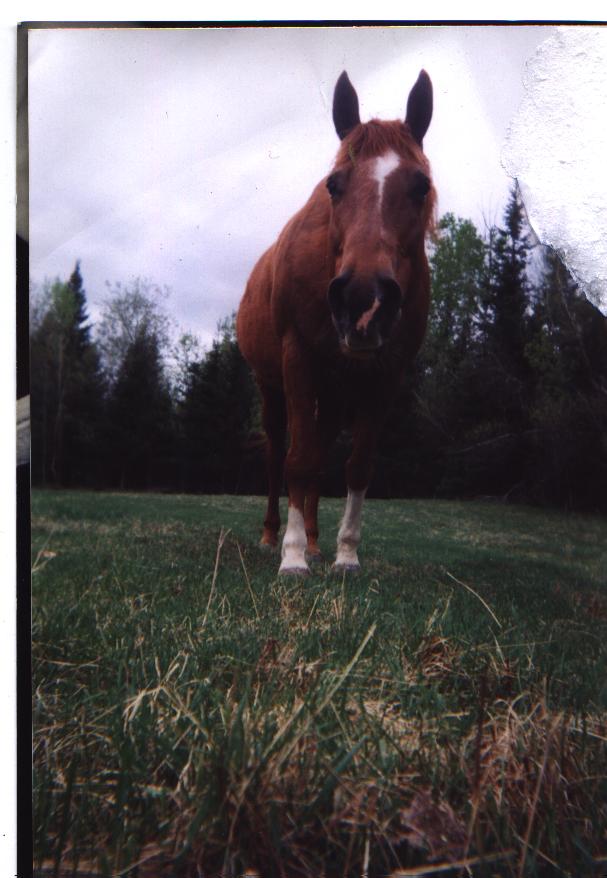
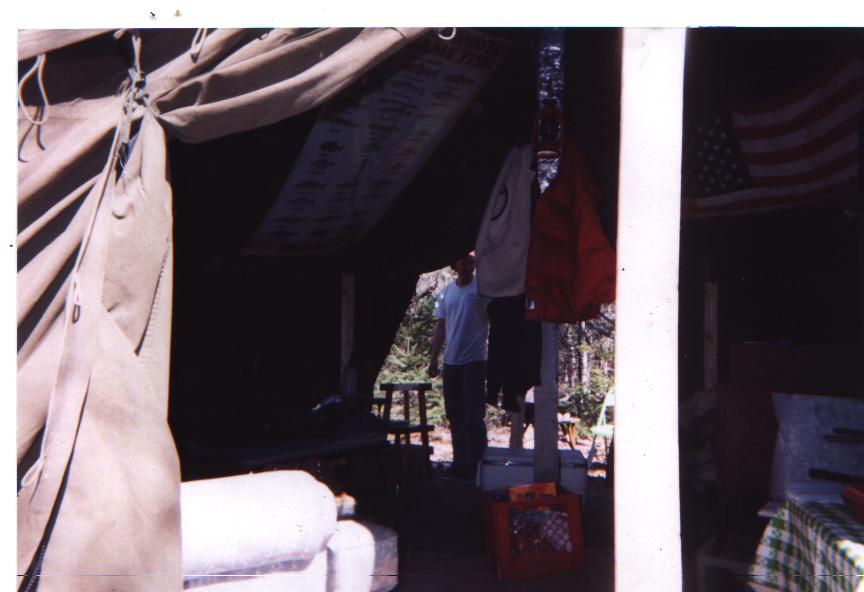
| The most beautiful thing about the cabin, and there was plenty, from outhouse to mice, was that it was free.� The landowner asked for fifty dollars a month or proof of work done to the place.� Us merely spending a night in the place let alone making it look lived in was proof enough for him and all he asked was we didn't burn it down.� We put a little work into it, and ironically made it too livable.� The land had been for sale for twenty years, we made it habitable, it sold.� We had to move.� This presents a problem in a region not known for housing options.� The dorms were full, and the closest rental was about fifty miles away.� So with little thought we (only two of us now) decided to buy an army tent and pitch it with permission on the back forty of an old horse farm.� Our driveway was a quarter mile walk through a field.� Our closest neighbor was Lucy, a beautiful old nag that didn't seem to mind us at all.� We brought her apples, she kept the coyotes away, it was symbiosis at it's finest!� | ||||||||||
| Not many people can say they lived in a tent with out power and running water in college.� Heck, not many do college without cable TV; I managed a 3.0 GPA and survived three Maine winters in shoddy cabins and a shoddier tent older than me. | ||||||||||
| The three years I spent at UnityCollege were marvelous.� All told, I spent six semesters at Unity, graduating with a Bachelors of Science degree with an emphasis in Park and Resource Management.� The community of the campus taught me more than any class, coexisting with some of the most environmentally conscience people one could meet.� I studied, hunted, fished and lived like few students ever could dream about. | ||||||||||
| Graduation found me in high spirits and I moved to Sugarloaf, Maine to work at a being world class ski bum while I sorted out exactly what to do with my life.� For two months I worked hard, plowing snow and doing general maintenance on the condominiums owned by the resort, and skied harder.� Unbeknownst to me I had been running a fever for some time, developed a brutal case of pneumonia, and worse yet empyema, a rare complication that envelopes the heart and lungs in hardened blood and pus.� It seems my appetite for the outdoors and staunch stubbornness nearly killed me.� I didn't know I was sick, but I managed to work and ski with pneumonia bad enough to kill most people.� I spent sixty-two days in the hospital in 1999, and experienced a 14 hour surgery to remove scar tissue and hardened pus from my thoracic cavity.� An enlightening experience, I have never looked at life the same.� If nothing else I had a fresh start, a new degree, eight good lives left, and determination to get a job that meant something to the bigger picture. | ||||||||||
| I moved back home with the folks, picked up a few shifts at the farm and set forth to find my new career.� I got a lead form a friend about a nearby company that specializes in industrial air quality, which needs mill-worthy workers with backgrounds in environmental science.� A brief interview got me in the door, and in little time I became a project scientist for Air Pollution Characterization and Control ltd.� I specialized in stack testing and permitting, that is I climbed smokestacks (Picture: Malden, MA 175ft, 65 mph wind, 17 degree F) and performed EPA protocol testing on emissions.� I was fascinated.� Soon I moved back to Maine to start an office, and to cash in on the lucrative paper industry.� I had my own pool of clients, and was certified by the state to write permit protocol and evaluate testing proficiency.� The job was terrible.� I averaged 70 hours a week, and would alternate weeks at a desk and weeks of fifteen and twenty hour days hanging off of stacks hundreds of feet high.� It was terrifying, satisfying, challenging, exciting and not what I wanted to be doing for the rest of my life.� | ||||||||||
| One day in the spring of 2002, I had an epiphany.� I was working at a paper mill on the roof of the main process, sixteen stories high.� The area was laden with sulfur dioxide, and at any moment we would have to evacuate.� The interesting thing about H2S is that when the levels are safe it smells like rotten eggs, but it is such a dense gas that when it is dangerous, you cannot smell it anymore.�� When the alarms for evacuation went off I coolly put on my respirator and started my way down the stairs.� Two flights down I could smell it, which is good.� Four flights later I couldn't smell it anymore.� This is when you panic.� One of two things can be happening: the H2S just got thicker and is turning into sulphuric acid in your lungs, or it dispersed but you can't just take off your respirator and find out.� So you do your best to run with all your gear down ten or so flights of stairs breathing deeper the questionable air that has just saturated your respirator cartridges and may or may not be killing you.� I made it to the bottom, kicked open the door and fell gasping to the ground.� I managed to rip off my mask and take a huge breath in sheer terror.� I looked up to see the workers making their way back into the mill cursing about getting behind on their work over a false alarm.� I needed to seriously rethink what I was doing. | ||||||||||
| Not long after that experience I gave a month notice to my employer.� I needed time to reassess things.� I do my best thinking with a rod in hand, so I hit the water for answers.� I realized what I wanted most is a career that is relevant to the bigger picture in life, relevant to me but also to more people than the ones I see day to day.� I love science, talking about it, learning, just being scientific.� And never had I had such a feeling of pride and accomplishment as coaching a little league team to its first victory.� Now I just needed to incorporate these things and figure out a way to get paid for doing it.�� When it came to me, it seemed so silly I hadn't thought of this before, that I had been wasting time up until that very moment even considering doing anything else.� I must teach!� | ||||||||||
| Back off man... I'm a scientist! | ||||||||||
| Dr. Peter Venkman | ||||||||||
| HOME | ||||||||||