Beauty of Material: Selecting Timber Species for Malay Woodcarving Ismail Said ([email protected])
Department of Architecture, School of Design and Environment
National University of Singapore
4 Architecture Drive, Singapore 117566
January 2002
Introduction
As early as the 14th century, woodcarving has been a significant craft in the vernacular architecture practiced by Malay craftsmen in Peninsular Malaysia (Ismail, 2001). It is an art of partially removing wood from a board or a plank following specific motifs and orders. By imitating a carved masterpiece, a woodcarver gradually modifies the motifs and produces his own manifestation onto the timber piece. This pattern becomes the trademark, both for the craver and for his architecture or craft.
The abundance of tropical hardwood species and as well as the skills of the craftsmen in the country created architecture with its own language or style. Not only the timber as the major building material and pitched roof as distinctive form that characterized the architecture, the carvings on its components add to its distinctiveness. Vernacular constructions such as house, mosque, palace, entranceway or gateway, tomb and pavilion, and boats are equipped with carvings with a variety of patterns or motifs.
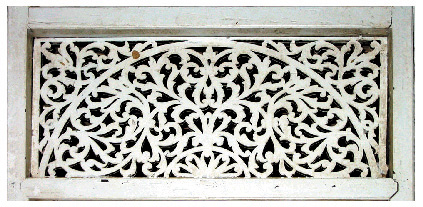
Aristocratic houses such as Kota Lama Duyong in Kuala Terengganu town and palaces such as Istana Jahar in Kota Baru town are equipped with varieties of relief and perforated carved components. These components served functions such as they allow light into the interior, the flow of breezes through of the building, and aesthetically, they add beauty and create character to the architecture. The craftsmen incised five types of motifs including flora, fauna, calligraphy, geometry and cosmos onto timber boards or blocks of varying timber species, sizes and colors. More than 20 architectural components are carved depicted in three incision modes: relief, perforated or a combination of both. They include wall panels, ventilation panels of doors or windows, door leaves, railings, gables and their boards, and fasciaboards that dominate the elevation of the buildings (See Figures 1.0).
Figure 1.0: Ventilation panel on top of a window of Tengku Long’s house in Kuala Terengganu
The degree of complexity in carving varies from one component to another; intricate or complex ones include door leaves and wall panels, and simple carvings include gableboard and fasciaboard. From the carving characteristics, namely, incision modes and frame layouts, one could differentiate the architecture of one state over another. The carvings signify the status and ownership of the residents and display the skillfulness of the craftsmen. For example, a Terengganu house is distinguished by its large gableboard whereas a large-latticed gable portrays a Perak house. As one gets closer to view the carved components, the distinction is further portrayed by the composition of the carvings and their motifs. As such, the elevation of the Terengganu house is adorned with perforated wall and ventilation panels of varying sizes carved in flora motifs; leaves, tendrils and flowers of local plants such as ketumbit, getamguri, keraknasi, jari buaya, and bakawali. But the panels at Perak houses are carved in different flora motifs including sunflowers and ketola, and sometimes mixed with cosmos motifs. These are regionally specific motifs found in the Malay woodcarvings in Peninsular Malaysia. On the other hand, both types of houses might use similar geometric and Arabic calligraphy motifs as portrayed on railings of varendah or tall window railings and fasciaboards.Similar flora, fauna and calligraphic motifs are manifested on non-architecture components such boats, weapons, furniture and house utensils, and musical instrument. The most elaborate carving on a boat is the makara carved in relief and perforated styles depicting mostly flora and sometimes figurine motifs as illustrated in Figure 3.0. The hilt of kris, badek, and spear are some of the weapons that are intricately carved on timber such as kemuning (Murraya paniculatum), leban (Vitex pubescens), sena (Pterocarpus indicus), and nibong (Oncosperma tigillarium). Likewise, the craftsmen manifested their ideas and skills on more than 15 types of furniture and house utensils.
This article presents the criteria of selecting tropical hardwoods practice by Malay craftsmen in the creation of their carvings. The criteria address the intrinsic knowledge of the craftsmen upon the beauty and meaning of tropical timbers. By applying these criteria, the making of woodcarving is one of the arts and crafts of the Malays that standout in its own stature.
Factors Influencing Timber Selection
Generally, the Malay craftsmen would apply three factors in selecting appropriate timber for their carvings. The factors include availability of timber, its physical characteristics and durability, and the craftsmen’s spiritual beliefs towards the timber species. The hierarchy of selection depends on the type of carved components, for example, the making of house components such as door leaves or ventilation panels is clearly determined by the availability of timber which should easily be obtained in large volume.
On the other hand, the Malay craftsmen choose only kemuning or kenaung for making kris hilt and sheath because of their fine interlocked grains and deep yellow sapwoods overlap with dark brown heartwood. In addition, these timbers are regarded as possessing good spirit that must be respected and that will accompany the weapon.
Availability of Timber
Tropical rain forests of Peninsular Malaysia produce a variety of quality, durable timber grown in the low-lying undulating land and hills of the Main Range. The trees are categorized as dipterocarp (species with resin) and non-dipterocarp (species without resin) producing large volumes of wood (Smith, 1999). A virgin hill forest could produce 3 to 4 trees per acre of heavy, medium and light hardwood species such as chengal, balau, merbau, and seraya (Shorea curtisii). They can reach more than 60m in height with diameter 1.2 to 1.5m. Their densities range from 560 to 900km/m3 and they have stiffness to resist bending applied by external loads, flexible enough to bend and to regain normal shape, and with hardness that manageable to cut and incise with sharp tools (Farmer, 1987). The heavy hardwoods are durable species that resist attacks from termite, powder-post beetles and fungi which would lessen their structural properties including flexibility, stiffness and hardness. A house builder would only need to cut two to three trees to construct an aristocratic house for a large family. Before the existence of machinery to cut and extract the timber from the site, the house builders would cut the tree and saw it into rough boards or planks and later the cut wood would be pulled by buffaloes to the building site. Thus the knowledge of selecting a suitable durable species with straight and solid bole, without decayed heartwood, is a crucial step in the process of building construction and carving. Some builders would only select a tree without dead branches or large buttresses. The purpose of this practice is to avoid selecting the tree that bad spirits might reside in. At present, however, the craftsmen simply purchases the timber in form of boards, planks, and posts from the sawmills. These timber members are suitable to make large building components such as door leaves, bargeboards, kingpost, wall panels, and ventilation panels as well as small members include railings and buah buton, a cubical feature attached to the lower end of the kingpost. The same timber species are used to make the structural building components such as posts, beams and floorboards as well as the carved components. It is common to find an entire house made from chengal, balau or merbau in the states of Terengganu, Kelantan, Perak and Pahang in the peninsular. For example, a house built in 1920, located at Kampong Bolok in Pahang, was constructed wholly from merbau; beginning from the footings, posts, beams, floorboard, walls, rafters, purlins and upward to include the kingposts.
The timbers are air-dried under a shed even under the houses allowing prevailing winds and the sun to dry them while protecting them from the rain. No preservative treatment is applied to the timber since the resins of most dipterocarps are able to resist the powder-post beetles, termites, and fungi attack. The drying (seasoning) process may take months or even years for some timber species particularly kemuning, kenaung and sena. A long period would ensure a gradual extraction of moisture content from the timber to a state of minimum shrinkage where the moisture content is less than 12%. Kiln-dried timber is not practical to work on since the fast drying process intensified the toughness and hardness of the fibers which later caused difficulty in cutting and incising.
Medium hardwoods form the forests such as medang (Litsea grandis), kundang hutan (Bouea macrophylla) and keladan (Drybalanops oblongifolia) are sometimes used for carving door leaves, furniture such as bed and cabinet, and musical instruments such as kenong and kompang. These timbers are more prone to attacks from powder-post beetles and fungi and thus they are placed where they will not come into contact with moisture.
Since a woodcarving is laborious to produce, the craftsmen generally avoid using light hardwoods because they easily decay by fungi or can be consumed by boring insects that weaken the structure and deformed the surface of the carved components. Thus timber species such as pulai (Alstonia angustifolia), jelutong (Dyrea costulata) and nyatoh (Palaquim spp.) are non-existent in the woodcarving arena.Apart from obtaining timber from the forest, the craftsmen would optimize timber choice by harvesting readily available fruit trees grown in the house compounds and orchards. They would cut large branches or sometimes the trunk of matured trees including ciku (Achras zapota), jackfruit (Artocarpus heterophyllus), rambai (Baccaurea bracteata) , belimbing (Averhorra belimbii), bacang (Mangifera foetida) and kundang (Bouea macrophylla). Since these timber pieces are relatively small, the craftsmen would carve them into household tools and utensils and musical instrument in relief motifs of flora and geometry. The tools and utensils include coconut grates, ladles, food containers, biscuit moulds, and rehal (a crsdle to place the Quran during readings). The practice of consuming timber from cultivated trees suggests that the Malay craftsmen are attentive to their environment where they live.
Timbers for carving are also extracted from the secondary and coastal forests where a mixture of heavy, medium and light hardwood species grow naturally. Leban (Vitex spp.), a heavy hardwood, and sena (Pterocarpus indicus), a light hardwood, are the common species obtained from the secondary forest for making sheaths of badek or kris and for carving some house utensils. The craftsmen living in coastal villages would harvest timber from penaga laut (Calophyllum inophyllum) and kelat jambu laut (Syzygium grande) from the beach forest. They are carved for such elements as boat paddles and grave markers. Hence, the Malay craftsmen optimize the use of timber found within or adjacent to their living environments
Physical Characteristics and Durability
In woodcarving, the physical characteristics that govern the suitability of timber are durability, color, grain and texture, and luster. Before working on the timber, first and foremost the craftsmen must select a timber piece that is free from all defects, namely, knots, pith flecks, resin streaks, brittlehearts, checks and splits, decay, bowing and cupping. Durability of hardwood is directly related to density; high density generally suggests strong resistance against fungi decay and boring insect attacks. Therefore, chengal, balau and merbau are the preferable species for most house components including structural, elemental and decorative types. The buildings that are made from these species are known to last for more than 150 years. Likewise, the boats made from chengal would resist the attacks of the teredo or shipworm which damage the timber by tunneling in the wood. The resistance is possibly due to the silica deposits in its storage tissue (Desch, 1981). Although keranji (Dialium spp.) timber has higher density than cengal or balau but lacks of resin, it is not use for carving in house components because it is susceptible to fungi decay.
In some heavy hardwoods there is no color distinction between sapwood and heartwood, but in the majority the heartwood is more deeply colored (Desch, 1981). On exposure to the air, chengal and balau are light brown to dark red-brown and become darker as they age. On the contrary, the merbau’s sapwood is pale yellow sharply defined from the dark red-brown heartwood. Generally, the final finish of the carved timber components made from these heavy hardwoods is finished with sandpaper. In carving house components, the craftsmen is less critical towards the timber color but very selective when carving weapon hilts and sheaths, furniture and musical instruments. As such only kemuning and kenaung with bright yellow sapwoods and dark brown heartwoods are chosen for the hilts of kris, badek and kerambit (a small knife). These weapons are considered auspicious tools and used only for ceremonial events or special occasions.
Grain and texture are two distinct charactertics of timber; the grain refers to the direction of the fibers, and texture applies to the relative size, and the amount of variation in the size of the cells. The chengal timber is easy to cut and incise because it has straight fibers and it does not give rise to ornamental figuring. It has fine and even texture and is thus suitable for almost all carvings, from large features such as boat’s figure head, to a building’s wall panels, to small objects such as rehal. The merbau has a more interesting appearance than the cengal or balau since it has interlocked and sometimes wavy grain and a coarse texture with large vessels and coarse rays (Farmer, 1987). But it is more difficult to incise since it is denser and has a higher hardness, thus it is used for large building components such as posts and seldom used for small crafts such as house utensils. Often Malay craftsmen carefully select tension wood from twisted trunk or branches of the kemuning tree. The timber will have spiral or interlocked grain, and when quarter sawn it will reveal striped figuring of yellow sapwood interlocked with dark brown heartwood. This figuring is favorable for the kris hilt particularly the tajung type found in Kelantan and Pattani in Southern Thailand.
Lustrous woods such as merbau, kemuning, tempinis, kenaung have cell walls that reflect light, particularly on quarter-sawn surfaces (Desch, 1981). The luster is a natural asset that craftsmen would seek to exhibit in carved furniture and small crafts such as kris hilts, knife sheaths, walking sticks, and picture frames. The luster, however, does not last long without finishing coat over the timber surface. For example, craftsmen apply several layers of shellac or varnish to a kris hilt to retain the lustrous surface of the kemuning.
Spirit of Wood
Apart from tangible characteristics of timber, the Malay craftsmen also select timber based on its spiritual possessing, either a benefiting or cursing value. Kemuning and kenaung are regarded the most auspicious timber because the craftsmen believe that they possess strong spirits that will accompany a weapon such kris, badek, kerambit or spear.
A few craftsmen in Kelantan believe that this spirit is compatible with the iron blade.
Hence, these timbers are reserved for creating hilts and sheaths of the weapons. As work begings, a craftsman cannot be definite on what style of kris hilt that a piece of kemuning or kenaung will finally become. Gradually, during the incision process, the timber reveals its grain, texture, and luster and only then the craftsmen know the hilt style the timber will become. The motifs on this hilt would be similar to large architectural components such as leaf of getamguri and jaribuaya, flower of ketumbit and keraknasi (Syed Ahmad, 1992; Ismail, 2001).The craftsmen would avoid using timber from the mangosteen tree or from a tree that a lighting strike, believing that such a tree is accompanied with bad or evil spirit. If its wood is incorporated into a house, the spirit may disturb the occupants of the building.
Conclusion
Recognizing and understanding the criteria for selecting tropical hardwood species for will pave the way to a successful product that is authentically of Malay character, both in physical characteristics and spiritual values. This understanding would promote the conservation of carving as a heritage in Malay architecture and crafts. Knowledgeably selecting the appropriate timber species will result in optimizing the usage of the timber grown in the dipterocarp forests, secondary forests, beach forests, orchards and house compounds.
References
1. Abdul Halim Nasir, (1986). Ukiran Kayu Melayu Tradisi (Malay Traditional Woodcarving), Dewan Bahasa dan Pustaka, Kuala Lumpur
2. Desch, H.E., (1981). Timber: Its Structure, Properties and Utilisation, The Macmillan Press Ltd, 6th ed., London
3. Farmer, R.H. (Ed). (1987). Handbook of Hardwoods, Princes Risborough Laboratory, 2nd Ed. London: Her Majesty’s Stationery Office
4. Ismail Said, Ahmad S.A., (2001). Timber Species in Malay Woodcarving, Publisher: University Technology Malaysia, Johor
5. Smith, J.W., (1999). Revised by K.M. Kochummen, Pocket Check List of Timber Trees, Malayan Forest Records No. 17, Forest Research Institute Malaysia
6. Syed Ahmad Jamal, (1992). Rupa dan Jiwa (Form and Siprit), Dewan Bahasa dan Pustaka, Kuala Lumpur