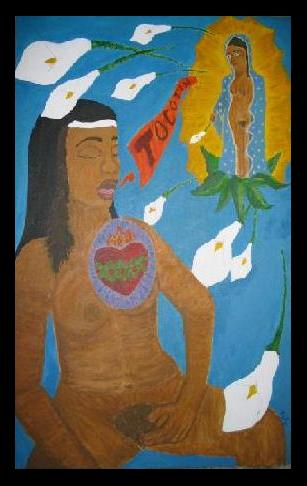
 My project, titled Lluvias Sagradas, aims to deconstruct taboos about masturbation, queerness, and spirituality through the multiple layers
of symbolism represented in this piece.
My project, titled Lluvias Sagradas, aims to deconstruct taboos about masturbation, queerness, and spirituality through the multiple layers
of symbolism represented in this piece.
My project, titled Lluvias Sagradas, aims to deconstruct taboos about masturbation, queerness, and spirituality through the multiple layers
of symbolism represented in this piece.
First, Sor Juana, through the act of masturbating, is ascending into the heavens to meet her lover, Tonantzin--or la Virgen--who is descending from the heavens on a maguey plant. La Virgen is in her robe, represented as a type of bathrobe which reveals her nudeness underneath. She is showering Sor Juana with white cala-lilies, usually symbolic of death but which I have reclaimed as a symbol of rebirth because through the act of masturbation Sor Juana is being reborn into a new spiritual being, all encompassing of love and sexual pleasure.
The showering of the cala-lilies is also a metaphor for the act of masturbation as Sor Juana is wet between her legs and will shower herself upon reaching an orgasm. Traditionally, a nun shows no skin except for that of her face. Sor Juana is not only showing her face, but also letting lose her hair as well as her public hair, vagina, and breasts. Sor Juana's nudeness represents her conformability with herself at all exposure; she wears only the head covering of her nun outfit as a reminder of her role within patriarchy, but more importantly because through this role, she has gotten closer to her lover, Guadalupe, and is in her own way defying patriarchy.
Sor Juana is also contesting hegemony because traditionally the Sacred Heart is associated with Jesus who is male and perceived as divine. Sor Juana, a living being and a woman, is neither male nor divine but has a sacred heart nonetheless. The fire on the sacred heart is also symbolic of the passion/heat between Sor Juana and la Virgen. Also, though the traditional sacred heart is surrounded by thorns, this one is surrounded by two serpents. These further represent women and are joined at the lips--alluding to the queerness of the two. The sacred heart is also surrounded by the color purple, yet another link to a queer identity. Finally, coming out of Sor Juana's mouth is the nahuatl symbol for speaking, hence her speaking to or singing of "Tocotin," a hymn to the Virgen. This is a final gesture of love and spirituality between Sor Juana and Tonantzin.
Overall, my project greatly relates to Chicana art and feminism because I, as a queer Chicana artist and feminist did this piece with these two issues in mind. In our class we discussed patriarchy, gender roles, Chicana icons, sexuality, sex, spirituality, and indigenism--all of which I have attempted to allude to in this piece. I was mostly influenced by one of my favorite Chicana artist and feminist, Alma Lopez, and her work with La Virgen and La Sirena. I wanted to use Lopez's ideas in a manner most relevant to myself.
Specifically, I feel Chicana art and even feminism have not fully explored masturbation. The tabooness around this theme was what most inspired me to reproduce this act on canvas and would really like to hear further dialogues on the subject. I see my piece as empowering because it makes the connections between spirituality, sexuality, love, and pleasure. I do not feel that my piece disrespects La Virgen, but instead, offers a more complex and multidimensional image of her. I also think spirituality is something that many queer Chicanas find useful and this piece was my way of exploring this for myself.