By ALLAN KOZINN

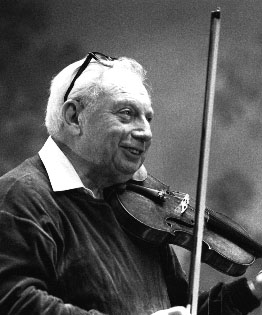
Isaac Stern, a violinist who in his prime was considered one of the great instrumentalists of the 20th century, and who also became an important power broker in the classical music world after he led a successful campaign to save Carnegie Hall from destruction, died at a Manhattan hospital yesterday. He was 81 and lived in Manhattan and Gaylordsville, Conn.
A spokeswoman for Carnegie Hall said he died from heart failure after an extended hospital stay.
The American classical music world has produced few images as characteristic as that of Mr. Stern, a violin in his hand and a pair of horn- rimmed eyeglasses perched atop his head. It was the image of a musician at work � typically rehearsing and persuading rather than performing, casual rather than formal, engaged rather than passive. Countless photographs and caricatures, and miles of film and videotape, captured Mr. Stern preparing for concerts, coaching young ensembles during his master classes, or proclaiming the glories of Carnegie Hall, of which he was president.
He was, in fact, nearly as well- known for his devotion to Carnegie Hall as for his violin playing. He gave more than 200 performances there, the first in 1943. When the hall was about to be demolished to make way for an office tower in 1960 � the prevailing wisdom was that Lincoln Center, then under construction, would replace Carnegie � Mr. Stern helped start a drive among musicians and the musical public that saved the hall. He was then elected president of the Carnegie Hall Corporation, which runs the hall.
In that capacity, he played a central role in the restoration of the building in 1986, and in the celebration of its centenary in 1991. In 1997, the main concert hall was named the Isaac Stern Auditorium in honor of his efforts.
Mr. Stern was neither a child prodigy nor a flashy virtuoso, but he built his reputation in the mid-1940's with a rich tone and emotional interpretive style. He was passionate about a range of works that began with Baroque sonatas and concertos, encompassed the full Romantic and early 20th century repertory, and included works composed with his warm, rounded sound in mind.
That sound was captured in a vast discography that documented the full scope of his repertory. It was also heard in movie theaters: In 1946, Mr. Stern played on the soundtrack of "Humoresque," and when John Garfield was shown performing, it was Mr. Stern's hands that were seen on the screen. He played the Belgian violin virtuoso Eug�ne Ysaye in the film "Tonight We Sing" in 1953, and in 1970 he played on the soundtrack for "Fiddler on the Roof." He was also the subject of several documentaries, including "From Mao to Mozart: Isaac Stern in China," which followed him on tour in 1979 and won an Academy Award for best full-length documentary in 1981.
In the early 1960's, when comparatively few soloists devoted time to chamber music, he teamed up with the pianist Eugene Istomin and the cellist Leonard Rose to perform and record as a trio. He later undertook partnerships with the flutist Jean-Pierre Rampal, the cellist Yo-Yo Ma, the pianist Emanuel Ax and several other musicians.
In his capacity not only as the president of Carnegie Hall, but also as an adviser to the powerful ICM Artists management agency, the chairman of the America-Israel Cultural Foundation and chairman and music adviser of the Jerusalem Music Center, he was able to encourage and open doors for young musicians he considered exceptionally talented. Mr. Ma, Mr. Ax, the violinists Itzhak Perlman, Pinchas Zukerman, Shlomo Mintz, Sergiu Luca, Joseph Swenson and Cho-Liang Lin and the pianist Yefim Bronfman were all given a crucial push by Mr. Stern early in their careers.
Inevitably, that ability to create opportunities caused bitterness among musicians who were unable to join his circle. But Mr. Stern took their criticism in stride.
"I didn't make power, I was granted power, as any person who is successful in public life is granted it," he told The New York Times Magazine in 1979. "What I am, I think, more than anything else, is a willing and capable catalyst."
`I Want to Play!'
Isaac Stern was born on July 21, 1920, in Kremenets in what is now Ukraine, but grew up in San Francisco, where his parents, Solomon and Clara Stern, settled in 1921. His mother had studied voice at the St. Petersburg Conservatory, and began teaching him the piano when he was 6 years old. He began to take violin lessons after hearing a friend who lived across the street playing the instrument.
He progressed quickly. After two years, with financial support from a wealthy patroness who heard him perform, he began studying at the San Francisco Conservatory, where his principal teacher was Naoum Blinder, the concertmaster of the San Francisco Symphony. He later studied briefly, in New York, with Louis Persinger, who had been Yehudi Menuhin's teacher, but always regarded Mr. Blinder as his principal influence, saying that what he admired in him was a teaching style that valued instinctive musicianship over scales and technical exercises.
In 1936, when he was 16, he made his debut with the San Francisco Symphony, collaborating with Mr. Blinder on the Bach Double Concerto under the baton of Pierre Monteux. A few months later he played the Tchaikovsky Concerto with Otto Klemperer and the Los Angeles Philharmonic. He made his New York debut with a recital at Town Hall in 1937. The reviews were respectful, and several described Mr. Stern as a promising newcomer who was likely to be heard from again. Olin Downes, writing in The New York Times, praised the "extent of his technique and his spirited, straightforward playing," but complained that "his bow presses too hard and vibrates the string too little," and that he was frequently strident in the upper registers.
"When the reviews came out I was in a state of shock," Mr. Stern told The Times in 1984. "I remember getting on one of those New York double-decker buses and riding around for five hours, thinking of my future. Should I take a safe job as a concertmaster of an orchestra? I had an offer. I didn't know what to do. Finally I said to myself, `Dammit, I want to play!' So I came back to New York the next year and got rave reviews, and maybe I didn't even play as well."
By 1939, the legendary impresario Sol Hurok was representing Mr. Stern who came to consider Mr. Hurok as a father figure. Within a decade, Mr. Hurok helped Mr. Stern become one of the busiest musicians of his day. In 1949, he played 120 concerts in a seven month tour of the United States, Europe and South America. Still, Mr. Hurok later said he wished he could curb Mr. Stern's desire to be constantly onstage, as well as his penchant for getting involved in causes of various kinds, musical and political.
"Stern is a man who cannot rest," Mr. Hurok told The New York Times in 1959. "I have begged him not to play so much. I tell him, `the less you play, the longer you will play.' It does no good. When he is not playing the violin he is on the telephone. I would like to abolish the telephone. It would add 10 years to his life."
Mr. Stern's association with Mr. Hurok, which lasted until the manager's death in 1974, was one of several long-lasting relationships that dated back to the early years of his career. In 1940, he began giving recitals with Alexander Zakin, who remained his regular accompanist in concert and on recordings until 1973. He made his first recordings for Columbia in 1945 � his debut was the Wieniawski Concerto No. 2 with the New York Philharmonic and Efrem Kurtz � and continued to recorded exclusively for that label in its various incarnations (as CBS Masterworks and Sony Classical) for the rest of his career.
In 1984, CBS Masterworks named Mr. Stern its first artist laureate, and kept much of his catalog consistently in print. Sony Classical celebrated his 50th anniversary with the label in 1995 by releasing a 44-CD collection of his recordings under the title "Isaac Stern: A Life in Music."
Mr. Stern's Carnegie Hall debut in 1943 was the start of his long love affair with that hall. And his New York Philharmonic debut in 1944 was the first of more than 100 performances with the orchestra. One particularly notable performance was a televised concert celebrating Mr. Stern's 60th birthday, in 1980. With Zubin Mehta conducting, Mr. Stern played a marathon program that included performances of double and triple concertos by Bach, Vivaldi and Mozart with Mr. Perlman and Mr. Zukerman, as well as the Brahms Violin Concerto.
By 1950, Mr. Stern had established himself as one of the best young violinists on the concert circuit, and the first American- trained violinist to gain so great a measure of international respect. He had, by then, performed with all the major American orchestras. During World War II, he performed for Allied troops in Greenland, Iceland and the South Pacific. He undertook a 10-week tour of Australia in 1947, and made his European debut at the Lucerne Festival the following year.
In 1948, Mr. Stern married Nora Kaye, a dancer. That marriage ended in divorce. So did his second marriage, to Vera Lindenblit, whom he married in 1951, and with whom he had three children, Shira, Michael and David. In 1996, Mr. Stern married Linda Reynolds, who survives him, as do his children and five grandchildren.
An Artist of the World
Mr. Stern was always outspoken about what he considered the necessary interchange between art and politics. In his earliest interviews, he argued that there should be a government department that supports the arts, and in the 1960's, he played an advisory role in the creation of the National Endowment for the Arts. When arts support was in danger of being cut in 1970, he appeared before Congress and told the legislatures that the United States ran the risk of becoming "an industrial complex without a soul."
He toured the Soviet Union with great fanfare in 1951 � the first American violinist to do so � but engaged Nikita Khrushchev in a debate about open artistic exchanges between the Soviet Union and the West. In 1967, Mr. Stern said that he would not tour the Soviet Union again until artists were allowed to come and go freely. He also boycotted a music festival in Athens in 1967, to protest the Greek military junta, and when the United Nations Educational Scientific and Cultural Organization suspended its programs in Israel in 1974, he organized a musicians' boycott of Unesco events.
He also avoided performing in Germany, declining invitations on the grounds that he did not feel right performing music in the country where the Holocaust was planned and executed. He partly relented in 1999. That April, he gave a nine-day series of master classes in Cologne. But he did not perform himself, and he made a point of encouraging the students to think not only about the technicalities of performing, but about an artist's responsibility "to continue the search for beauty and humanity."
"With my visit, I forgive nothing," he said, adding "but it isn't very human not to give people a chance to change."
Despite his own refusal to perform in Germany, he encouraged Mr. Perlman and Mr. Zukerman to perform there because he believed it was important for Israeli musicians to establish an artistic presence there. He devoted considerable effort, in fact, to helping Israel develop a cultural life. In 1964, he became chairman of the America- Israel Cultural Foundation, which supports young musicians in their studies and raises money for Israeli cultural organizations. He also founded the Jerusalem Music Center in 1973.
Mr. Stern performed in Israel regularly, and was often on hand at important moments in the country's history. His performance of the Mendelssohn Concerto with Leonard Bernstein and the Israel Philharmonic on Mount Scopus soon after the Six Day War, in 1967, was the focus of the film "Journey to Jerusalem." During the Yom Kippur War in 1973, he canceled several engagements and rushed to Israel to perform in hospitals, often at patients' bedsides, and for troops in the Negev, where he wove the melody of "Hatikva," the Israeli national anthem, into his performances of the Mendelssohn Concerto. And during the Gulf War, in 1991, when a missile attack interrupted one of his performances, he donned a gas mask and played a Bach unaccompanied Sarabande.
Rescuing Carnegie Hall
His other main passion was Carnegie Hall. When the hall was in danger of being torn down, he organized the Citizens' Committee to Save Carnegie Hall, along with a list of supporters that included Eleanor Roosevelt, Fritz Kreisler, Jascha Heifetz, Arthur Rubinstein, Dame Myra Hess, Van Cliburn, Leopold Stokowski, Marian Anderson, Fritz Reiner and many other musicians and philanthropists.
"Simply for reasons of sentiment and piety, it would be wanton to destroy it," he said of Carnegie Hall at the time. "Think of Tchaikovsky conducting there at the opening, in 1891! Think of Paderewski and Chaliapin! But there are practical reasons, too, for not destroying it. The young people of this country are demanding more and more music and producing more and more first- rate musicians. How dare we take away from them, the music, and the audiences of the future, one of the great music rooms of the world?"
Mr. Stern's efforts led to legislation that allowed the New York City to buy the hall for $5 million, and when the Carnegie Hall Corporation was established to administer it, Mr. Stern was elected its first president, a position he held until his death..
At the time of the Carnegie Hall battle, Mr. Stern was 40 years old and at the height of his powers. Harold C. Schonberg, reviewing one of his performances in The New York Times in 1962 put his artistry in perspective.
"Mr. Stern's playing," Mr. Schonberg wrote, "is a perfect illustration of the fact that a big tone can be delicately and even vigorously colored without recourse to a heavy vibrato. There are also a few other features of his playing that differ from the masters of yore. His rhythm is unflagging and his tempos on the fast side. He is not a musician who dawdles over a phrase; there are no intermissions, no time out during a piece for a meditative dissertation on the beauties of a specific passage. And by holding to a clean musical line, Mr. Stern makes his interpretations that much more beautiful."
During the 1960's, Mr. Stern made chamber music a central component of his repertory. The Istomin-Stern-Rose Trio made its debut in Israel in 1961 and its first New York performances the following year. The group made classic recordings of the centerpieces of the trio repertory, including all the Beethoven, Schubert and Mendelssohn Trios. After Rose died in 1984, Mr. Stern formed a new trio with Mr. Ax and Mr. Ma, with the violinist Jaime Laredo sometimes rounding out the ensemble.
Mr. Stern's other collaborations include appearances with Benny Goodman and his sextet in 1963, frequent performances and recordings with Mr. Rampal, and occasional collaborations, some also recorded, with the pianists Daniel Barenboim, Peter Serkin, Joseph Kalichstein and Mr. Bronfman; the violinists David Oistrakh, Midori, Mr. Lin, Mr. Zukerman and Mr. Perlman; the violist Michael Tree and the cellists Pablo Casals, Sharon Robinson, Matt Haimovitz and Peter Wiley.
eaching and Music-Making
He was also an engaging teacher, and in recent years he gave a regular series of master classes and workshops for young chamber ensembles at Carnegie Hall.
"You cannot force someone to think as you do, or to feel as you do," he said of his teaching in 1995. "But you can teach them to think a little better, to think a little more. To listen a little more critically. To listen to what they're really doing, not what they think they're doing. To have more respect for the necessary lengthy internal and external collusion between the performer and the composer."
Mr. Stern was also more devoted to contemporary works than many soloists of his stature. He included the Bartok, Prokofiev, Berg and Barber concertos in his repertory long before they were commonly played. He never commissioned new works, explaining that he did not want to be obligated to play the pieces if they turned out badly, and that he was more interested in whether he liked a work than in giving its first performance. Still, several works were commissioned by orchestras and other organizations on his behalf, including concertos by Krzyzstof Penderecki, Henri Dutilleux, George Rochberg and Peter Maxwell Davies.
Mr. Stern gave the world premieres of those works, as well as Mr. Bernstein's "Serenade" and William Schuman's Violin Concerto, and he recorded all but the Schuman. He also gave the American premieres of the Bartok Concerto No. 1 and the Hindemith Concerto, and made the first recordings of both. And he collaborated with Copland and Stravinsky on recordings of their violin works.
There were times, in the last decades of his career, when Mr. Stern's concert performances were less consistently polished than they had been, and suggested that he was devoting greater attention to his other preoccupations � running Carnegie Hall, campaigning for increased government support for the arts and education, and seeking out new talent to lend his support to � than to practicing. When critics addressed these questions, Mr. Stern responded testily. "Whether I'm capable of the same uncaring, unworried pyrotechnics of 30 years ago doesn't make any difference," he said. "What has happened is that my music-making has deepened, and that cannot be touched."
Nevertheless, he cut back substantially on his performances in the 1990's, and when he did perform, it was more often than not in chamber music rather than as a soloist. He published an autobiography, "My First 79 Years," written with the novelist Chaim Potok, in 1999, and in September 2000, Carnegie Hall honored him with a weekend-long celebration of his 80th birthday that included an exhibition of materials from his personal archives, screenings of documentaries about him, a day of chamber music and educational concerts, and a birthday concert at which more than a dozen of his colleagues and prot�g�s performed.
Mr. Stern received many honors and awards, including the first Albert Schweitzer Award (1974), the Kennedy Center Honors Award (1984), a Lifetime Achievement Grammy (1987) and an Emmy for Outstanding Individual Classical Music Performance (1987). He received the Commander's Cross of the Order of the Dannebrog, from Denmark (1985), the Wolf Prize, from Israel (1987) and was made a Commandeur of the French Legion d'Honneur (1990).
"I have been very fortunate in 60 years of performance," he said in 1995, "to have learned what it means to be an eternal student, an eternal optimist � because you hope the next time will always be a little better � and eternally in love with music. Also, as I said to a young player the other day, you have no idea of what you don't know. Now it's time that you begin to learn. And you should get up every morning and say thank God, thank the Lord, thank whomever you want, thank you, thank you, for making me a musician."
Copyright 2001 The New York Times Company
NEW YORK (AP) -- Tchaikovsky. Dvorak. Mahler. Gershwin. Horowitz. Bernstein. Marian Anderson. Bennie Goodman. Judy Garland. These are only some of the musical geniuses who have performed at Carnegie Hall.
Then there was Isaac Stern, the fiddler who saved it from the demolition crews. But his legacy extends far beyond.
Stern, who died Saturday at age 81 of complications from heart surgery, was one of the foremost violinists of the 20th century.
He was among the most recorded classical musicians in history, making well over 100 recordings, including some that are considered THE definitive interpretations.
He had a knack for discovering and cultivating the talents of succeeding generations. Among them: the violinists Itzhak Perlman and Pinchas Zukerman and cellist Yo-Yo Ma.
And he had the astuteness, commitment and gift of gab to raise millions of dollars for the many causes he deemed worthy.
"He would get on the elevator, and between my floor and the street floor, he'd get me to agree to do two benefits and make donations to charities," soprano Beverly Sills told The Associated Press on Sunday as she recalled neighbor.
"It's such a major loss to the musical world because he was larger than life," said pianist Joseph Kalichstein, who performed with Stern last May in Japan in one of the violinist's last concerts.
"He dared to think big and challenged us to soar -- to dream the impossible, take risks, embrace new ideas and to enjoy our success," said Sanford I. Weill, chairman of Citigroup Inc. and of Carnegie Hall's board, in a statement.
Ma recalled that it was Stern who introduced the then-9-year-old cellist to his teacher, Leonard Rose, some four decades ago.
"He had an incredible impact on impressionable young musicians, ... just to be able to listen to his accumulated wisdom on life," Ma told the AP on Sunday in a telephone conversation from Boston. "He had such an incredible love for life. ... It's such a joy to remember the way he would make music, with such love, with such passion."
Born July 21, 1920, in the fledgling Soviet Union, Stern and his parents moved to San Francisco when he was 10 months old.
Believing that music was an essential ingredient to education, they started him on the piano when he was 6. Two years later, he picked up the violin, inspired by a friend's fiddling.
At 16, Stern attracted his first national attention, performing the Brahms Violin Concerto with Pierre Monteux conducting the San Francisco Symphony in a nationally broadcast radio concert.
The following year, he made his New York debut at Town Hall to mixed reviews. Afterward, Stern recalled in his memoir "My First 79 Years," he rode a bus to nowhere for six hours. "I had hoped that my Town Hall debut would be the moment of breakthrough," he said. "Instead, the New York critics were telling me to go home and practice some more. ... And, riding that bus, I was asking myself repeatedly: Should I keep on trying?"
He decided to practice.
Six years later, on Jan. 8, 1943, he made his Carnegie Hall debut in a recital produced by the impresario Sol Hurok. "I played almost defiantly, to demonstrate my skills, to show them all what I was capable of doing with the fiddle," Stern recalled.
The performance attracted the attention of composer-critic Virgil Thomson, who in the New York Herald Tribune proclaimed him "one of the world's master fiddle players."
He later played in countless places around the world: Iceland, Greenland and the South Pacific for Allied troops during World War II; Moscow after Stalin's death; Jerusalem's Mount Scopus immediately after Israeli soldiers recaptured it in 1967.
During the 1991 Gulf War, a concert in Jerusalem was interrupted by a siren warning of an Iraqi Scud missile attack. After the audience put on gas masks, Stern returned to the stage and played the Sarabande from Bach's D minor Partita for solo violin.
Because of the Holocaust, he boycotted Germany until 1999, when he decided to go there to teach but not perform. He said he felt the need to hear young German musicians and pass along lessons about music -- and humanity.
"It isn't very human not to give people a chance to change," he said. "I want to teach them that they, as musicians, must live and play at the same time. ... Our responsibility is to continue the search for beauty and humanity. That is what survives."
In the late 1950s, as New York City was planning Lincoln Center, a developer proposed razing Carnegie Hall, renowned for its fabled acoustics. Stern mobilized his fellow artists and benefactors, eventually securing legislation that enabled the city to acquire the building in 1960 for $5 million.
"I talked a lot," Stern said in a 1997 interview with CNN's Larry King. "It's something I do very well. When you believe in something, you can move mountains."
"To me, Carnegie Hall is nothing less than an affirmation of the human spirit," Stern once said. "That, I think, is why it is necessary. Because Carnegie Hall is not just a building, it is a centrality of ideas, of imaginative experiments, of some failures and vaulting successes -- but most of all it is a place of people, of human beings. Carnegie Hall is the 'house that music built.' It is the ultimate symbol of the highest human achievement: great artistry."
Survivors include his wife, Linda Reynolds Stern, whom he married in 1996; three children from a previous marriage: daughter Shira, a rabbi, and sons Michael and David, both conductors; and five grandchildren.

 Get your own Free Home Page