Milled Fabric - used for traditional Austrian fashion
The raw material for milled fabric is pure wool. Even our Stone Age predecessors used animal hides and hair to clothe themselves. Finds from the early Germanic Bronze Age and literature show that all Indo-Germanic peoples used sheep
´s wool mixed with cow or deer hair, as a basic material for clothing. Man spun wool as early as the Neolithic age and in ancient Egypt. In our latitudes, the spinning of woolthreads was made easier first by the invention of the hand spinning-wheel in the 13th century, and later by the invention of the pedal-driven spinning-wheel around 1600. The major breakthrough did not come, however, until the 18th century, when machine spinning was introduced at the beginning of the industrial revolution.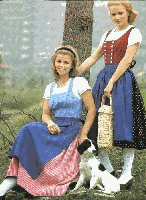
Under normal circumstances, milling is a most unwelcome process - no housewife would like to take out the washing and suddenly discover that it is milled or, by another name, felted. Heat, mechanical processes and water make the knit fabric shrink to approx. two thirds of its original size. The heat opens up the fine scaly layer of wool, and the woolly fibres hook into each other. The result is a fabric that retains the natural properties of shorn wool, but it is more dense and hard-wearing than the original knit fabric
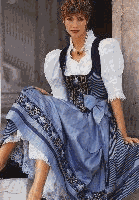
In the northern hemisphere, pestles seem to have been used for a long time to crush textiles in a mortar. Today's milling process was probably an accidental invention - our ancestors would have recognised at some stage that a shrunken and felted fabric can still be used and is in fact extremely resistant to the weather and of good quality. And then they would have wanted to use these positive properties in a controlled manner. The first milled fabric to have been produced intentionally was crushed in warm water - by trampling or in a mortar - and treated with urine and sheep's droppings or with peaty soil and fuller's earth. In due course, this type of milling made way to fulling in mills (pestle or hammer milling). French and German documents from the 12th and 13th centuries bear witness to this development. Medieval fulling mills were usually powered by a water wheel connected to a shaft, which again drove one or several pestles. The lower part, planks overlapping in a roof tile pattern, crushed the fabric which lay in a wooden trough (milling trough or milling stock). It took approx. 15 to 18 hours to produce the milled fabric which, in the process, shrank by about 20 to 50% across and 30% along. In 1831, Bouret from England is said to have designed the crank or hammer milling machine, and soon after, Dyer - also from England - commissioned his roller or cylinder milling machine.
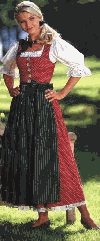
Since 1883, the milling process has come a long way. Today, large washing machines make the process easier. Knit fabric is washed in an overdimensioned washing machine and shrinks through the combined effect of water, heat and, most importantly, the mechanical spinning movement. The heat causes the scaly layer of wool to open, and tiny wool hairs hook into each other as a result of the tumbling movement in the machine, thereby producing the typical milled structure. With the exception of a minor addition of laundry soap to remove spinning oils, the
GIESSWEIN company now uses only pure water at a temperature of approx. 30 degree centigrade. After milling, the fabric needs to be dried and ironed. Depending on the textile type, the fabric may subsequently be vapour-steamed. Finally, the finished fabric is rolled on tables and awaits any further milling reactions.Milled products are in higher demand than ever before. Apart from the quality and fashionability, fans of milled fabric appreciate the traditional properties of the textile: made of pure shorn wool, milled fabric preserves the natural qualities of wool and has a high ecological value. Wool protects the wearer from wind, low temperatures and water. Depending on the ambient temperature, milled fabric may have a heating or cooling effect, and it is always water-repellent. In contrast to unmilled wool, milled cloth stretches to a certain extent and is therefore comfortable to wear. Hard-wearing, antisoiling, easy to clean, stable to light and water, naturally dropping and comfortable to the touch, milled fabric can be used in any situation, offering fun and mobility at work and in your free time.