
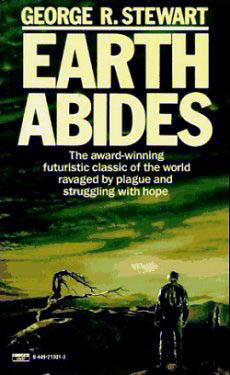
First off, this book was written in 1949 ! Anyone would figure this out after reading the first few chapters because, well, it does not have that mushy 'correctness' tone so prevalent in our time.
The main character's name is Isherwood Williams. Most of the book reads as though we were reading his journal. He is not the last man on earth, he does find other survivors early on. They form a 'tribe' as he calls them. Ish, being the most intellectual of the group, is constantly worrying about how or even if the tribe will restore civilization.
This is where I take some points away. I was not expecting lasers or aliens. This is not what this book is about. It is way more down to earth, which is fine. In fact, the small scattered paragraphs about what would / is happening to the earth itself after the fall of civilization, is what I found most interesting. If the author was going to keep it at ground level, lets have some more depth in the characters and life situations.
I enjoy post-apocalyptic stories and movies. This story started off well enough, but by the end I started to lose interest. Don't get me wrong, it is a good book, but I'm sure you can suggest a better one.
Some good lines from the book:
'he treasured the honesty of his own skepticism'
'genius is the capacity for seeing what is not there'
....this of course includes the madman

Q: What do you think would happen if the ancestors of the Incas had lived in Spain, and the ancesotors of the Spanish had lived in South America ? Would the Incas have gained the necessary tools to sail across the Atlantic and conquer the Spanish ?
Diamond would quickly answer 'yes' and in his book, he fleshes out his argument. His reasoning follows that the ultimate factor for some peoples to be more advanced than others is based upon their environment - specifically geography.
I have always slightly favored genetics over environment, and that is one of the reasons why I chose to read this book. I knew going into it, that I would be presented with a good case for the other side of the argument. Although I am not wholly convinced, Diamond does a good job to support his theory.
It is a good read, and I have learned much about peoples and countries barely mentioned in any of my college courses. Most interesting was the first-hand historical account of the Spanish army in the land of the Incas.
How do you feel about Diamond's claim that geography is the ultimate factor in determining the advancement of a people ?
What about individuals themselves and their culture / beliefs / religion ? How much of an impact did or will they have on a people's history ?
3 things I'd like to mention:
1. If science proves one race is inherently more intelligent than the rest, so what. Should everyone else just hand over the world to them ? Do they get bragging rights ? and if they so brag, what does that say about them ? Besides, it would not mean that every single person belonging to that race is intelligent.
2. I still believe that genetics determine a person's capacity for learning. What each person does with their abilities is another story. At some point race / culture / environment will have an impact.
3. History shows that this world is a tough place to try to live in. Don't let anything limit you,, but be thankful for what you have.


