
It Could Happen Here
Catastrophic hurricanes like Katrina could devastate Long Island--and the government's incompetence is purely to blame
The awful scenario
The streets of downtown Manhattan are submerged under several feet of water. Canal Street truly lives up to its name as rescuers plow through on boats, attempting to rescue victims trapped in apartment buildings. Below ground, the subway tunnels are filled with seawater that has poured in, as are the Holland and Brooklyn-Battery tunnels. An American icon, Coney Island, now resembles an American Venice. Debris, trash, and even corpses float aimlessly in the polluted, sewage-contaminated floodwaters. The stench is overwhelming. Seeking higher ground, the locals are crowding onto building roofs as well as parks in Brooklyn and upper Manhattan. All over the flooded city, thousands of shell-shocked victims cry out vainly for assistance. And help from afar is hard to come by, as Kennedy, La Guardia, and Islip-MacArthur airports are all submerged under water.
Surely this evokes grisly scenes from devastated New Orleans, but this is the likely result of a Category 3 or 4 hurricane like Katrina striking New York City. A storm surge prediction program called SLOSH gives us this most unsettling forecast.
Meanwhile, here on Long Island such a storm would be every bit as brutal and merciless. Experts at SUNY Suffolk and SUNY Stony Brook warn that even a small Category 1 hurricane would flood large areas of the south shore as well as the north and south forks. Further research warns that a hurricane of Katrina�s strength would cause storm surges averaging 12 to 25 feet along the south shore as well as inundate Montauk Highway, rendering it impassable and areas eastward, unreachable. Power lines would be torn down by the fierce howling winds, water and sewage systems would fail, and basements would become pools. Escape by water or air would prove extremely difficult on account of the high winds and churning seas causing bridge, ferry, and airport shutdowns. In the worst-case scenario, a ferocious Category 3 or 4 hurricane could inundate entire towns on the south shore, the barrier islands, and points east, from Freeport to Montauk and everything in between.
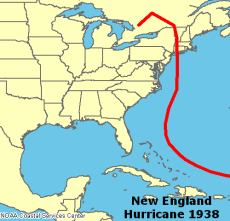 |
| The path of the 1938 hurricane called "The Long Island Express." It ripped through Long Island on a northward path, causing damage as far north as Canada.
image: www.nhc.noaa.gov |
Think it can�t happen here? Think again. Four Katrina-strength hurricanes have attacked the area in the past two centuries. The most recent of these struck in 1938. The legendary "Long Island Express" ripped through the island with record-breaking winds of over 180 mph. Titanic waves of 30 to 50 feet punished coastal towns and homes. The storm claimed over 50 lives on the island, and the economic damage was immense. Crops were ruined, farms decimated, homes leveled. TIME magazine reports that the damage, in 1998 dollars, would place the storm as the sixth costliest storm of all time. Finally, the storm literally changed the face of Long Island; it created 12 new inlets including the Shinnecock Inlet, and this altered erosion patterns that threaten beaches and coastal homes to this day.
Long Island was dominated by rural farms at the time. Now, with over 3 million people living in Nassau and Suffolk countries alone, the economic and human cost of a Katrina-strength hurricane would dwarf that of New Orleans. Most Long Islanders don't think much of these fierce storms because they are so uncommon in this region. However, the National Center for Atmospheric Research warns that more hurricanes will attack the eastern US coasts in coming years; some scientists suggest that global warming has made recent storms stronger and more frequent. It would be foolish to assume "it can't happen here," even a vicious storm like the one that devastated the Gulf Coast.
The blunt truth is that Long Island is not prepared for such a hurricane, either physically or psychologically. And if the response to a future hurricane is anything like that which New Orleans has been treated to, Long Islanders are in serious trouble.
The government�s slow response
Observers of Katrina's wrath and her aftermath have made much ado about the horrendous damage, the lack of preparation, the difficulty of evacuation, and the slow response by the state and federal governments. Although survivors and authorities are doing the best they can with limited resources, the consensus is that more could�ve been done to address the situation. A brief look at the government�s actions before and after Katrina�s attack reveals its incompetence in the face of disaster.
It took four days for the National Guard to respond in force after the hurricane hit the city; some members of the local police force abandoned their jobs in the aftermath too. The immediate result was a lack of resources and manpower to rescue survivors trapped in the festering floodwaters. Martial law meant that people housed in the city�s Superdome were forbidden by authorities to cross a nearby bridge and evacuate on their own accord. Meanwhile, the USS Bataan was docked near the city, and it was prepared to send in rescue helicopters and offer victims its hospital beds, doctors, food, and water supplies. It needed a Presidential authorization to come in though. It didn�t receive it until days after the hurricane landed.
The Mirror of Britain reports that 400,000 NATO-approved ration packs donated by Britain--the same food that British soldiers eat--are being hoarded in warehouses and may be destroyed. The FDA declared them "unfit for human consumption" because the rations did not meet certain outdated meat importation standards. Food from Spain, Italy, and Israel met the same fate. Meanwhile, victims are still going hungry.
Meanwhile, the Federal Emergency Management agency (FEMA) routinely blocked relief efforts in the region by other parties: it prevented the Coast Guard from delivering diesel fuel; a 600-bed Navy hospital was left unused; and firefighters were forbidden to enter flooded areas. It also spurned relief efforts from individuals and private companies: the agency turned away Wal-Mart trucks containing desperately needed supplies; donated generators were refused; and a local airboat club in Florida prepared to go to the afflicted areas with food, water, fuel, and supplies for the victims, but FEMA bureaucrats told them not to go.
All of this might be partly explained by the fact that the former head of FEMA, Michael D. Brown, had no disaster management experience whatsoever.
To make matters worse, the federal government's intense focus on the statistically low threat of terrorism means that states have fewer resources for ongoing emergencies posed by earthquakes, blizzards, tornadoes, and hurricanes such as Katrina. The National Emergency Management Association recently released a report pointing out that, as of last year, the average budget for a state-level emergency management agency was $40 million, nearly a quarter less than the year before.
On top of that, the feds have been busy cutting funding for hurricane preparedness measures in the region. In 2003 Congress voted to cut the FEMA�s funding by half, impacting mitigation programs meant to assist with local recovery efforts. The President was also very stingy with funds for emergency hurricane preparedness in Louisiana; his budget authorized about $10 million, a mere sixth of what local officials say they need. And next year, The Army Corps of Engineers' funding will be cut from $4.6 billion to $4 billion as provided by the President's budget proposal.
Al Naomi, who manages the Corps� New Orleans district, says, "I've been here over 30 years and I've never seen this level of reduction."
New Orleans mayor Ray Nagin complained, "We authorized $8 billion to go to Iraq lickety-quick. After 9/11, we gave the president unprecedented powers lickety-quick to take care of New York and other places. Now, you mean to tell me that a place where…you probably have thousands of people that have died and thousands more that are dying every day, that we can't figure out a way to authorize the resources that we need? Come on, man."
Mishaps along the Mississippi
But aside from FEMA cuts and budget shortfalls, there are also less obvious threats posed by the Army Corps of Engineers' flood control strategy and local building regulations.
The Army Corps of Engineers is responsible for flood control along the Mississippi River. Its strategy since the Reconstruction era has traditionally focused on the use of levees to hold back the mighty waters. But this approach may cause more problems than it solves. A 1994 study on levees asserts that they tend to interrupt the natural ebb and flow of the river, threatening communities upstream with water backups. Think of pouring a lot of water into a small funnel all at once. In addition, using levees alone causes sediment to accumulate on the river bottom, and the result is that the water level increases and levees must be built ever higher�there are stretches of the river that are actually above ground level due to levee over-construction. Both these factors contribute to more dangerous flooding.
In contrast, economist Mark Thornton writes, "Engineering science, common experience, and economics all point to a strategy that combines levees with outlets and reservoirs to handle floods and other engineering techniques like cutoffs and jetties to straighten the river and increase the river's flow, sediment capacity, and bottom-scouring ability. Civil engineers…understood this strategy." Countries such as the Netherlands and Belgium employ this very strategy, in contrast to the US. Thornton continues, "But the [US] government's military engineers relied solely on levees even though their own data and studies contradicted this approach. The result was both costly and dangerous."
And when the Mississippi River experiences great floods like the one in 1993, the effects are worsened by the government-coordinated prevention measures. The National Research Council reports that "Levee failures have been responsible for roughly one-third of all flood disasters in the United States." The flooding in New Orleans during Katrina�s aftermath and Rita�s recent passing is a poignant reminder of that fact. These were supposedly built to withstand a strong hurricane, but Mayor Nagin asserts that the levees suffered from poor maintenance and supervision.
Lax building regulations exacerbate the government�s lackluster flood control strategy. Areas bordering the Mississippi River have enacted standards to prevent over-development on the floodplain, and they tend to be strict. But Missouri prohibits individual counties from setting standards stricter than the state level. Not only does this prohibit local riverside communities from having flexibility in managing their own affairs, it also encourages development in an area prone to flooding. Overall, it is yet another example of government incompetence in the face of Mother Nature�s power. Add to this the aforementioned cuts to emergency management agencies and you have a recipe for disaster.
Long Islanders need alternative solutions
It is time to ask some challenging questions and face some uncomfortable facts. The media constantly describes the situation in New Orleans as "anarchy." Yet the problems in the areas affected by Katrina stem from failures on the part of big government, not a total lack thereof. The real tragedy is that people relied too much on the hope that the government would step in to solve their woes--after all, the government holds a virtual monopoly on infrastructure, emergency services, and law enforcement. As we have seen, the government failed miserably. This fact is to blame for the humanitarian crisis. Given this, Long Islanders ought to consider alternative solutions to its own hurricane threat.
|
The Long Island Express: Quick Facts
*reached landfall September 1938, at Southhampton *record 180 mph winds caused by hurricane's rapid northern movement amplifying winds *50 killed on Long Island; total of 700 deaths throughout Northeast *6th costliest storm of all time *destroyed apple & potato crop *created Moriches and Shinnecock Inlets |
There is nothing that can prevent a hurricane from landing, but large-scale damage from storm surges can be avoided through the use of levees or seawalls. South shore communities could hire private contractors to build seawalls or levees in order to guard the most vulnerable areas�or better yet, seek help from humanitarian groups such as the Red Cross. Compared to FEMA and the Army Corps of Engineers� mishandling of the situation at the Gulf coast, the Red Cross has a better success rate. For example, in Vietnam, the Red Cross fashioned an improved system of seawalls with a creative local solution--planting mangrove trees by the existing dikes to hold the earth in place during a surge. When a powerful typhoon hit Vietnam in 2000, the areas protected by these reinforced seawalls suffered no deaths, and the seawalls themselves survived the force of the storm fully intact. The question for Long Islanders is whether or not it would be economically feasible (or practical) to erect seawalls along the south shore.
Researchers at the Stony Brook Storm Surge Group also suggest that by constructing three large storm surge barriers at the entrances to New York Harbor, lower Manhattan as well as low-lying areas of Kings and Queens counties, could be protected against the worst flooding during a hurricane or nor�easter.
Whatever the case, Long Island communities clearly need to develop evacuation strategies too. In the event of a powerful hurricane, all routes from the island will be cut off. Bridges, tunnels, and ferries to Manhattan and the mainland would be closed due to the high winds, Kennedy, LaGuardia, and Islip-MacArthur airports would be shut down, and the Meadowbrook and Belt Parkways, as well as the Southern State, Montauk, and Sunrise Highways could also experience some flooding. As mentioned before, parts of the south fork would be cut off from the mainland due to flooding. How would Long Islanders escape to safety?
Once again, we find answers in Vietnam. The Vietnamese government set up 900 �flood kindergartens� where parents would place their children under the supervision of others. These dramatically decreased the number of children lost in floods; in 2002, the number was half that of 2001, and one-third the number in 2000. Countless numbers of people, including children, have been killed or hurt in the New Orleans floods because they could not evacuate in time. To protect children, the elderly, and the infirm, Long Island communities could replicate these �flood kindergartens� using private day care centers, community centers, churches or schools on higher ground in the middle of the island. There also exists an inland evacuation center near Nassau Coliseum.
 |
| Long Island communities need to devise evacuation strategies; some local highways will experience flooding, while others will be plagued with gridlock.
image: www.fiber-optics.info |
On top of that, communities can work with bus and taxi companies to set up evacuation projects in case of a drastic emergency, for the benefit of those who do not own cars. The key thing would be to get people away from the low lying and flood-prone south shore and onto higher ground towards the north shore until the hurricane passes and the floodwaters recede. The flooding would not be as bad as New Orleans because our island slopes toward the sea, but nonetheless communities need to figure out contingency plans in the event of hurricane flooding. These plans have to account for the fact that once a hurricane passes the Carolinas, its course becomes hard to predict, and Long Island would have little notice before a particularly ferocious storm hits. A warning system combined with a sophisticated evacuation plan is a must.
This is by no means an exhaustive list of suggestions. Long Island communities must begin a dialogue to come up with creative ways to prepare for a potential Katrina-strength hurricane drawing upon other locales� experiences and anticipate our unique needs, rather than sitting around waiting for state and federal governments to step in to lend a hand.
Local authorities need to work with their communities and the private sector to create strategies to evacuate towns, provide security patrols to prevent crime, rescue and aid victims who cannot escape, and help humanitarian agencies like the Red Cross provide help to Long Islanders. And private companies and NGOs (non-governmental organizations) can find ways to better coordinate with Long Island communities for projects like seawalls and relief efforts.
Conclusion
Local communities, as well as private firms and developers, understand their own needs better than any government bureaucracy; therefore they are better equipped to respond efficiently to disasters such as hurricanes. In the case of Katrina it was the private sector that pulled through every time: intervention by the Red Cross and other humanitarian agencies; countless community food drives; donations of money from people all over the country (over $600 million as of this writing); families opening up their homes to victims made homeless by the floods, a non-profit hospital that struggled to remain functional despite a lack of supplies; businesses chartering buses to deliver victims from the flooded hellhole; ordinary people coming in to help any way they can. Also, SUNY Stony Brook is offering New York students attending Tulane University in New Orleans, as well as other universities in the afflicted areas, places as transfer students for the fall semester.
Yet the majority of the public will clamor for the federal government to take greater action and spend more money and manpower, despite its clear incompetence in handling these situations and its inability (or as some put it, unwillingness) to invest in greater preparedness measures. In fact, Congress approved $52 billion for disaster relief, most of which was awarded to FEMA, the very agency which failed so miserably in its relief efforts. Officials of all stripes--even the President himself--freely admit that their response was severely lacking, and their utter failure to act accordingly is understood no better than by the victims across the Gulf region.
It is imperative that this situation does not repeat itself here on Long Island, should a disaster on the scale of Katrina ever strike here. We must find ways to take matters into our own hands.
Author's Note: An abridged version of this article was printed in Issue 2 of the Suffolk Standard, October 2005. You are currently reading the full, original version.