(Oh Messiah! pray to God for our safety from the epidemic)." (page
8, The Badr, 10th May 1906)
(Oh Messiah! pray to God for our safety from the epidemic)." (page
8, The Badr, 10th May 1906)Refutation of Maulvi Muhammad Ali's Account of Ahmadiyya Dissensions
After dealing with the alleged resemblance between my Jamaat and the
followers of Jesus, Maulvi Muhammad Ali proceeds to describe the history
of dissensions in the Ahmadiyya Movement, and endeavours to show how after
the death of the Promised Messiah a certain conjunction of circumstances
gradually led the present writer to introduce changes in my former beliefs.
These changes, according to Maulvi Muhammad Ali, relate to three matters; (1) that I propagated the belief that Hazrat Mirza Ghulam Ahmad was actually a Nabi; (2) the belief that he was 'the Ahmad' spoken of in the prophecy of Jesus referred to in the Holy Quran in 61 : 6; and (3) the belief that all those so-called Muslims who have not entered into his Bai'at formally, wherever they may be, are Kafirs and outside the pale of Islam, even though they may not have heard the name of the Promised Messiah.
That these beliefs have my full concurrence, I readily admit. What I deny is the statement that I have been entertaining these views since 1914 or only three or four years before. On the contrary, as I shall presently show, the first and the last of these beliefs were entertained by me even during the lifetime of the Promised Messiah, while the second belief developed soon after the death of the Promised Messiah as a result of the teachings I received from Hazrat Khalifatul-Massih I, and of the various discourses I had with him on the subject.
I shall speak first of the question of prophethood. My arguments on the subject will be stated at length in their appropriate place later on. For the present I only deem it necessary to state in brief that, in my opinion, the fact that the Holy Prophet Muhammad (peace and blessings of God be on him), who was the most truthful of all men and the most jealous guardian of the honour of Islam, repeatedly gave the name of Nabi to the Messiah that was to come, is ample evidence of the fact that the expected Messiah was to be actually a Nabi. But since it has been claimed by the Holy Quran that its teachings are for all countries and for all ages, it follows that no new prophet could be expected who may bring a new Law. The saying of the Holy Prophet with reference to himself "Ana Akhirul Anbiyai" (I am the last of the prophets) goes also to prove the same thing, viz., that after the Holy Prophet no other prophet is to appear who should attain the rank of prophethood except through obedience to him. In other words, whoever should after the Holy Prophet attain the rank of Nabi, must be one from among the followers of the Holy Prophet and must achieve the rank through the spiritual grace of the Holy Prophet.
Ragarding the prophecy Ismuhu Ahmad contained in the Holy Quran (61 : 6), my opinion is that the passage contains a double prophecy, relating to two persons, one a counter-type and the other his prototype. The counter-type of course is the Promised Messiah, while the prototype is the Holy Prophet. The passage under reference speaks directly about the counter-type. A reference to the prototype of course comes in, but only indirectly in as much as the counter-type of a prophet necessarily presumes the existence of his original. Thus the verse does furnish a prophecy regarding the original prophet from whom the immediate subject of the prophecy derived his dignity. The prophethood of the Holy Prophet was not a derived one. He was an original prophet who was not indebted to any human teacher for the grace of prophethood, but was himself a dispenser of grace to others. To consider him as a recipient of spiritual grace from any human teacher is in my view a detraction from his proper dignity. For these reasons and on certain other grounds, I hold the opinion that the subject of this prophecy is primarily the Promised Messiah who is the reflex of the Holy Prophet and the counter-type of Jesus Christ. But the whole question is one regarding which no decision on the basis of revealed authority has been left by any of the prophets. Any discussion of the question therefore has little more than mere academic interest. If any person holds a different view regarding the interpretation of the verse, all that I shall say is that he is mistaken, but I shall deem him, on that account, any the less an Ahmadi, and much less shall I deem him a sinner. In short, the question as to who is the proper subject of this Quranic prophecy is not at all of such moment as to make it a problem of any great religious importance.
As for the question of Kufr (unbelief) of non-Ahmadi Muslims, my belief is that Kufr really arises from a denial of God. Hence, whenever there comes any revelation from God of such a nature that its acceptence is obligatory on every man, a rejection of the same leads to Kufr. Belief in such a revelation, however, presupposes belief in the bearer of the revelation. Hence it follows that a belief in the bearer of such revelation is a necessary part of one's faith. The man who rejects a prophet thus necessarily becomes a Kafir, not because he denies the truth of any particular prophet X or Y, but such denial will necessarily lead him to reject a revelation of God. To me, the Kufr which arises from the denial of any Nabi has its basis in this principle and not in any personal quality of the Nabi. And in as much as the revelation of which the acceptence is obligatory on mankind comes only through prophets, it is the rejection of such recipients of divine revelation and not of others that leads to unbelief. Now, as we hold that the revelation which came to the Promised Messiah are such that their acceptence is obligatory on mankind in general, to us, the man who rejects the Promised Messiah is a Kafir agreeably to the teachings of the Holy Quran, although he may well be a believer in all the other truths of religion because presence even the one of the necessary conditions of Kufr is sufficient to make a man Kafir. I may however add that in my opinion Kufr arises from a denial of one or more of the fundamental articles of religion, not because such a denial makes a man the object of unending punishment, but because the denial makes him guilty of rebellion against God and leads to the extinction of his spiritual life. Now, as Islam bases its judgement upon what is patent and not upon what is possible, it cannot but class as Kafirs such as fail to accept any of the prophets, even though such failure may be due to their want of information concerning him. In the latter case, they will not, of course, be the objects of divine punishment. The denial would be due to causes altogether beyond their control. It is in accordance with the same principle that Mussalmans have so long with one accord designated as Kafirs all those who have not accepted the faith of Islam, without taking into consideration the question whether or not such failure is occasioned by want of adequate information concerning the Holy Prophet. And the doctor is yet to be born who will class in the category of Mussalmans the Esquimaux of the North Pole, and Red Indians of America, the Hottentots of Africa or the Maoris of Australia, or those million of Christians, who living in central Europe or in other out of the way places have not yet heard anything regarding the teachings of the Holy Prophet.
Such are my convictions. Whether they are right or wrong it is not my present purpose to discuss. I shall discuss their merits later on. My object here is only to present in brief only a statement of my convictions as they are, for the benefit of reader.
After this statement of my convictions, I wish next to make certain
observations on the acount of the course of events which, according to
Maulvi Muhammad Ali, led up to the split in the Ahmadiyya Movement.
I hope to make clear to every fair minded reader, who will care to weigh
the facts without bias or prejudice, how Maulvi Muhammad Ali in his narration
of the events has intentionally departed from truth and dispensed with
the fear of God. For it is possible that a wrong
exposition of doctrine, or a wrong use of argument may be attributed to
some misunderstanding on the part of the writer, but what if we find him
preverting not one or two but a long series of events to suit a premeditated
purpose? In the latter case we are constrained to attribute the action
to a conscious design of deceiving the unwary reader[1].
Eleven Misstatements in Maulvi Muhammad Ali's Account of Dessensions:
These are the eleven points raised by Maulvi Muhammad Ali in describing
the history of the dissensions. Before entering upon a discussion
of the merits of the beliefs which divide us, I wish to deal with these
points in order to make it clear to the readers, unacquainted with theses
matters how far our opponents have been regardful of truth and facts.
Moreover, let us all remember that long before the publication of Zahiruddin's book I had announced the prophethood of the Promised Messiah. If Zahiruddin was really the originator of the doctrine I may well inquire -- how was it that full five years befoore the publication of his book, and during the lifetime of the Promised Messiah, I could describe the Promised Messiah as a Nabi, in my writings? How was it that Maulvi Muhammad Ali himself himself could commend those writings of mine which contained open references to the prophethood of the Promised Messiah and even cite them in proof of the truth of the Promised Messiah. Maulvi Muhammad Ali admits that M. Zahiruddin's book had been finished in April 1911, and thinks that it must therefore have been written towards the close of 1910 or in the early months of 1911. The book contains 120 pages of small size and might have taken at the most a month in writing. But even assuming Maulvi Muhammad Ali's estimate to be correct, it may well be asked -- how could the contents of this book published in 1911, have possibly been known to me in 1906, when I so emphatically declare the prophethood of the Promised Messiah? What I say relates to the year 1905 when I was only seventeen years old. In that year in collaboration with the late Shaikh Abdur Rahim of Malerkotla, Chaudhari Fateh Muhammad Sayal M. A., later Muslim Missionary, and some other students, I decided to publish a periodical to advance the cause of the Movement and to create in the younger members zeal for the service of religion. Accordingly after securing the approval of the Promised Messiah and requesting him to select a suitable name for the periodical, we published the same under the name Tash-hizul-Azhan. At the instance of these friends I myself undertook the editing of it. The first number was issued on the 1st March 1906. In the introductory article written by me, and published in the first number, I made metion of the prophethood of the Promised Messiah and explicitly called him by the name of Nabi. On page 10 of that issue, writing about the Promised Messiah and addressing the people of the world in general, I wrote:
"Do you think that because you belong to a great nation or because possess gold and jewels, or because you have a large following, or because you are a millionaire or a king or a scholar or head of a pious foundation or a fakir, that there is, therefore, no need for you to obey this Rasul?"Again in the same article on page 11 of that issue I wrote:
"Only a few have accepted him, most have rejecte him. This has been the divine rule in the case of all previous Nabis; and the same has been the case now."Similarly on page 8, I wrote:
"In short, every nation has been expecting a Nabi and the time assigned for his advent is the one we are now in. Our beloved Prophet Muhammad (peace and blessing of God be on him) mentioned certain signs which were to mark the advent of this Nabi and in other ways made it easy for us to recognise him. Such predections go to prove how high and great the rank is of our prophet."Similarly on page 5 and 6, I wrote:
"We are now to see whether or not there is any need for a Nabi to appear in this age, and whether we should call this age a good or an evil one. So far as can be seen, no age of the world has exceeded the present in vice and crime. The whole world has been crying with one voice that the high water mark of iniquity has been reached. This is the age which more than any other stands in need of a divine messenger."This article was so much approved by Khalifatul-Massih I, that in the mosque he urged many people, among them Khwaja Kamaluddin, to read it. He also praised the article in the presence of the Promised Messiah. But perhaps such encomiums by the Khalifatul-Massih will not be so convincing to Maulvi Muhammad Ali as his own remarks. He may therefore look upon the comments which he himself made on this article in the Review of Religions while reviewing the Tash-hizul-Azhan. Those comments bear sufficient testimony to the nature of the views then entertained by him. He wrote:
"The editor of the magzine is Mirza Bashir-ud-Din Mahmud Ahmad, son of the Promised Messiah. In the first number there is an introductory article from his pen running over 14 pages. The article will, of course, be read in due course by members of our Movement but what I wish to do is to cite this article before the opponents of our Movement as a manifest evidence of the truth of the Movement. The article purports to say that when disorders prevail on the earth and the majority of the people abandon the path of God, and betake themselves to the path of vice, and sit down like vultures to feast on the carrion of a dead world forgetful altogether of the life to come, at such a time it is always the rule with God that from among the same people He raises a Nabi to remind the people of the time of His true teachings and to point out to the people the right way to Him. Then such of them as have been blinded by their vices in the intoxication of material enjoyment, either laugh at the words of the Nabi, or persecute him and his followers, and seek to overthrow his movement. But since the movement is founded by God, it cannot be destroyed by the machinations of man. On the contrary, the Nabi even under such circumstances informs his adversaries in advance that it is they who will ultimately be overthrown and that a portion of them will be destroyed and making of them an example God will guide the rest to the right faith. All these prophecies come to pass as predicted. This is the rule with God, which has always held true, and the same has happened in the present case."These were the remarks made by Maulvi Muhammad Ali on my article published as introductory to the Tash-hizul-Azhan, on the 1st March 1906, during the lifetime of the Promised Messiah. After this I may leave it to every fair minded reader to consider for himself the question that if it is true, as is stated by Maulvi Muhammad Ali that the belief in the Nabuwwat (prophethood) of the Promised Messiah was an invention of M. Zahiruddin and that the Promised Messiah was not a Nabi, then how could it be that as early as 1906, while the Promised Messiah was yet alive, it was already known to me that he was a Nabi and I attached so much importance to the point that I made it the central theme of my introductory article in the Tash-hizul-Azhan that just as in the past Nabis had been raised by God so also in this age there was need for another prophet and he was no other than the Promised Messiah? But I may waive the question for a while and assume that even then I was acting under the influence of M. Zahiruddin and it was at his suggestion that I spoke of the Promised Messiah as a Nabi but there still remains the other question viz., how was it that in reviewing the article a writer of Maulvi Muhammad Ali's experience, who now poses as the sole mandatory for the reform of the Community, should have expressed himself in such laudatory terms? In that article I had said very explicitly that the Promised Messiah was a Nabi and had said so not once or twice but quite a number of times, and had moreover added that it was the Promised Messiah's claim that God had vouchsafed to him His revelations just as he did to Adam or Noah or Abraham or Moses or Jesus or Muhammad (peace be on them all). [Tash-hizul-Azhan No. 1, Vol. 1, page 1-9]. If it had been a fact that at that time the members of the Community did not regard the Promised Messiah as a Nabi, then my words should have come to Maulvi Muhammad Ali as an unpleasent surprise, in as much as in the said article another person after the Holy Prophet had been styled a Nabi. It is not open to Maulvi Muhammad Ali to say that he had reviewed my article without proper scrutiny because in his review he was able to quote a summary of my article in my own words. He must, therefore, have read at least that portion of the article which he had quoted and even in this portion there was mention of the Promised Messiah as a Nabi. If the belief in his Nabuwwat had been promulgated after the death of the Promised Messiah, then it was only natural that Maulvi Muhammad Ali should have raised a cry of protest on coming across such a claim in my article. But on the contrary, we find him referring to it as a miracle of the Promised Messiah that there should arise such a noble thought in the bosom of one of his children at an age when young men are apt to be occupied with play, which fact according to Maulvi Muhammad Ali was proof of the complete unison between the public and private life of the Promised Messiah, since such unison alone could produce a deep impression upon the young mind of a child. All this, however, has now changed. According to the present opinion of Maulvi Muhammad Ali, my views published in the Tash-hizul-Azhan are highly dangerous, dark and full of error. In other words, the article had put the axe at the root of Islam and things had been said in it which in the opinion of Maulvi Muhammad Ali were to prove the sourse of a dissension hitherto unknown in Islam. The article was a poision cup intended to destroy all spiritual life. What therefore was meet was not to refer to it as a miracle, but to greet it with execration and abhorrence and instead of saying the such excellent views of his son proved the truth of the Promised Messiah, Maulvi Muhammad Ali should have likened me to the son of Noah and seriously warned the people not to be decieved by my doctrines, which were not those taught by the Promised Messiah, who never claimed to be a Nabi and never intended that the term should be applied to him. He might have gone even further. Apprehensive of the harm that was likely to be caused to Islam by my article, he might have gone to the Promised Messiah crying and lamentating and told him of the mischief that had been done and might have urged that I should be expelled from the Community. By this means he might have saved the Community from a grave calamity and won a great reward. But on the contrary we find at that time Maulvi Muhammad Ali heartily commending my views. May we know ask whether at that time Maulvi Muhammad Ali himself was one of that undiscerning set of admirers regarding whom he wrote "Being brought up within the narrow circle of admirers of his father, he contracted the narrow views which fall to the lot of young men brought up under similar circumstances" (The Split p. 23), or was it that he was aiming merely at flattering me when he wrote the remarks quoted above? Or, was he aware that the Promised Messiah really claimed to be a Nabi, but feared that as he was still alive a rejection of his prophethood might lead to an exposure of his (the Maulvi's) own secret thoughts and the discovery of the truth? Or, was it also his own conviction at that time that the Promised Messiah was really a Nabi? These are the only three possible motives which could have actuated Maulvi Muhammad Ali when he commended my views. One would naturally feel curious to ask which of them it was it that inpired his action? Was it a desire to humour me? Was it the fear of an exposure? Or was it real personal conviction? For myself, I am disposed to think that at that time Maulvi Muhammad Ali honestly shared the conviction that the Promised Messiah was a Nabi. To attribute the origin of the doctrine to M. Zahiruddin is thus a very unhappy invention on the part of Maulvi Muhammad Ali. Maulvi Muhammad Ali had a passing fancy and proceeded to use it as a foundation to build upon it an airy castle. As a matter of fact the Ahmadiyya community has since the lifetime of the Promised Messiah recognised him as a Nabi. In particular, Maulvi Muhammad Ali as well as myself have alike borne written testimony to this conviction and the only difference between us is that I have up to this time remained faithful to my old convictions while Maulvi Muhammad Ali has already retracted them.
In connection with the changed attitude of Maulvi Muhammad Ali, it is remarkable how close a parallel it offers to the case of Maulvi Muhammad Hussain of Batala, one of the greatest opponents of the Promised Messiah. The latter also in the early years of the Promised Messiah's career held up to universal admiration the very revelations of the Promised Messiah which later on he pronounced to be heretical, and in his review of the Promised Messiah's work the Brahin-i-Ahmadiyya attributed to it an excellence nothing short of the miraculous. Regarding the said work he wrote:
"In my opinion it (the Brahin-i-Ahmadiyya) is a book the like of which has not up till now been produced in the history of Islam.........and its author has proved himself such a loyal and steadfast servant of Islam offering in its service his wealth, life, pen and tongue, that an example equal to his, it is hard to find even among the early Mussalmans. If there is anyone who is disposed to consider my words a mere oriental exaggeration, then I would request him to mention at least one book of like merit."And similarly the greatest opponent of the Promised Successor of the Promised Messiah in reviewing in early years an article by that successor containing views, stigmatised later as false by that very opponent, has expressed himself in the following laudatory words:
"The editor of the magzine is Mirza Bashiruddin Mahmud Ahmad, son of the Promised Messiah. In the first number there is an introductory article from his pen running over 14 pages. The article will be read in due course by by members of the Movement but what I purpose to do here is to cite before the opponents of the Movement, this same article as a manifest proof of the truth of the Movement."Further on he wrote alluding to the same article:
"But the intense love for religion and zeal for the service of Islam so transparent in the above unvarnished words are something miraculous."He continued:
"Now let those black-hearted people who call Mirza Sahib an imposter answer this question: If all this is an imposture then whence arose this genuine zeal in the heart of this young boy? Falsehood is dirt and ought to produce only obnoxious fruits and not something so pure and beautifulof which we can hardly find a parallel."Again he wrote:
"Consider whether we can ever deem him an imposter whose teaching and training have produced such a fruit." [The Review of Religions (Urdu edn), Vol. V., p. 119].Thus it would appear that there is a most extraordinary coincidence between the case of Maulvi Muhammad Ali and that of Maulvi Muhammad Hussain of Batala. Bold indeed must be the man who can say that such a coincidence was there without a divine purpose. The hand of God can clearly be seen at work behind the two conjunctions of circumstances. "A sufficient matter for reflection for anyone who will reflect."
In short, it is incorrect to say that it was from M. zahiruddin that I first derived this belief in the prophethood of the Promised Messiah. The facts are that some five years before the publication of M. Zahiruddin's book, and during the lifetime of the Promised Messiah (peace be on him) in my introductory article in the Tash-hizul-Azhan I had already declared the prophethood of the Promised Messiah, and Maulvi Muhammad Ali had commended that very article and published a summary of the same in his own magzine The Review of Religions (Urdu edn), and Maulvi Sahib referred to my views as a miracle of the Promised Messiah and used the same as an argument against the opponents of the Movement. All these facts are sufficient to prove that at that time Maulvi Muhammad Ali himself believed that the Promised Messiah was really a Nabi. Nor was the article the only one published by me. There were also others in which I mentioned the prophethood of the Promised Messiah. For example, one of my articles was published in The Badr of 10th May 1906, which concluded with the following words:
"For God's sake take warning and bow down your heads in humility before Him, and supplicate His Rasul sayingAgain, on page 13 of The Badr of 1st May, 1906, in my article entitled "Alhakam and Watan" there occurred the sentence:
"The earth and the Heavens may pass away but the word of this divine Nabi can never fail of fulfilment."These two quotations also serve to show that even in the lifetime of the Promised Messiah I entertained the belief that he was a Nabi, and that I did not keep the conviction a secret in my own bosom but availed myself of every opportunity to declare it in public.
After quoting these references published during the lifetime of the Promised Messiah, I would now quote some others published after the death of the Promised Messiah, so that it may be clear to all seekers of truth that at no time has it been my policy to make a secret of my convictions, nor have I ever been slow to give publicity to them. On the contrary, ever since I have begun to write, I have repeatedly brought these views to the notice of the public and my writings, from first article on the subject up to now, from a long, connected and continuous series without a link missing.
The most important events in the history of the Community subsequent to the death of the Promised Messiah are of course those which immediately followed his death. Agreeably to the divine rule in the case of the previous Nabis, his death took place under circumstances which led his enemies to believe that the work which he had set out to accomplish would now be completely undone. Even some of the professed Ahmadis were shaken much as the tribes of Arabia were shaken on the occasion of the death of the Holy Prophet (peace be on him). In view of such circumstances, it was felt necessary in order to frustrate the attacks of enemies and to strengthen the hearts of friends that steps should be taken to allay those doubts and misgivings which the opponents of the Promised Messiah sought to create regarding his work. Accordingly, Hazrat Khalifatul-Masih I as well as many other Ahmadis including myself wrote articles refuting the objections raised by the opponents. One of my articles was published in the Tash-hizul-Azhan of June and July 1908, and was also issued separately as a booklet. It was named "Sadiqon Ki Raushni Ko Kaun Dur Karsakta Hai" (Who Can Extinguish the Light of the Righteous) by Hazrat Khalifatul-Masih I, acting under the direction of a revelation. The book and the magzine were largely circulated both among Ahmadis and non-Ahmadis, with a view to counteracting the doubts and misgivings which the enemies of the Promised Messiah had sought to create after his death. In this little book, at no less than 22 places I called the Promised Messiah by the name of Nabi. It is not necessary here to quote all the passages in full. The interested reader may consult the book itself for his satisfaction. Here I wish to quote only a few lines by way of example. This will suffice to convince the reader how in this book the Promised Messiah was called a Nabi by me:
"Well, if they should still persist in their denial, then what else can one do than say in the words of the Promised Messiah's revelationi.e., 'There came a Nabi and spent days and nights grieving for the people till he departed from this life, but still the people persisted in their denial'. We do not pray to God for the destruction of these unbelievers; we have anguish in our hearts for their sake and a yearning that God may grant to them His guidance and the grace to recognise His Nabi. They may mock and scoff at us but we would still pray for them. 'God Omnipotent! Thou knowest our hearts and art aware how sorely striken they are for the sake of these erring ones. Thou Knower of the unseen and the manifest! Mark our sufferings and have pity on us and relieve us of our woe and inform our brethren of the path pf Thy guidance, the path of light which Thy Nabi has opened for us and grant them the grace to recognise the same'." (Tash-hizul-Azhan, Vol. 3 page 217)
Thus, at a time when the death of the Promised Messiah had thrown
the whole Ahmadiyya community into a spasm of grief, the fact that I repeatedly
called him a Nabi while Khalifatul-Masih I, Maulvi Muhammad Ali
himself, and all the other members of the Community raised not a voice
against my action, rather, on the contrary, they looked upon it with approving
eyes, conclusively proves that it was at that time, not only my own conviction
but a conviction of the Community as a whole that the Promised Messiah
was a Nabi.
Similarly, on the occasion of the Annual Conference of the year held in April 1909, the speech delivered by me contained the following words. This speech was published both in The Badr and in the Tash-hizul-Azhan. Hazrat Khalifatul-Masih I, was in the chair. I said:
"This divine promise was not made to us in order that we might believe in the death of Jesus, rather, God promised to us through His Rasul, the Promised Messiah that if we should make a purchase similar to what was made by the previous people, then we too should receive s similar favoured treatment." (Tash-hizul-Azhan, February 1909, p. 28)Further on I said:
"God is no tyrant. We may look to ourselves and observe that one of His Nabi came to us and left us having done his work." (p. 39)Later on, I again spoke on the same subject in the Annual Conference held in December, 1910. This speech was published in the Badr of 19th January, 1911. In this speech also I laid special stress upon the prophethood of the Promised Messiah, which point might be said to have been the central topic of the whole discourse. The reason for this lay in the following circumstances. In 1910, my respected and valued friend Mufti Muhammad Sadiq, and Maulvi Sadruddin, one of the friends of Maulvi Muhammad Ali, were sent out on a missionary tour. In the course of their tour they had occasion to meet Maulvi Shibli, the well-known founder of the Nawat-ul-Ulema. In the conversation that ensued, mention was made of the prophethood of the Promised Messiah. In answer to a question by Maulvi Shibli the two gentlemen said that they called the Promised Messiah a Nabi in the strictly literal sense of the word. Although the answer was quite accurate, seeing that the literal significance and the theological connotation of the term Nabi are identical, yet the form of the answer conveyed a certain impression that the word Nabi bore a certain technical meaning when used by the Divine Being. It seemed to me undesirable that such a dubious mode of expression should find general currency in the Community. The apprehension was further deepened when I marked that during that year a number of Ahmadis had mixed themselves up with some of the secular topics of the day (e.g., agitation over the Muslim University question) and were gradually breaking away from the central purpose f the Movement. This knowledge made me resolve to draw the special attention of the Commuinity to this question on the occasion of the Annual Conference. Hazrat Khalifatul-Masih I, was not present during the speech, but Khwaja Kamaluddin, Maulvi Muhammad Ali, and Maulvi Muhammad Ahsan were all present. In the presence of these gentlemen and befor ethe Community at large I spoke on the point, and that speech of mine clearly shows that I had all along believed the Promised Messiah to be a Nabi. A few extracts from the apeech which was published in The Badr of 19th January, 1911, may be quoted:
"He is God who out of His bounty granted to you the grace to follow a Nabi."Again referring to the difference between Ahmadis and non-Ahmadis, I said:
"I have seen two dealers trafficking in the same article, each averring with reference to his own goods 'Sir! my goods are of a special quality.' But in your case you may even point to an obvious difference between the two parties. Nevertheless, there are those among you who will say 'No, no, there is no difference' What, is it no difference that you follow a Nabi whereas the other party rejects that Nabi ?
"Remember also that Mirza Sahib was a Nabi and that this rank of Nabuwwat he attained by following closely the Holy Prophet who was the Khatam-un-Nabiyyin (the seal of the Prophets), and I do not know how many others there are who may be destined to attain to the same rank. Why should we not call him Nabi whom God called Nabi?[2] We may see in one of his later revelations God addressing him saying:
(O Nabi ! feed the hungry and the poor)."Whoever considers even a single word of the Promised Messiah to be false is rejected of God, because God does not keep any of His Nabis in error till the time of his death.
"Why would you renounce one mark which distinguishes you from others. You have accepted a Nabi, one who was the elect of God; while your opponents have rejected him. In the lifetime of the Promised Messiah a suggestion was made that Ahmadis and non-Ahmadis might work together in the preaching of Islam. But the Promised Messiah asked "Which Islam will you preach to the world? Will you hide the signs which God has vouchsafed to you and conceal the favours which He has shown to you?
"Even so, one Nabi came to us from God. If we follow him we shall be the recipients of the same rewards which were promised to the Companions of the Holy prophet."
From these passages it is evident what my convictions were regarding
the prophethood of the Promised Messiah. This speech was delivered
in the presence of Khwaja Kamaluddin, Maulvi Muhammad Ali and Maulvi Muhammad
Ahsan. They had particular reason for being present at the time,
as my speech was to be followed by the reading of the Annual Report of
the Sadr Anjuman-i-Ahmadiyya and the appeal for contributions, and they
were all members of the Anjuman. Thus, it would appear that none
of them could plead want of knowledge of my views on the subject of the
Promised Messiah's prophethood.
From the above it should also be evident that all my writings from the year 1906 to December 1910, go to prove that I had all along believed the Promised Messiah to be a Nabi. Later on, in march 1911, I wrote an article on the status of those who did not believe in the Promised Messiah. This was published in the April issue of the Tash-hizul-Azhan and in The Badr of 4th May 1911, and the Al-Hakam of 14th May 1911. This was followed by a long succession of writings and lectures on the subject, knowledge of which has not been denied and cannot be denied even by Maulvi Muhammad Ali.
In the light of the above facts, I would now ask every fair-minded reader to say whether it could be said or even imagined that the influence of Zahiruddin's teachings and particularly a study of his book Nabi-Ullah Ka Zahur led me to a belief in the Nabuwwat of the Promised Messiah. This book, on the admission of Maulvi Muhammad Ali himself, is the first book written by Zahiruddin on the subject of the prophethood of the Promised Messiah. Maulvi Muhammad Ali also admits that the writing of the book was completed in April 1911. On the last page of the book there is a note saying 'Finished writing, the 26th of April, 1911', and on the same page there is another note 'This is by the publisher Chaudhri Barkat Ali' from which it appears that the book was sent to the press on some date subsequent to the 5th July 1911. On the other hand, it may be observed that my article on the subject of 'Kufr or Islam' of non-Ahmadis, which was in fact not the first but the last article on the above controversy (as has been already explained), was published in the Tash-hizul-Azhan of April 1911 and, as will appear from the following quotation from The Badr of 16th April 1911, had been written in March 1911. The learned editor of The Badr in one of his replies to Maulvi Sanaullah published in The Badr of 16th April 1911, while explaining his views regarding the status of non-Ahmadis, wrote as follows:
"On this subject Hazrat Sahibzadah Mahmud Ahmad Sahib has already written an elaborate article and submitted the same to Hazrat Khalifatul-Masih I. It is to be hoped that every important aspect of the question will be found thoroughly discussed in that article."It is a general rule with newspapers that they bear a date one day in advance of the actual date of publication, that is, they bear the date on which they are made over to the post office. Thus this number of The Badr must have been actually aritten on 15th April, 1911. The editor remarked that the article was already before Hazrat Khalifatul-Masih I, from which it would appear that the article had been submitted to the Khalifatul-Masih sometime before the writing of this note. It may therefore be concluded that the article was written March 1911. The question therefore arises, How could my article which was written in March 1911 and published in the following month, be the result of M. Zahiruddin's book which was written in April 1911 and published in July 1911? And what can be said regarding the honesty of an author who, though fully aware of the respective dates of the two writtings, does nevertheless, only in order to mislead and misguide people living in distant parts of the world, proceed to state that the work which was written one month after my last article on the subject of the prophethood of the Promised Messiah and published three months after the same, was the origin and source from which I had derived my views. Can a person be deemed worthy of calling people to faith who does not himself shrink from practising deception in matters of faith? A man who has no scruples while indulging in such a distortion of facts can hardly be a fit person to invite others to truth.
I really wonder how Maulvi Muhammad Ali could venture to state that M. Zahiruddin's book was the origin of my writings, and his beliefs the source of my inspiration. He admits that my article on 'Kufr or Islam' was published in April 1911, and the note, quoted above, in The Badr bears ample testimony to the fact that it had been written in the month of March preceding. On the other hand, in the book written by M. Zahiruddin on the page which bears the note referred to by Maulvi Muhammad Ali and only four lines below the note is to be found the statement that the work was published in July 1911. The date, 5th July 1911, has in fact been noted in bolder type than that in which has been printed the date quoted by Maulvi Muhammad Ali. In view of facts so obvious, and in spite of possessing full knowledge regarding them, the statement of Maulvi Muhammad Ali that it was Zahiruddin's book which inspired my article could not but be due to a design on his part to mislead his unwary readers. Errors of reasoning may be assigned to some honest mistake, but the manipulation of a long series of facts and their presentation in a distorted manner cannot be ascribed to any such mistake. The fact of the matter is that M. Zahiruddin by reason of his obnoxious beliefs had deviated far from the true teachings of Islam and Maulvi Muhammad Ali thought that if somehow or other he could trace my beliefs to the influence of Zahiruddin, there would result a general disinclination in the public mind for my beliefs, while a corresponding inclination would result for the beliefs advocated by Maulvi Sahib. It is, however, futile for him to entertain such a hope, for who could succeed in throwing dust at the moon or in concealing a light describing it as darkness!
As I have already proved and, as is well known to Maulvi Muhammad Ali himself, though he may not find it convenient to admit it in public, belief in the Nabuwwat of the Promised Messiah has been entertained and openly advocated by me since the lifetime of the Promised Messiah. After his death, during the years 1908, 1909 and 1910, to be quite precise, the belief was preached by me continuously through my various writings. My last contribution on the subject, which to suit his ends Maulvi Muhammad Ali has described as the first, was written one month before the book by M. Zahiruddin was written and three months before it was published. Under the circumstances to describe Zahiruddin as the source of my inspiration and the author of beliefs which I advocate, is a travesty of facts of which there are but few parallels in the world. The author of the belief is the Promised Messiah or rather, we may say, the Holy prophet himself (peace be on him) who spoke of the Promised Messiah as a Nabi. We may go even further and say that the author of the belief is God Himself, in as much as He it is who addressed the Promised Messiah as Nabi.
We know there are Christian historians who, blinded by prejudice, seek
to deceive the world by affirming that Islam was the product of the collective
deliberations of certain little known persons of the time of the Holy Prophet.
Their rashness in making such a statement is, however, put in the shade
by the hardihood displayed in this instance by Maulvi Muhammad Ali.
For, as the proverb goes, 'Bold must be the thief who goes with a
light in his hand', Christian historians seek to distort things which happened
a long time ago, while Maulvi Muhammad Ali speaking about views which he
himself endorsed in 1906, which have since been continuously promulgated,
and of which he has been well aware himself, now seeks to assign their
origin to a book published in 1911!
Facts Relating to Zahiruddin's Expulsion:
We now proceed to the next point in Maulvi Muhammad Ali's narrative
of the history of the dissensions. He writes:
"Much notice of the book was not taken by the Ahmadiyya community.
But probably the contents of the book or some other leaflet on the same
subject were brought to the notice of the first Khalifa. Upon this,
there was some correspondence between the Khalifa and Zahiruddin and as
a result an announcement was made by the Khalifa to the effect that as
Muhammad Zahiruddin was promulgating new doctrines he was not to be considered
as having any connection with the Ahmadiyya Community." (The Ahmadiyya
Movement, Part IV., The Split, by Maulvi Muhammad Ali)
The following points deserve special attention in the above statement
:-
(i) The contents of the book, Nabi-Ullah Ka Zahur, or some other leaflet on the same subject were brought to the notice of Hazrat Khalifatul-Masih I.Before entering upon a systematic refutation of these statements, I wish to say at once that all these statements are incorrect and have ben made designedly with a view to misleading the public.
(ii) This led to some correspondence between Khalifatul-Masih I and Zahiruddin. Apparently this means that after reading the book or some other leaflet, Khalifatul-Masih I wrote to Zahiruddin.
(iii) When nothing fruitful resulted from the correspondence, Khalifatul-Masih I made an announcement to the effect that as Muhammad zahiruddin was promulgating new beliefs he was not to be considered as having any connection with the Ahmadiyya community.
There is no doubt that M. Zahiruddin now entertains beliefs repugnant to the teachings of Islam and of the Promised Messiah, but no such beliefs found a place in the book Nabi-Ullah Ka Zahur nor was the book at all looked upon with disfavour by the Ahmadiyya community. Maulvi Muhammad Ali says that the book Nabi-Ullah Ka Zahur or some other leaflet on the same subject was brought to the notice of Khalifatul-Masih I, who was therefore displeased with it. This statements is altogether unfounded. Hazrat Khalifatul-Masih I was not displeased with the book Nabi-Ullah Ka Zahur. Evidence of this will be seen in the facts narrated below.
In the years 1911 and 1912, some tracts were published by two men named Maulvi Yar Muhammad and Abdullah Timapuri. Each of these men claimed to be the Imam (leader) of the Community under special authority from God. There was therefore some danger of people being decieved by their tracts and notices. Hence, Khalifatul-Masih I was obliged to make an announcement against them in one of his speeches. But the words used by him in the announcement were general and only Abdullah Timapuri was mentioned by name. The words of the announcement were as follows:
"Again there are young men who are in too great hurry to write books although they posses neither the wisdom nor the insight required by an author. Mere fancies are of little avail so long as one does not get into touch with facts. Such writings give rise to dissensions. If therefore difficulties should arise, one ought to seek help from God and have recourse to prayer.When the above was published, friends of Maulvi Muhammad Ali, namely Khwaja Kamaluddin, Dr. Yakub Beg, Dr. Muhammad Hussain and others gave out that the announcement was concerning M. Zahiruddin's book Nabi-Ullah Ka Zahur. Zahiruddin thereupon in a letter to Khalifatul-Masih I, made the inquiry whether the Khalifatul-Masih had made any such announcement about his book. In reply, the Khalifatul-Masih wrote to him saying that the announcement did not appertain to his book but to notices issued by Maulvi Yar Muhammad and Abdullah Timapuri. Subsequently we find M. Zahiruddin in his letter dated 22nd June 1912 to Khalifatul-Masih I, referring to the Khalifa's assurance in the following words:
I would warn our members to shun such people. There is a number of them who go about giving publicity to their pretensions." (The Badr 25th January 1912)
"Your favour is to hand. In reply I beg to submit that if in making the announcement the men you had in mind were only Abdullah Timapuri and Maulvi Yar Muhammad, then it would have been well to mention the names of the two men in the announcement is it would have saved people from all risk of misunderstanding."In answer to this letter Khalifatul-Masih wrote:
"You said that it contained a reference to you. I answered that it contained no reference to you, and contrary to my views of what is proper in such cases, I mentioned to you the names of the persons to whom my announcement referred. But in spite of that you have now declared in very plain words that you are opposed to the beliefs entertained by Nuruddin (meaning himself)." [letter of Khalifatul-Masih I, dated 11th July 1912].This correspondence was published in the Al-Hakam, the oldest organ of the Movement, on 14th October 1912, i.e. in the lifetime of Khalifatul-Masih I, and it is from the same journal (pages 6 and 7) that the above excerpts have been made. A perusal of the two excrepts will make it clear to the reader that in making the statement that Khalifatul-Masih I dispproved of Zahiruddin's book and held a corrsepondence with him on the subject Maulvi Muhammad Ali has not been faithful to facts. For, as is evident from the correspondence held between Khalifatul-Masih I and Zahiruddin, Khalifatul-Masih I denied the fact that he had made any announcement adverse to the book Nabiullah Ka Zahur. If it was a fact that a corrsepondence had originated from a perusal and disapproval of the book, then what need was there for Zahiruddin to refer to the announcement in order to prove the Khalifa's displeasure, for in that case the letter of the Khalifa itself could have served as sufficient evidence of the Khalifa's displeasure. But instead of referring to any such letter, we find Zahiruddin writing to the Khalifa that he had made an announcement against Zahiruddin's book, which fact we find was being denied by the Khalifa. The latter wrote that the announcement had in view the notices circulated by certain men and in order to substantiate his word he had, contrary to his usual practice, mentioned even the name sof those against whom the announcement had been made. These facts are suffiecient to prove that the Khalifa did not disapprove of the book Nabiullah Ka Zahur or any other leaflet on the same subject. He rather repudiated the suspicion that he had in any announcement expressed a disapproval of the book and found fault with Zahiruddin who, in spite of the assurance on his part, had proceeded to assert in clear terms that he was opposed to beliefs entertained by the Khalifa. If it was actually after a reading of the book Nabiullah Ka Zahur or some other leaflet on the subject that the Khalifa began his correspondence with Zahiruddin, then there appears no reason why the Khalifa should have tried to dispel the suspicion that there was reference to Zahiruddin in the Khalifa's announcement, nor any reason why Zahiruddin should not have been included among the persons alluded to in the said announcement. Under the circumstances one also fails to understand why the Khalifa should have had to complain that when he had clearly pointed out that Zahiruddin was not the subject of the annoucement, the latter should still persist in saying that he differed from the Khalifa in his beliefs. If the Khalifa had actually disapproved of Zahiruddin's book, then whether the fact was mentioned in the announcement or not, a difference in beliefs would still have been an established fact. But the Khalifa denied the existence of any such differences and asked why Zahiruddin still insisted that he had differences with the Khalifa, when the Khalifa had already assured him that the announcement bore no reference to him. From this statement, it is clear that up to that time the Khalifa did not think that there were any differences between him and Zahiruddin in the matter of beliefs, and considered it groundless and unreasonable that Zahiruddin should speak of differences with the Khalifa.
The second point in which Maulvi Muhammad Ali has departed from the truth in his narrative of facts relating to M. Zahiruddin, is that the Khalifa started correspondence with Zahiruddin after a perusal of the book. As a matter of fact, the correspondence was started not by the Khalifa but by Zahiruddin. The reason why Maulvi Muhammad Ali used language which would convey that it was the Khalifa who started the correspondence seems to be that Maulvi Muhammad Ali wants to prove that the Khalifa when he read the book, was highly displeased with it and wrote to Zahiruddin about it. But as would appear from the contemporary notices of these events, correspondence on the subject was initiated by Zahiruddin, and the occasion for it, as can be ascertained from the Al-Hakam of 14th October 1912, arose as follows; The Khalifatul-Masih had gone to Lahore to take part in a certain function. There he delivered a speech on this same question, which divides today the two sections of Ahmadis, the adherents and the seceders. The Editor of the Zamindar was also present at the apeech of which he subsequently published a garbled reprt[3] in his paper. He wrote that Khalifatul-Masih I had declared all non-Ahmadis to be Mussalmans. Zahiruddin, when he read the report, made haste to write without adequate deliberation a very impertinent and disrespectful letter to the Khalifa. He found fault with the Khalifa's views and declared them to be opposed to the teachings of the Promised Messiah. Upon this, the Khalifa wrote to him with the greatest affection and tried to explain matters to him. But Zahiruddin was lacking in uprightness and understanding. He increased in his impertinence, and in spite of the fact that a correct version of the speech had in the meantime been published in the Al-Hakam and many of his objections had already been satisfactorily answered, he remained obdurate and doubtful of the good faith of the Khalifa. This may be seen from his letter published in the Al-Hakam of 14th October 1912, wherein he wrote:
"Your favour is to hand. If the persons you had in view were only Abdullah Timapuri and Yar Muhammad."These words clearly show that, in spite of the assurance by the Khalifah that his announcement did not relate to Zahiruddin and that it related only to Maulvi Yar Muhammad and Abdullah Timapuri, Zahiruddin was still unsatisfied with the assurance, and signified his disbelief by an ' if ' . He also proceeded to reiterate his former statement that he was opposed to the beliefs of the Khalifa.
All this correspondence and the way in which it began has been set forth in the Al-Hakam of 14th October 1912. It fully contradicts the version given by Maulvi Muhammad Ali that it was the Khalifa who began correspondence with Zahiruddin, after he had read Nabiullah Ka Zahur. It shows, on the contrary, that it was Zahiruddin who really began the correspondence, and that the origin of the correspondence did not lie in the fact of the Khalifa's disapproval of the book Nabiullah Ka Zahur but in the fact of Zahiruddin reading a garbled version of the Khalifa's speech at Lahore and his taking exception to it. It is therefore no small thing on the part of Maulvi Muhammad Ali that he should venture to distort facts published and known to the public, should in fact invent a new set of facts quite different from those already published, and then incorporate them in The Split.
The third point relating to Zahiruddin, which Maulvi Muhammad Ali has mentioned is that after the correspondence an announcement was published by Khalifatul-Masih I to the effect that "as Muhammad Zhiruddin was promulgating new doctrines he was not to be considered as having any connection with the Ahmadiyya community." As I have already said, this statement of Maulvi Muhammad Ali is also wholly false and contrary to facts. Maulvi Muhammad Ali found it necessary, in order to compass his purpose, to prove that the book Nabiullah Ka Zahur was really at the root of all these dissensions and that the Khalifa was opposed to the views set forth in it. He, therefore, tried to distort the actual facts and to fabricate new facts which would lend support to his version. In the announcement by the Khalifa, it was not mentioned that as Muhammad Zahiruddin was promulgating new doctrines, he was not to be considered as having any connection with the Ahmadiyya community. What the Khalifa wrote was that as, notwithstanding his assertion that a certain announcement did not refer to him (Zahiruddin), he still persisted in saying that he was opposed to beliefs held by the Khalifa, therefore, on the basis of his letter (and not on the basis of his book) the Khalifa announced that Zahiruddin had no connection with the Ahmadiyya community.
As stated by Maulvi Muhammad Ali, this anouncement by the Khalifa was published in The Badr of 11th July 1912. I shall here quote the announcement in full in order that readers may judge for themselves how far Maulvi Muhammad Ali has been honest in his statement of the case. The announcement was as follows :-
"ZAHIRUDDIN ARUPI" "Some time ago, an announcement was made in The Badr to the effect that people sometimes published notices of their own accord, which notices must not be considered to have been published on behalf of the Movement, in as much as they are not published with the permission or approval of the Khalifatul-Masih. Soon after this, upon a communication recieved from Munshi Zahiruddin Arupi, Hazrat Khalifatul-Masih has been pleased to order the following announcement in the papers: The recent notice had no reference to Muhammad Zahiruddin, but referred to Maulvi Yar Muhammad and Abdullah Timapuri. It is a pity, however, that Muhammad Zahiruddin has chosen to make a strange responce to that announcement. In a recent letter he has informed me that he disagrees with my beliefs. Accordingly, on the basis of his letter, I inform my community that Muhammad Zahiruddin differs from me in his beliefs. Under these circumstances, he has, as it were, run from the shower to stand under the gutter. If he had mentioned some minor point of difference, it could have been passed over in silence. But now as he speaks of a difference of belief and is firm in his convictions, therefore, I have no further connection with him, nor have my community anything to do with him. A very strange response this, which Muhammad Zahiruddin has made!
Verily for God we are and to Him we return."
The above is a translation of the announcement in The Badr.
One may well mark that in this announcement there is neither directly nor
indirectly any reference to the fact that Zahiruddin had been promulgating
new beliefs. The announcement merely states that as notwithstanding
the Khalifa's assurance that a certain announcement did not refer to him,
instead of feeling ashamed of what he had written and making amends for
the impertinence of his conduct, Zahiruddin wrote to the Khalifa that he
had differences of belief with the Khalifa. It was, therefore, on
the ground of his letter that the Khalifa announced that under the circumstances
Zahiruddin had no connection whatsoever with he Khalifa, nor anything to
do with the Khalifa's followers.
Now let any one read the above announcement side by side with the following words of Maulvi Muhammad Ali:
"As Muhammad Zahiruddin was promulgating new doctrines he was not to be considered as having any connection with the Ahmadiyya community."The words "promulgating new doctrines" have obviously been put intentionally by Maulvi Muhammad Ali in order to prove the contention that the reason for excommunicating Zahiruddin from the Ahmadiyya community was his book Nabiullah Ka Zahur or some other leaflet on the same subject. As a matter of fact, in the Khalifa's announcement there is no reference to any book or tract published by Zahiruddin but only to a letter which he addressed to the Khalifa, wherein, in spite of the written assurance given by the Khalifa that his announcement was not directed against the notices published by Maulvi Yar Muhammad and Abdullah Timapuri, Zahiruddin impertinently proceeded to address the Khalifa in the words:
"Sir, I differ from certain beliefs held by you, and so long as you do not prove the error of my views I shall continue to stand by them." (Al-Hakam, page 46, October 1912)Accordingly, we find that in the reply to the letter which was sent to him privately by the Khalifa, he proceeded to say:
"You contended that it had reference to you. I assured you that it bore no reference to you and contrary to my practice, I even mentioned to you the names of the persons referred to in the announcement. But in spite of that, you state very boldly that you are opposed to beliefs entertained by Nuruddin and stand firmly by your own beliefs."In another letter, the Khalifa wrote:
"Because you state in your letter that you differ from beliefs held by me, I do not consider you an Ahmadi."If one were to read these quotations side by side with the public announcement, one would clearly see that the Khalifatul-Masih expelled Muhammad Zahiruddin from the Ahmadiyya community, not on account of any book or tract published by him, nor on account of any actual differences of belief, but on account of Zahiruddin's own profession in writing that he differed from the beliefs held by the Khalifa, and that he was firmly attached to his own beliefs. In fact, the Khalifatul-Masih was sorry that when he had explicitly stated that Zahiruddin was not the subject of his announcement, the latter should persist in stating that he was opposed to the Khalifa's beliefs. And when a follower confesses that he holds beliefs contrary to those of the Khalifa of his time and that he will not give in in spite of explanations, but will only further stiffen in his opposition, what remedy is there for such a case but to exclude the recalcitrant from the community?
The question may now be asked, when there were no actual differences of belief or doctrine between the Khalifa and Muhammad Zahiruddin, and when the incorrect version of the speech published by the Zamindar had already been corrected by the Al-Hakam, and when the Khalifa himself had contradicted the unfounded report regarding Muhammad Zahiruddin's book to which some persons had given publicity, what ground was there for Zahiruddin to urge that he had differences of doctrines with the Khalifa? To understand this, it should be remembered that although the book Nabiullah Ka Zahur contained nothing repugnant to the teachings of the Movement, yet at the time (1912), when his differences with the Khalifa began, a change had begun to come over the views of Zahiruddin. He had begun to entertain the belief that he too was the subject of some prophecies by the Promised Messiah. He had, in fact, actually begun to spread such views among Ahmadis and was aiming at a rift in the Community. In his letters, he had made it a rule to charge the Khalifa with want of veracity. For instance, as already pointed out, it was clear from his letters that he recieved with suspicion the assurance by the Khalifa that his announcement did not relate to zahir, and inwardly believed that the report of the speech as published by the Zamindar was the correct one, while the one published in the Al-Hakam was intended to satisfy Ahmadis. It was on account of this that in his correspondence, in spite of the repeated assurances by the Khalifa, Zahiruddin persisted in declaring that he was opposed to the doctrines of the Khalifa. When, however, he found that the Khalifa had expelled him from the Community and that no body took his part, he recanted outwardly and apologised for his conduct and was received back into the Community. But in reality he was only waiting for a more favourable opportunity. Thus, his professed doctrinal difference with the Khalifa was not based upon any actual facts. It had its basis in the secret conviction that the doctrines outwardly avowed by the Khalifa were sheer camouflage, his actual beliefs being far other than those which he openly professed. Zahiruddin wanted to persuade the Community to this view about the Khalifatul-Masih. But his machinations proved unavailing and he met with complete discomfiture. In corroboration of my view about Zahiruddin, it may also be mentioned that Zahiruddin is one of those few men who held that in fulfilment of one of the visions of the Promised Messiah, Khalifatul-Masih I had turned an apostate towards the latter part of his life.
This is some of the internal evidence which goes to disprove the allegation made by Maulvi Muhammad Ali that Khalifatul-Masih I expelled M. Zahiruddin because he disapproved of his book Nabiullah Ka Zahur. I shall now proceed to adduce some external evidence. First, there is the fact that reference to the book Nabiullah Ka Zahur is to be found in various places in the Ahmadiyya literature, but nowhere has a voice been raised in condemnation of the book. On the contrary, wherever any comment is to be found, it is invariably in commendation of the book. In The Badr, volume for 1911, may be seen an acknowledgment of the receipt of the book and an advertisement of it issued by the editor, but not a word which may be said to be adverse to the book. If the book was really so objectionable, how was it that notices regarding it were issued in the newspapers of the Movement by the editors of the papers but not a word was said to warn the Community against its obnoxious contents? It is no doubt true that particular notice need not be taken of every minor difference of view but doctrines promulgated in the book in question were, in the words of Maulvi Muhammad Ali himself, so dangerous in their nature that the Khalifatul-masih had to expel Zahiruddin from the Community on account of them. How then could such a dangerous book have been passed without an adverse notice?
If the notice in The Badr were all we had on the point, it might be said that the Editor of The Badr had published the advertisement in the way of an acknowledgment of the book and had not actually scrutinised its contents. We find, however, that even The Review of Religions, of which Maulvi Muhammad Ali himself was at the time Editor, published a highly commendatory notice of the book, which I quote below in full :-
" Nabiullah Ka Zahur Part I----------This is a booklet of 126 small sized pages written recently by our friend Munshi Zahiruddin in support of the claim of the Promised Messiah (peace be on him). In this book there is a long and elaborate dissertation on the word Khatam-un-Nabiyyin. It also contains many other matters both instructive and important. It has resolved a large number of doubts and objections by cogent arguments. It discusses a large number of Quranic verses from new standpoints. The signs, which have been adduced by the Holy Quran in evidence of the truth of a genuine prophet, have been enumerated in the book together with their original references, and they have been illustrated in their application to the Promised Messiah. Some of the peculiar and novel arguments of the Chakralvi sect have been very satisfactorily refuted. The book is really worth a perusal. The paper and the print are also good." (The Review of Religions, October, 1911).Regarding the above quotation, Maulvi Muhammad Ali is reported to have said that at the time to which this quotation from the Review relates, he was busy with the translation of the Holy Quran, and could not devote sufficient attention to The Review of Religions, and that therefore any matter published in the Review of Religions at the time cannot fairly be cited against him. I am prepared to accept this plea. But what I say is not that this review was composed by Maulvi Muhammad Ali himself, and that therefore, it is admissible as evidence against him. What I say is that the Ahmadiyya community did not regard the book in the light suggested by Maulvi Muhammad Ali and this, because we find that in the accredited organ of its central executive, the Sadr Anjuman-i-Ahmadiyya, a very emphatic and favourable notice of the book was published by the editorial staff, it matters not whether by the pen of Maulvi Muhammad Ali or by any other writer. If the book was considered as objectionable as Maulvi Muhammad Ali would have us believe, such a review of it was quite impossible. It should be remembered that there is one important difference between 'articles' and 'reviews' published in any paper. Articles may sometimes be published which express views opposed to those of the editor. It is not necessary that opinions of correspondents should always conform to those held by editors. But with reviews the case is different. Commendatory notices of books are always evidence of the fact that the editorial staff of the paper is in full agreement with the views expressed by the reviewer. If, however, in this instance, it was a cse of mistaken judgment on the part of the reviewer, then it was the duty of members of the Community to raise a voice against the reviewer. And the least one could expect was that as soon as, according to Maulvi Muhammad Ali, Khalifatul-Masih I, after reading the book and corresponding with the author, had ordered his expulsion from the Community, the Sadr Anjuman-i-Ahmadiyya, in whose organ the appreciation had been published or maulvi Muhammad Ali himself who was formally, if not actually, the editor of that organ and was therefore, in the eyes of the public, responsible for its reviews, or the writer of the appreciation himself, should have taken steps to undo the harm that had been done to the Community by means of the notice and to inform the Community that the book contained sentiments so dangerous as to have led Khalifatul-Masih I, to expel its author from the community, and that whatever commendation of the book had been published in the Anjuman's magzine was a mistake which need not mislead any of the members.
In addition to evidence furnished by this commendatory notice in The Review of Religions, there is other strong evidence which disposes of the allegation by Maulvi Muhammad Ali. This is that thw whole story of the expulsion of M. Zahiruddin and his readmission into the Community was published in the Al-Hakam, the oldest newspaper of the Movement, during the lifetime of Khalifatul-Masih I. The same article which contained the story, contained also a commendation of the book Nabiullah Ka Zahur. It could not possibly be that while announcing the pardon granted to Zahiruddin, the Al-Hakam should at the same time have been commending the book, publication of which had led to the author's excommication, and had compelled him to sue for pardon. Would not such levity on the part of the Editor of Al-Hakam have rendered himself liable to excommunication by Khalifatul-Masih I? Is it possible that the Editor, while noting that Zahiruddin had committed a mistake and now repented and was sorry, should have himself committed the same offence and commended that very poisonous book? Any one who cares to peruse the article in the Al-Hakam, cannot but arrive at the conclusion that the expulsion of Zahiruddin from the Community was not based on "the contents of the book (Nabiullah Ka Zahur) or some other leaflet on the same subject." (It is important to remember that up to that time no other book or leaflet on the same or kindred subject had been published by Zahiruddin.) In expressing his views on the story of the excommunication and pardon, the editor of the Al-Hakam wrote:
"The service rendered to the Movement by Maulvi Zahiruddin by his publicationof the books Nabiullah Ka Zahur, Vedon Ka Fatur and Raddi Chakralavi, is not such as we can afford to forget."These words clearly show that the book Nabiullah Ka Zahur did not provide the ground for expulsion for had it been so, the oldest organ of the Movement, while dwelling on the story of the expulsion, could not have expressed itself in such glowing terms in appreciation of the book.
But in addition to the above, there is yet another consideration which proves the groundlessness of the allegation made by Maulvi Muhammad Ali. This is that while, according to Maulvi Muhammad Ali, it was the book Nabiullah Ka Zahur which was the ground for the expulsion of Zahiruddin, it remains to be explained why I was not similarly expelled on the ground of what I wrote on the subject of Kufr of those who had not accepted the Promised Messiah, especially as what I wrote was, according to Maulvi Muhammad Ali, founded on the doctrine of Nabuwwat taught by Zahiruddin, although as a matter of fact my article had been published before Zahiruddin's book, and had been read in its entirety by Khalifatul-Masih I, himself?
I feel sure that a consideration of the whole evidence, internal and external, will force upon every judicious reader the conviction that Maulvi Muhammad Ali has knowingly and intentionally attempted to compile a false history of the Movement in order to mislead those who live in distant lands. Whoever makes a study of the facts and the references to newspaper writings quoted above, cannot fail to confess to a feeling of amazment at the following words of Maulvi Muhammad Ali:
(i) "Much notice of the book does not seem to have been taken by the Ahmadiyya community.Zahiruddin's Second Expulsion:
(ii) "But probably the contents of the book or some other leaflet on the same subject were brought to the notice of the late Maulvi Nuruddin Sahib, then head of the Ahmadiyya community, and after some correspondence between Zahiruddin and Maulvi sahib, an announcement was made by the latter in the paper The Badr dated 11th July 1911 (this announcement has already been quoted at length some pages back and itself sufficient disproof of Maulvi Muhammad Ali's allegation) to the effect that as Muhammad Zahiruddin was promulgating new doctrines, he was not to be considered as having any connection with the Ahmadiyya Community." (The Split pp.13-14)
The third point, worthy of note in Maulvi Muhammad Ali's account of the dissensions, is that in April 1913, Zahiruddin published another tract in which he tried to prove that the new Kalima (formula of faith), promulgated by him, was not an error, and that therefore he was once more cut off from the Community, and though ostensibly this was because he was a claimant to the Khilafat, really it was because of the promulgation of the new beliefs.
There is no doubt that Zahiruddin published another tract in April 1913, but, so far as I am aware, there was nothing like an announcement of his expulsion from the Community, because the opinion, expressed by him in the tract, was so much at variance with Islam that no need was felt either by the head of the Ahmadiyya community or any learned member of it to excommunicate him from the brotherhood. The person who formulates a new Kalima after the Holy Prophet, ispo facto withdraws himself from the Movement, and there is no need for his formal expulsion from the Community. This, in my opinion, was the reason why no announcement regarding him was published by the Community. It is, therefore, incorrect to say that either the Community or their Leader said anything regarding Zahiruddin's claim to the office of Khalifa. Like Maulvi Muhammad Ali himself, M. zahiruddin was one who did not recognise the validity of Khilafat. He could not, therefore, be a claimant to that office. What he claimed was that he was the promised Muslih (reformer). He held the opinion that a claim to the leadership of the Community was valid only if established on the basis of revelation, vision or prophecy. Accordingly, we find that he was never charged by the Community with having made a claim to the Khilafat, nor was there any announcement ever made of his exclusion from the Community on the ground of any such claim. It is true that the Community, in actual practice, severed all connection with him, but that was because of the novel doctrines forged by him, e.g., formulating a new Kalima (formula of faith), turning the face towards Qadian while at prayer, asserting that the Promised Messiah was a Nabi with a new Shariat (Law), denying the authority of Khalifatul-Masih I, and charging him with various malpractices. So far as I can recollect, the only person who took any notice of his writings was Mir qasim Ali, editor of the Al-Haq. In his paper, then published from Delhi, he referred to him in the following words:
"A perusal of zahiruddin's book has given me a mixed feeling of regret and disappointment. Regret, because the said gentleman has apparently taken 'the road of Tukistan, thinking that he was going to the Ka'ba'; and disappointment, because I fail to discover in the book any evidence of scholarship or any new information which might prove of advantage to the Ahmadiyya Movement or to Islam; or if there is any, it is at any rate too deep to be perceived by a man of my understanding and attainments."He continues:
"I would respectfully request members of the Movement, who are given to public writing, to bestow on the bills of Zahiruddin the same amount of attention which they have been devoting to Abdullah and Yar Muhammad." (Al-Haq, May 30th and June 7th, 1913).From the above extracts it is clear that apart from dismissing Zahiruddin's doctrines with contempt, the only notice taken by the Community of those writings was to leave them severely alone, and this has been ever since the attitude of the Community towards writings of this kind.
Argument from an Article by Maulvi Muhammad Ahsan:
The fourth misstatement in the account of Ahmadiyya dissensions as related by Maulvi Muhammad Ali, is that Maulvi Muhammad Ahsan, in his report of a controversy held at Rampur, published under the heading 'Discussion relating to Partial Prophethood in Subordination to Complete Prophethood', has stated that "by following the Holy prophet one can be granted partial prophethood in subordination to complete prophethood for helping the cause of the faith of Islam." Maulvi Muhammad Ali writes:
"The same learned old man wrote an article in the monthly paper Tash-hizul-Azhan edited by M. Mahmud under the heading 'Prophethood among the Followers of Muhammad' in which he showed that the only prophethood which could be granted to Muslims was Nabuwwat-i-Juzvi or partial prophethood."What Maulvi Muhammad Ali means to prove by this citation is that the belief of the more eminent Companions of the Promised Messiah (peace be on him) was that the door of prophethood was closed after the Holy Prophet (peace be on him), the door only of partial prophethood being left open. Another point which Maulvi Muhammad Ali seeks to prove from the fact that the article was published in the Magazine of which I was myself the editor, is that at that time I either shared the same views with Maulvi Muhammad Ahsan or did not venture to give public utterance to my own views for fear of Khalifatul-Masih I. I am, however, sorry to submit that the facts of the case fail to bear out either of the two conclusions which maulvi Muhammad Ali seeks to draw from them. In the first place, the words of Maulvi Muhammad Ahsan possess no special authority. They may be regarded as possessing the same value as the words of any other learned man. In the second place, the publication of his article in the Tash-hizul-Azhan cannot lend any special value to the views expressed therein, becaus ethe article was published in October, 1913, when I had already for two years ceased to have any avtive connection with the Magazine. At that time, Qazi Muhammad Zahuruddin Akmal was the de facto editor of the Magazine. The managing body of the paper, however, continued to print my name on the cover in order to retain its popularity, in as much as it was I who had been editing it since its foundation. Under the circumstances, if any particular view was at tha time published in the Magazine, it cannot justly be cited against me. I was not then its active editor nor were the articles published in the Magazine shown to me whether in original or in proof. Nevertheless, if Maulvi Muhammad Ali would still insist upon holding me responsible for the matter in the Magazine, on the ground that my name was connected with it as its normal editor, then it would be only right and proper that Maulvi Muhammad Ali should himself accept responsibility for the notice of the book Nabiullah Ka Zahur, published in the Review of Religions.
But apart from the question of responsibility, I deem it necessary to point out that a consideration of Maulvi Muhammad Ahsan's articles goes to show, that they by no means justify the conclusion drawn by Maulvi Muhammad Ali. For, excepting the use of the term Juzvi Nabuwwat, the articles serve only to confirm the Nabuwwat of the Promised Messiah in the sense claimed by us.
What concerns us is the writer's intention, not the terms which he uses. A difference of terms is of no great moment so long as we agree on the meaning of those terms. It is true that Maulvi Muhammad Ahsan in his article in the Tash-hizul-Azhan spoke of the Nabuwwat of the Promised Messiah as a Juzvi Nabuwwat (or Partial Prophethood), but at the same time he added regarding all the Israelite prophets, raised after the Pophet Moses, that their Nabuwwat also was Nabuwwat-i-Juzvi. He wrote:
"Hence it follows that prophecies regarding future events granted in proof of the truth of Islam will be transmitted through the medium of Nabuwwat and that is what is meant by Nabuwwati Ghair Tashri'i (Prophethood without Law) or Nabuwwat-i-Juzvi (Partial Prophethood). All the Nabis who came after Moses, were honoured by the gift of this kind of Nabuwwat because the Nabuwwat of Ahkam (Law bearing Prophethood) had ceased among the Israelites with the advent of the Torah." (Tash-hizul-Azhan, October 1913, page 500).From these words, it is cear that according to Maulvi Muhammad Ahsan, the Mubashshirat (Gift of Prophecy) promised to the followers of the Holy prophet in

I wish here to quote a few passages from some of the other writings of Maulvi Muhammad Ahsan in order to prove my contention. Maulvi Muhammad Ahsan, elsewhere speaks of Maulvi Muhammad Ali in the following words:-
"Maulvi Muhammad Ali has not understood the meaning of the term Juzvi Nabuwwat (partial prophethood) nor of Majazi Nabuwwat (metaphorical prophethood), nor of Zilli Nabuwwat (reflex prophethood), because he is of opinion that just as we may call somebody a lion because of his great prowess, so likewise the name of Nabi has been given to the Jari-Ullah-fi-Hulalil-Anbiya (revelational title of the Promised Messiah, meaning Fighter for Allah in the mantles of the prophets). God protect us! Maulvi Sahib does not even understand to whom the term Majazi is being applied. My dear friend, metaphor strictly is false. If the Promised Messiah is Nabi-i-Majazi in this sense, then his prophethood is false! God protect us from such views! The fact is that the Holy Prophet is the original prophet, and the Promised Messiah a succeeding prophet. Whatever of the original prophet may be attributed to the succeeding prophet is in the nature of a majaz (metaphor), as may be seen in many of the revelations of the Promised Messiah, as for example in the revelationLikewise, the following lines of Maulvi Muhammad Ahsan are quoted from his book Sitta-i-Zaruria where, in order to confute the deniers of the prophethood of Ahmad the Promised Messiah, he proves from the verse Khatam-un-Nabiyyin the continuance of prophethood in the Khairul-Umam (the best of people, meaning the Mussalmans), and refutes the doctrine advocated by Maulvi Muhammad Ali. He writes:This is the meaning of Majaz. Similarly Maulvi Muhammad Ali has also failed to understand the meaning either of Nabuwwat Juzvi or Zilli. I have already explained in Sitta-i-Zaruria 'that under such circumstances if there should happen to arise an equality between the original and the reflex, there is still no harm, because the superiority will still remain with the original on account of its priority.' This is what is signified by Zilliat (Reflexion). Nor has Maulvi Muhammad Ali understood the meaning of the term Juzvi, because, according to the generally accepted hadith, "nothing remains of Nabuwwat save Mubashshirat" (prophecy). Thus, only because the Jari-Ullah (the Promised Messiah--Tr.) has not brought any new Shariat (Law) save the Shariat of Islam nor any new book superseding the Holy Quran, he is called a Juzvi Nabi."
"Regarding the meaning of the word Nabi and Rasul, there is avery great divergence of opinion prevailing among the doctors of religion, but if from among the conflicting mass of opinion we are to accept the meaning furnished by the Tafsir-i-Kabir, what is there to prevent us from such a course? The meaning given there is as follows: 'Rasul is a Nabi who in addition to miracles, has had a book revealed to him, and a Nabi other than a Rasul, is one to whom no book has been revealed and who has simply been commanded to call people to a book previously revealed.' (Volume VI, page 192). Thus, if it is proved that, in accordance with the above definition, the Promised Messiah is a Nabi and not a Rasul and wherever the name Rasul has been applied to him it is to be understood in the sense of Nabi, I do not see what objection can there be to such a view." (Sitta-i-Zaruria, p. 67).He writes further:
"The verseAgain:
should be understood in a sense that would signify praise and exaltation of the Holy prophet with God. That is the proper sense of the verse. Now, let us see what this sense can properly be. It is that after the advent of the Holy Prophet, there can arise no prophet such as will bring any new command of Shariat (Law), which is not already to be met with in the Holy Quran or in the Sunna (Practice) of the Holy prophet or which will abrogate any command of Islam." (Ibid p. 59).
"The Holy Prophet was the 'Seal of the Prophets', which means that the excellences of all the arlier prophets were to be found in him." (Ibid p. 61)Again he writes:
"What is signified by the term, 'Seal of the Prophets', is that the Holy Prophet had attained the highest stage of perfection granted to prophets, not that the grace of his prophethood would never reach any of his followers." (Ibid p. 64).
"If the Holy Prophet is the Prophet of prophets only in reference to the prophets before him, then, in the first place such a claim would be lacking in evidence, in as much as there is no prophet who has attained to the rank of prophet by following the Holy Prophet. In the second place, such a belief will attribute to the Holy Prophet one kind of excellence, that of personal perfection. But it will withhold from him the other kind of excellence, that of making others perfect. May God save us from such a view! Now, as a matter of fact, even the prophets of whom he is the Master, enjoyed this kind of excellence, that of making others perfect. For example, among the followers of Moses, there arose hundreds of prophets who attained to the rank by virtue of faithfully following Moses their teacher; and yet let us remember what the Holy Prophet said: 'Had Moses been alive, he would have had no choice but to follow me'." (Ibid p. 71)Maulvi Muhammad Ahsan writes further on:
"To understand the term Khatam-un-Nabiyyin in this sense adds to the dignity and glory of the Holy Prophet, in as much as it makes both the preceding and the succeeding prophets depend upon him." (Ibid p. 66)And again:
"We claim two things for the Holy Prophet. The first is that after the advent of the Holy Prophet, there cannot appear till the last day another prophet who will bring a new Shariat (Law), and the second that obedience to the Holy Prophet keeps the door open for JuzviNabis (partial prophets) to appear for the defense of Islam, and to function in subordination to the perfect Prophet."Argument From My Article Kufr wa Islam:
The fifth point raised in Maulvi Muhammad Ali's account of the dissensions, is that while M. Zahiruddin was broadcasting his beliefs, I took up the question of Kufr (unbelief) of those who did not formally accept the Bai'at (oath of allegiance) of the Promised Messiah; and that although it is stated by me that the article which I wrote on this subject, was shown to Khalifatul-Masih I, the way in which the Khalifa understood the article was clear from a later announcement, issued by Khwaja Kamaluddin and signed by the Khalifa. In this announcement it was explained that my article could be accepted only if it was interpreted as meaning "that those who did not accept the Promised Messiah were only deniers of, or unbelievers in, the Promised Messiah and not actually outside the pale of Islam."
Before I proceed to critcise this statement of Maulvi Muhammad Ali in the light of what actually happened I wish to draw the attention of the readers to the statement itself. The gist of Khwaja Kamaluddin's article, reproduced by Maulvi Muhammad Ali, is so devoid of sense that it can hardly fail to surprise the intelligent reader. What sense can there be in the statement that those who did not accept the Promised Messiah were deniers of the Promised Messiah? Can anybody in his senses think it possible that one might not accept the Promised Messiah and yet be a believer in the Promised Messiah? If this and nothing more, was to be understood by my article, was not my article a piece of sheer inanity, and, in that case, was not the action of the Khalifatul-Masih in correcting it and sanctioning its publication something still less complimentary? To say therefore that the Khalifatul-Masih permitted the publication of my article because he understood it in the sense quoted by Khwaja Kamaluddin, is something altogether without foundation, and constitutes in itself a refutation of Maulvi Muhammad Ali's contention.
But I do not stop here. I am prepared to cite the writings of Maulvi Muhammad Ali himself in refutation of his own statement. In his book, Maulvi Muhammad Ali writes:-
"M. Mahmud had taken up another point viz., the question of Kufr of those who did not formally accept the Bai'at of the Promised Messiah."Now if, as stated by Maulvi Muhammad Ali, my article did not deal with the Kufr of non-Ahmadis, but, in the words of Khwaja Kamaluddin, merely laid down that those who did not accept the Promised Messiah, were deniers of the Promised Mesiiah, how could Maulvi Muhammad Ali trace my belief on the point to the leaflet issued by Zahiruddin (of course, actually subsequent to my article)? To prove the point that those who did not accept the Promised Messiah were deniers of the Promised Messiah, it was certainly immaterial whether the Promised Messiah was a Nabi or a not-Nabi. A claim like that could be made about every claimant and every truth. I do not claim to be a Nabi, but a proposition like the one put forward by Maulvi Muhammad Ali, can, without breech of propriety, be made even about me. It can be said that those who do not accept me are my deniers. It is only the doctrine of Kufr, which could have been derived from the doctrine of Nabuwwat of the Promised Messiah. Thus, it is evident from the writings of Maulvi Muhammad Ali himself that the subject I had stressed in my article was the Kufr of those who did not accept the Promised Messiah.
This article of mine was read by Khalifatul-Masih I., from beginning to end and was approved by him for publication. The following events prove the point.
The reason why in March, 1911 I wrote an article on the subject of the Kufr of those who did not accept the Promised Messiah, was that at that time some Ahmadis, under the influence of non-Ahmadis, had begun to write in some non-Ahmadi papers that there was no material difference between Ahmadis and non-Ahmadis, both being Mussalmans. I was afraid lest this erroneous view should find currency in the Ahmadiyya community. So I wrote the article and submitted it to Khalifatul-Masih I, for his approval. This was in March 1911. At that time he was seriously indisposed. The article therefore remained with him for a considerable time. During this time some organs of the Ahmadiyya Movement made references to the article. But as the article remained in the custody of Khalifatul-Masih I, it began to be rumoured by some advocates of Khwaja Kamaluddin's views that the article had been strongly disapproved of by the Khalifa. The Khalifa's indisposition continued, and I thought it improper under the circumstances to trouble him with a reminder. At length, after a month, Hazrat Khalifatul-Masih I, partially regained his health. He then looked through the article and, at several places, corrected it in his own hand. When he had finished I was sitting beside him. He returned the article to me saying "Mian, I do not like being hard. You are young, but I am old." (These, or to this effect, were the words he used). Among those also present at the time was Maulvi Sadruddin. He, forthwith, reported it to his friends at Lahore, with what additions of his own, I do not know. But within a few days the report had gone round that Khalifatul-Masih I, had disapproved of my article, while the fact only was that the article contained references to persons, who were at the time members of the community, and Hazrat Khalifatul-Masih had disapproved only of these references, fearing they might prove a source of discord. He had, therefore, crossed out the objectionable passages. What remained of the article, fully accorded with his own views and conformed to his own beliefs. But as it had been rumoured that Hazrat Khalifatul-Masih had disapproved of my article, I thought it improper to publish it without obtaining his permission again. I had in fact resolved not to publish the article at all in case Hazrat Khalifatul-Masih disapproved of it in the slightest detail. Accordingly, I wrote the following letter to Hazrat Khalifatul-Masih.
"My Master and Leader! Peace be on you! You have not been pleased to put any marks on my article to show which words you think are too severe; also if I myself were to go through the article again, it would be of little or no use, because the words which failed to strike me as too severe when I first wrote the article, are not likely now to strike me as such. I, therefore, doubt whether it is at all proper for me needlessly to give you cause for displeasure. God is more jealous than I; He will Himself look after His own affairs, and He being All-powerful, it is but vain on my part to be so solicitous about his work. If anything is going to happen contrary to His pleasure, He will Himself cause its prevention. It happens, however, that without my previous knowledge references to the article have been published in Al-Hakam and The Badr. If, under the circumstances, the article does not appear it may afford those already given to calling me names, occasion to think that all talk article was a hoax, intended to thwart and terrify them. If, therefore, there is nothing wrong in such a course, I would solicit permission to publish an announcement in the papers to the following effect: 'The editors of Al-Hakam and The Badr have, in their respective papers, made references to a certain article of mine. This was done without my knowledge or approval. But as it was impossible for me to publish the article without the permission of Hazrat Khalifatul-Masih--fearing it should cause discord in the community--I submitted the article to Hazrat Khalifatul-Masih who has been pleased to disapprove of it. I am, therefore, not in a position to publish the article, and take this opportunity to request other friends also to write no more on the question, which may, henceforth, be considered as finally decided.' In case however you consider it improper that such an announcement should be made, I shall refrain from doing so. It will but add one more reproach to where there already are so many.In reply to the above, Hazrat Khalifatul-Masih I., wrote the following words on the margin of the letter. (The original letter together with Hazrat Khalifatul-Masih's reply are still with me).
Mahmud."
" My dear, I have now marked the proper places. I have no disagreement regarding the main purport of the article -- none whatever. But you see, even one commissioned by God, who would be justified by virtue of his commission to speak with some degree of severity, has been commanded :Your youth and physical weakness impel you to severity. To me, a milder course seems preferable. Let the article go to the press. "
It is evident from this reply that the Khalifa-tul-Masih marked
the passages which appeared to him to
have been strongly worded. It is also clear that what displeased him
in the article were merely some words which I had used about some weak
Ahmadis. This is evident from the fact that the Quranic verse quoted
by Hazrat Khalifatul-Masih bore reference not to the disbelievers but to
the followers of the Holy Prophet. As it was, the objectionable words
had now been crossed out by Hazrat Khalifatul-Masih, who was also pleased
for a second time to allow its publication. It was then that I made
over the article to the printers. Hazrat Khalifatul-Masih had also
directed that the proofs should be shown to him. The manager of the
Tash-hizul-Azhan
was accordingly directed not to print the Magazine without first showing
the proofs to Hazrat Khalifatul-Masih. At this stage, I had to go
to Amritsar for a few days on a certain business. During my absence,
it was rumoured that the Khalifa-tul-Masih had been shown a passage from
the Tiryuqul-Qulub, from which it followed that the Promised
Messiah had not called his deniers Kafirs. Thereupon, I submitted
to the Khalifatul-Masih reference to the explanation which the Promised
Messiah had himself given of this passage, and once more, I put it to the
Khalifatul-Masih that if he did not approve of the publication of the article,
I would gladly withhold it. In reply, the Khalifatul-Masih said
"I am no hypocrite. You had better publish the article." What
he meant was that in granting me permission to print, the, article, he
had not acted with duplicity. My purpose in putting the question
again and again was to prevent all possible objections. Later on,
the proofs of the article were also submitted to the Khalifatul-Masih.
But again there was delay in his looking through the proofs. This gave
occasion to our friends to spread, for a second time, the report that the
Khalifa-tul-Masih had the copy washed from the printing stone and prohibited
the publication of the article. But ultimately the proofs also were
looked through by Huzrat Khalifatul-Masih and so the article at last was
published.
It is clear from all this that the article in question was not published in haste. It was read through twice, from beginning to end, by the Khalifatul-Masih himself, and was corrected at various places in his own hand. (The original article, corrected by Hazrat Khalifatul-Masih is still with me and is evidence of my statement.) The question of its publication was repeatedly submitted to Hazrat Khalifatul-Masih. Under such circumstances, the article, although written by me could justly be regarded as that of the Khalifatul-Masih himself. For he looked through it more than once and corrected it with his own hand.
I shall now proceed to give here a summary of the article in question and to quote fully a few passages, in order to enable every reader to judge for himself whether it was possible to read into my article any meaning other than the one it really conveyed. The article was elaborately entitled— 'A Muslim is one who believes in all the messengers of God.' The title itself is sufficient to show that the article was not meant to prove merely that 'those who did not accept the Promised Messiah were deniers of the Promised Messiah'. Its object rather was to demonstrate that those who did not believe in the Promised Messiah were not Muslims. The article commences with an introduction, in which it is stated that a certain similarity pervades the histories of all the prophets and their movements, and that likewise opponents of the prophets also bear among themselves a certain resemblance. But as the Promised Messiah bore a special likeness to Jesus, it followed that the history of the life of the Promised Messiah and of that of his movement would resemble, more than others, the history of Jesus and his followers. Nevertheless, as the Promised Messiah was also the spiritual counter-type of the Holy Prophet, it was certain that the followers of the Promised Messiah would be saved from the serious disasters which overtook the followers of Jesus. The article then proceeded to state that after the death of Jesus, non-Christian communities encompassed the ruin of the faith preached by Jesus, by adopting a policy of amity towards the Christians. Something similar was going on at the present time. Non-Ahmadis were trying to induce us to join their fold. The reason for this was that Satan had discovered that he could make no impression upon Ahmadis by a frontal attack; he had, therefore, set up after them irreligious folks of the day in the hope that they would succeed in injuring the Ahmadiyya Movement under the guise of friendship. Accordingly, the cry had been raised that the difference between Ahmadis and non-Ahmadis was not serious enough to justify their maintaining such a distance. It had also been urged that it is of no benefit to either of the two parties to call others Kafirs. Those, they say, who called the Mirza Sahib (the Promised Messiah) Kafir were obviously wrong, but it was now for Ahmadis to forgive and forget. Such were the specious agruments advanced by the advocates of rapprochement. But praise be to God—I proceeded to say—Who endowed some of us with insight, and they realised the true dignity of His messenger. They were not prepared to regard as ordinary the denial of him for whom heaven and earth had borne testimony, who was the Promised One of all the earlier prophets, for whose sake the great God humiliated and brought to naught so many of the learned savants and saints from amongst the so-called Mussalmans, and who had the promise that till the last day, God would let his followers have the upper hand over his enemies.
Regarding the main subject of my article, I wrote that as we believed the Promised Messiah to be one of the prophets of God, we could not possibly regard his deniers as Muslims. It is true we did not consider them to be Kafir-billah, (deniers of God), but how could we doubt that they were Kafir-bil-mamur (deniers of a God's messenger) ? Those who say that they regarded Mirza Sahib as a righteous person and so did not deserve to be called Kafirs, ought to consider whether a righteous person ever spoke an untruth. If Mirza Sahib was indeed a rightous person, what possible objection could there be to their subscribing to his claim. After this, the article proceeded to quote passages from the writings of the Promised Messiah to show that he regarded his deniers as Kafirs. Some of the passages, quoted in the article, are reproduced here in brief: To the apostate Abdul Hakim of Patiala, he wrote :
"At any rate, when the great God has revealed to me that every body whom my Call has reached and who has failed to accept my claim, is not a Muslim, and is liable to account before God, how can I at the instance of one individual, whose heart is steeped in a thousand darknesses, ignore the command of God. It is easier to cut off such a one from my Community. Accordingly from this date I hereby exclude you from the Community of my followers."Following this, I proceeded to explain the purport of the above passage in the following words. "The above words apply not merely to those who take an active part in denouncing the Promised Messiah; but every person who fails to accept him is not a Muslim." Further on, I explained, in the words of the Promised Messiah himself, the meaning he attached to the expression "Reaching of Call." This was that the Promised Messiah had made his Call reach every part of the globe, and hence the whole world might be said to have received his Call. It was unnecessary for this purpose that the information should be carried separately to each individual. After this, I went on to prove from the writings of the Promised Messiah that those who did not explicitly style the Promised Messiah as a Kafir but nor did they accept his claim, were to be classed with those who styled him as a Kafir; so also were those who only waited for fuller information and put off entering into his Bai'at. Then, in my own words, I summarised the purport of the quotations as follows:
"Thus, according to these, quotations, not only are those deemed to be Kafirs, who openly style the Promised Messiah as Kafir, and those who, although they do not style him thus, decline still to accept his claim, but even those who, in their hearts, believe the Promised Messiah to be true, and do not even deny him with their tongues, but hesitate to enter into his Bai'at, have here been adjudged to be Kafirs."After this, some more quotations were given in support of the main contention, and the weakness implicit in the overture for friendship was exposed, and the Promised .Messiah's Fatwa (pronouncement) which forbade Ahmadis to pray behind non-Ahmadi Imams was quoted. And lastly, it was argued from a verse of the Holy Quran that such people as had failed to recognise the Promised Messiah as a Rasul, even if they called him a righteous person with their tongues, were yet veritable Kafirs.
Such was my article which was twice read through by Hazrat Khalifatul-Masih,
and corrected in several places in his own hand, and regarding the purport
of which he remarked that he had no difference whatsoever. Now, after
reading the above and after perusing those passages which I have quoted,
is it possible for any intelligent person to imagine that Hazrat Khalifatul-Masih
could possibly take the article to say no more than that those who did
not accept Hazrat Mirza Sahib were only
deniers of Hazrat Mirza Sahib?
The question now remains, how was it that Hazrat Khalifatul-Masih at
all put his signature to the incorrect version of the article given by
Khwaja Kamaluddin? In answering this, we should remember in the first
place that, in view of the circumstances described above, it is altogether
impossible to conclude, from the mere fact of Hazrat Khahfatul-Masih signing
the announcement by Khwaja Sahib, that he disapproved of my
article. This, because the written approval which Hazrat Khalifatul-Masih
accorded to my article and the corrections he himself made in it still
exist. Nor can it be supposed that Hazrat Khalifatul-Masih misunderstood
the purport of my article, because it was impossible even for a mere schoolboy
to receive the article in the sense attributed to it by Khwaja Kamaluddin.
Seeing, therefore, the impossibility of both these alternatives, the only
alternative left is to believe that either Hazrat Khalifatul-Masih did
not actually read the Khwaja's announcement, and
authorised its publication merely upon hearing about it from Khwaja
Sahib, or that the ambiguous announcement, wherein Khwaja Sahib by the
deft use of a tortuous style had tried to undo the effect of my article,
had been wrongly understood by Hazrat Khalifatul-Masih. The announcement
by Khwaja Sahib as well as the substance of it, given by Maulvi Muhammad
Ali, would show that Khwaja Sahib had intended to attain his end by the
use of ambiguous language. But for this, he could well have declared
in plain words that non-Ahmadis were Muslims. He had no business
to try and interpret my article while I was alive and was well able to
interpret it myself. If any doubt really existed regarding its intention,
he ought to have referred the matter to me. The very line of action,
adopted by him, shows that he aimed at hood-winking the public, and it
was to this end that he employed an equivocal style of. expression.
If Hazrat Khalifatul-Masih really read the announcement and sanctioned
its publication, then he must have misunderstood its purport; and there
is corroborative evidence in support of this view.
It happened that when the announcement by Khwaja Karnalnddin was published,
there was general whispering among the people that Hazrat Khalifatul-Masih
was vacillating, sometimes saying one thing and sometimes another; that
while on the one hand, he had put his signature to my article, he had,
on the other, also signed the announcement by Khwaja Sahib. One gentleman
brought this to the notice of Hazrat Khalifatul-Masih. I was at the
time sitting near by Hazrat Khalifatul-Masih denied that there was any
discrepancy between his actions, and said that he had signed the announcement
by Khwaja Sahib only because Khwaja Sahib had assured him that he had nothing
to object to in Mian Sahib's (the present writer's) article and that his
announcement had been prepared only to save those thousands of Ahmadis,
who lived on the frontier from being molested by their opponents, and that
it was simply to appease the frontier-men, that he had expressed the sense
of the article in language calculated to avert trouble. I remember
that there were present at the time two or three other persons also, and,
so far as I remember, there was present also an Ahmadi from the frontier,
who had in a letter already made reference to this very question.
Very likely, it was Mufti Muhammad Sadiq who brought this question
to the notice of Hazrat Khalifatul-Masih. I do not know whether Mufti
Muhammad Sadiq still remembers the incident but for myself I am prepared
to affirm it on oath; I now ask Maulvi Muhammad Ali and his friends whether
he or they are prepared to affirm on oath that Hazrat Khalifatul-Masih
really understood the purport of my article in the sense alleged by Maulvi
Muhammad Ali. I am sure they will never venture to do so, and will
only make excuses to escape the oath. They know full well that it
is impossible to understand my article in any but its
own evident sense.
Misstatement About Saying Prayers Behind Non-Ahmadi Imams:
The sixth item which calls for attention in Maulvi Muhammad Ali's account of the dissensions, is his statement that towards the close of 1913, I once again made the announcement that the deniers of the Promised Messiah were Kafirs, that this announcement reached the ears of Hazrat Khalifatul-Masih and that his Fatwa allowing Ahmadis to pray behind non-Ahmadi Imams, was also criticised by me, though during my pilgrimage to Mecca in 1912, I had myself said my prayers behind non-Ahmadi Imams, and so had all Ahmadis who went on pilgrimage during the time of Khalifatul-Masih I; that as Khalifatul-Masih I., was ill at the time, he ordered Maulvi Muhammad Ali to enlighten the community on this question and even dictated to him some notes on it.
The whole of this account, including the allusion to a Fatwa
issued by Khalifatul-Masih I., permitting Ahmadis to pray behind non-Ahmadi
Imams is false, as false as any of the others. The facts are that
Khwaja Kamaluddin, from a natural timidity of temperament and a desire
to win the goodwill of non-Ahmadis had ever been trying to secure an order
permitting Ahmadis to pray behind non-Ahmadis. When he went to England,
he wrote repeatedly to Khalifatul-Masih I, urgently requesting for the
grant of such permission, even urging that unless such permission was given,
there would be trouble. People in England would be prejudiced against
Islam, and all his missionary activities would be jeopardised.
As Khwaja Sahib was already looking for an excuse, Khalifatul-Masih I.,
when he read his letter, said, " Let him pray behind them."
This, so-called permission was forthwith cabled to Khwaja Sahib by his
friends, and was utilized by the former, in praying behind that prominent
opponent of the Ahmadiyya Movement—Zafar Ali Khan, Editor of the Zamindar,
to the permanent undoing of his own faith. The permission, however,
could in no way be treated as a Fatwa, because neither the Khalifatul-Masih,
nor any other person has any authority to issue a Fatwa, contrary to the
express Fatwa of the Promised Messiah. It is the latter who
is our proper Teacher and Guide. No-body except him has the authority
to issue a Fatwa on his own account. Hazrat Khalifa-tul-Masih I.,
himself was but, a disciple of the Promised Messiah, and had like others
sworn allegiance to the Master. He was, therefore, bound to obey
the injunctions of the Promised Messiah as much as any of his other followers.
As a matter of fact, Khalifatul-Masih I, himself never claimed any superior
authoriy. He once wrote, "I swear by God that I believe with
all
my heart in all the claims of the Promised .Messiah and hold firmly
to them, and it is my faith that the acceptance of them is a necessary
condition of salvation. Nuruddin." Again he once said:
"Listen ! your disputes fall under three classes. The first class relates to such matters and principles regarding which a decision has been left by the Promised Messiah. Those who go against any such decision cease to be Ahmadis. Then, there are matters regarding which the Promised Messiah has remained silent. With regard to these, it is not for you to speak until you have first received permission thereof from me. Therefore, while the Khalifa is silent or till the Khalifa of the Khalifa does not appear in the world, you have no business to pronounce opinions on these matters." (From a speech at Lahore : Al-Hakam June 21, and 28, 1912.)If one were to read the above words of Hazrat Khalifatul-Masih side by side with the Fatwa of the Promised Messiah quoted below, one might see whether it was possible even to imagine Hazrat Khalifatul-Masih issuing a Fatwa permitting Ahmadis to pray behind non-Ahmadis.
The Promised Messiah writes:
"Remember that God has informed me that it is forbidden to you and forbidden altogether that you should pray behind any Mukaffir (who attributes Kufr to another), Mukazzib (a denier) or Mutaraddid (a doubter). Your Imam should be one who is one of yourselves." (Appendix,What Hazrat Khalifatul-Masih wrote to Khwaja Kamaluddin pertained to Khawja Sahib himself and was a comment on his individual condition. It was not a Fatwa, as may easily be understood from the following incident. Somebody wrote to Hazrat Khalifatul-Masih for permission to pray behind a non-Ahmadi Imam, and Hazrat Khalifatul-Masih accorded the permission. Upon this, the elder brother of the applicant also wrote to Hazrat Khalifatul-Masih soliciting a similar permission. In reply, Hazrat Khalifatul-Masih directed that he should first make himself like his younger brother, and then a similar permission would be granted to him. The younger brother did not, care even to say his daily prayers. If the permission sought were likely to induce him to be regular in his prayers, there would be no harm done. It is evident from the reply and even from the fact that the elder brother thought it necessary to write such a letter, that the permission granted by Hazrat Khalifatul-Masih was not of the nature of a Fatwa, but a concession allowed to meet the special circumstances of a particular individual. Similarly, it was in view of the weakness of Khwaja Sahib and under the apprehension that withholding of permission might prove too severe a trial for Khwaja Sahib's faith, that Khalifatul-Masih I., accorded to Khwaja Sahib permission to pray behind non-Ahmadis. We would never be justified in treating the permission as a general Fatwa. It was only a particular direction applied to a particular individual. As for the statement that I criticised the Fatwa, it is absolutely without any kind of evidence to support it. For, when there was no Fatwa, it is idle to speak of anybody, criticising or denying the Fatwa. When we belived that the authority of the Promised Messiah is final, there was little need for me to find fault with anything contrary to the Promised Messiah's Fatwa. Even assuming that Hazrat Khaliftul-Masih had actually issued a contrary Fatwa, still, according to us, such a Fatwa could not have formed part of our faith.
Tuhfa-i-Oolarviynh, page 18)
Maulvi Muhammad Ali has charged me with having offered prayers—while on pilgrimage to Mecca—behind a non-Ahmadi Imam, and this, in accordance with a Fatwa of Khalifatul-Masih I. This is a misstatement which, in spite of his knowledge of the true facts, Maulvi Muhammad Ali continues to repeat. The facts are as follows.
In the year 1912, I went on pilgrimage to Mecca in company with Syed
Abdul Muhyi Arab, visiting Egypt on our way. My maternal grandfather,
Mir Nasir Nawab Sahib, also went on pilgrimage the same year. He
went to Mecca direct from Qadian. We met at Jaddah, and from there
journeyed together to Mecca. On the very first day at Mecca, while
we were circumambulating the Ka'aba, time came for the evening prayers.
I wished to withdraw, but our way was barred and the
service had already commenced. Mir Nasir Nawab Sahib told me
that Hazrat Khalifatul-Masih had ordered that, while at Mecca, we might
pray behind non-Ahmadi Imams. Upon this, I joined the service.
Later on, when we were still in the precincts of the Ka'aba, came
the time for the night prayers, and we joined as before. When we
returned to our residence, I said turning to Syed Abdul Muhyi Arab,
"The prayers we offered were only to comply with the command of Hazrat
Khalifatul-Masih, let us now offer our prayers for the sake of Allah. Such
prayers cannot rightly be offered behind non-Ahmadi Imams." We, then
repeated both the services. The next day, I believe, we joined another
service behind a non-Ahmadi Imam. But I began to feel that although
we subsequently repeated the service, a certain weight was oppressing my
mind, and I felt that if I continued like that, I should certainly fall
ill. At last on the second day, I was compelled to speak on the subject
to Syed Abdal Muhyi Arab. I said, "My regard for my grandfather prevents
me from putting the question to him, but will you kindly inquire of him
whether Hazrat Khalifatul Masih's orders in this matter were given to him
directly or was it that he learnt of them from a common report."
Upon inquiry, it transpired that there were no direct orders but that my
grandfather had heard that some such orders had been given to some person.
I thanked God for the news and from that time, in spite of objections from
various quarters, we always offered our prayers in our own congregation.
We were in Mecca for about 20 days. At all times we offered our prayers
either in our own house or in the Ka'aba in a congregation of our
own. And it was a special favour of God that although, as a general
rule, none save the few recognised sects were allowed to form a congregation
within the quadrangle of the Ka'aba, no one objected to our congregation
; and it often happened that many latecomers joined us in our prayers and
swelled our congregation to a considerable size. My grandfather felt
apprehension lest his part in the matter might in future, prove a source
of trouble. He, therefore, said that he would bring the question
to the notice of Hazrat Khalifatul-Masih on his return to Qadian.
When at last we returned, our friends one after another invited us to functions
arranged to welcome us. Among others, Mian Hamid Ali, an old servant
of the Promised Messiah, who had attended upon him for 40 years invited
us to tea. The guests included Hazrat Khalifatul-Masih, Mir Nasir
Nawab Sahib, Syed Abdul Muhyi Arab and myself. One gentleman, Hakim
Muhammad Omar, put the question to Hazrut Khalifatul-Masih. The latter
replied that he had never given any Fatwa of that kind, that his
permission was given only to such people as were weak and timorous.
Such people, if they found themselves begirt by non-Ahmadis, might perform
their prayers behind non-Ahmadis, and repeat their prayers when they returned
to their own places. Thanks to God that my action thus accorded both
with the Fatwa of the Promised Messiah and with the views of the
Khalifa of the day.
But here the question may be asked, why did I choose to carry out the supposed command of Hazrat Khalifatul-Masih, and perform Namaz behind non-Ahmadi Imams, when there existed already a contrary Fatwa of the Promised Messiah? The answer is that from the practice of the Companions of the Holy Prophet of Islam (peace and blessings of God be on him) it is evident that they considered it obligatory in such matters to carry out the commands of the Khalifa of the day, even when they did not agree with him regarding their propriety. Accordingly, we find in Bukhari and in other books of tradition and history that once, when Hazrat Osman was the Khalifa, he departed from the practice of the Holy Prophet, and during a certain Hajj—while in a state of journey—performed four Rik'ats of Namaz at Safa, instead of two. This caused considerable excitement among some of the Holy Companions, but nevertheless they all followed him in performing the full four Rik'ats. Hazrat Abdur Bahman bin Auf resolved that in his own congregation he would perform only two Rik'ats of Namaz. But he chanced to meet Abdulla bin Masud who inquired of him whether the Khalifa had issued any new command. Abdur Rahman said, 'No', and added that, as for himself, he had performed only two Rik'ats of Namaz. Abdullah bin Masud said that it was true that all evidence went to prove that the Holy Prophet had performed only two Rik'ats of Namaz, but then when he (Abdullah bin Masud) had heard that the Khalifa of the day had performed four Rik'ats, he too had performed the same number of Rik'ats. (At the time of the pilgrimage, on account of the large number of pligrims, the prayers at Mina are offered in several separate congregations). Abdullah also advised Abdur Rahman to do likewise and told him that it was improper to act in a manner contrary to the practice of the Khalifa. Upon this, Abdur Rahman admitted the truth of Abdullah's remarks, and promised in future to follow his advice. All this is related in The Bukhari. Nevertheless, these people were so deeply attached to the Holy Prophet (peace be on him) that Abdullah bin Masud, when he had finished his prayer, besought Allah to accept only two Rik'ats of his Namaz. Agreeably to this precedent, when I was told that the Khalifa had issued certain orders, I chose to comply with the same (although later on it transpired that the Khalifa had issued no such orders), and just as a Companion of the Holy Prophet had supplicated to God that only two out of the four Rik'ats of Niimaz, performed by him might be accepted, similarly, when I returned to my residence, I also performed my Namaz again. Thus, it was a special favour of God that He gave me the opportunity to follow in all respects the example of the Companions of the Holy Prophet.
Full details of what happened during the pilgrimage have been narrated by me on occasions, and have several times been published in print, but Maulvi Muhammad Ali would still persist in misrepresenting the facts to the people, and try to induce them to believe that, while I had myself said my prayers behind noh-Ahrnadi Imams, I was now dissuading others from doing so. I would ask every fair-minded reader to say whether it is possible for any reasonable person, acquainted with the details of what happened, honestly to charge me with any, such duplicity, and whether to describe facts in the way in which Maulvi Muhammad Ali has done, is not really an attempt to mislead the people? He learnt of them from me and my companions. Is it not unfair on his part to relate one part of the story and suppress the other parts?
Next, there is the statement that Hazrat Khalifa-tul-Masih charged Maulvi Muhammad Ali with the duty of enlightening the Ahmadiyya community on the question of the Kufr or Islam of non-Ahmadis, and that he himself dictated some notes on the subject which were the basis of Maulvi Muhammad Ali's pamphlet. Regarding this statement, so much, of course, is true that Hazrat Khalifatul-Masih who was at the time very seriously indisposed, did ask Maulvi Muhammad Ali to write a tract and also that he dictated some notes to Maulvi Muhammad Ali, but it is untrue and completely untrue to say that Hazrat Khalifatul-Masih asked Maulvi Muhammad Ali to prove, that non-Ahmadis were Muslims, and that this direction by Hazrat Khalifatul-Masih was occasioned by any speech or writing of mine. The facts are that in those days Maulvi Muhammad Ali was busy translating the Holy Quran into English. He had often to consult Hazrat Khalifatul-Masih about the interpretation of particular verses. In the course of one such interview, while I was present with Hazrat Khalifatul-Masih, the latter expressed himself saying
"Maulvi Sahib (addressing Maulvi Muhammad Ali) ! There are verses in the Holy Quran regarding which people have a general misconception and find it difficult to reconcile them with other verses. For example, there is the verse :Agreeably to these remarks, Hazrat Khalifatul-Masih continued from time to time to dictate notes about the meaning of these verses. This conversation took place, while I was present with Hazrat Khalifatul-Masih, and I am prepared to vouch for its truth upon oath. May I inquire whether Maulvi Muhammnd Ali also is similarly prepared to vouch upon oath for the accuracy of his version of the incident? The allegation that Hazrat Khalifatul-Masih ordered Maulvi Muhammad Ali because of some announcement made by me, is such an outrageous distortion of facts, that I really wonder how Maulvi Sahib could resort to it.
and the verse
and some other verses regarding which it is generally thought that they are in conflict with other verses of the Holy Quran. You are now writing your commentary. You would do well to write something in explanation of this supposed conflict. I shall help you with some notes".
A Supposed Warning by Khalifatul-Masih I:
The seventh item in Maulvi Muhammad Ali's account is the statement that Hazrat Khalifatul-Masih warned me that I had not understood the true significance of the question of Kufr and Islam. In this connection I wish parenthetically to note that in cases of difference of opinion, there are matters regarding which it is possible, without attributing actual dishonesty to one's opponent, to say that the latter is labouring under a misconception. But the account given by Maulvi Muhammad Ali is so far at variance with the facts that one can hardly help expressing the view that he has distorted the facts intentionally. The real facts of the case are as follows :
Some 15 or 20 days before his death, Hazrut Khalifatul-Masih, while dictating notes to Maulvi Muhammad Ali, observed, in the course of a point :
"There are people who wonder at me and ask what has happened to me that at times I call non-Ahmadis Muslims and at times Kafirs. They have failed to understand it. Yes, even our Mian (meaning the present writer) has not understood it. "Relating to this incident, I have already published in my Al-Qaul-ul-Fasl sworn testimonies of several persons who were present at the time. The same are reproduced below :
"I was with Hazrat Khalifatul-Masih with several other friends including Mian Sahib (the present writer), when in the course of his discourse Hazrat observed ' The question of Kufr and Islam is regarded as a most difficult one but in spite of what people say regarding me—that I some-times call non-Ahmadis Muslims and at other times Kafirs—God has given me such an understanding of the question as has not been given to anybody else, not even to our Mian. I swear by the Omnipresent and Omniscient God that this was what Hazrat Khalifatul-Masih said. "(Sd.) (Maulvi Syed) Muhammad Sarwar (Shah),
Principal, Madrassah-i-Diniyyat, Qadian.
. " The above statement, so far as I can remember, is quite true except that instead of the wordsi.e. ' People say regarding me', my impression is that Hazrat Khalifatul-Masih said :
i.e. ' People object to me' that I sometimes call the non-Ahmadis Kafirs and at other times Mussalmans."
(Sd.). (Maulvi) Sher All, B.A.,
Editor, The Review of Religions.
"So far as I can remember Hazrat Khalifatul-Masih while hearing translation of the Holy Quran which was being done by Maulvi Muhammad Ali, expressed himself saying 'It is objected that I sometimes call non-Ahmadis Mussalmans and at other times Kafirs. It is a difficult matter which has not been understood by any body, not even by the Mian (the present writer). This is another of those questions which remain to be explained to non-Ahmadis."(Sd.) (Khan) Muhammad Ali Khan,
Jagirdar of Malerkotia, uncle of the Nawab of Malerkotla.
"I went to the house of Hazrat Khalifatul-Masih to inquire about the state of his health. I saw Maulvi Muhammad Ali reading out the notes of his translation of the Holy Quran. Sahibzada Sahib (the present writer) was sitting near the head of Hazrat Khalifatul-Masih. At that time Hazrat Khalifatul-Masih observed 'It is objected against me that I sometimes call non-Ahmadis Kafirs and sometimes Mussalmans. It is a delicate point which even our Mian (the present writer) has not quite understood '."(Sd). Mehr Muhammad. Khan of Malerkotia,
at present resident of Qadian.
From this evidence, it would appear that the observation made by
Hazrat Khalifatul-Masih did not
refer to the question of Kufr and Islam as such. It referred
rather to the general complaint of inconsistency in his writings—that he
sometimes called non-Ahmadis Mussalmans and at other times Kafirs.
It was about this complaint that he said, that it arose from a mistaken
view of his writings, that there was a general failure to understand their
proper sense, that the inconsistency was merely imaginary and that the
misunderstanding was so common in the Community that even I had not escaped
its influence. These observations of Khalifatul-Masih I., were indeed
well founded and as a matter of fact they still hold true. I have
just observed that it is difficult to understand how Khalifatul-Masih I.,
endorsed the article by Khwaja Sahib after having certified the correctness
of views set forth in my article. The only possible explanation of
the action lies in supposing that Hazrat Khalifatul-Masih if he at all
read the article by Khwaja Kamaluddin, did not on account of the. ambiguity
of its language, get at its real intention. He was, therefore, quite
justified in remarking that even I had failed to understand the inconsistency.
As a matter of fact, even to this day, I am at a loss to reconcile the
two actions. As a last resort one may be driven to interpret the
few in the light of the many, and the ambiguous in the light of that which
is certain. But who can conclude from Hazrat Khalifatul-Masih's remarks
that according to him I had not understood the question of Kufr and Islam?
Even supposing that a person had failed to understand how Hazrat Khalifa-tul-Masih
could subscribe to an article which proved that non-Ahmadis were Kafirs,
and again endorse another article which negatived the conclusions of the
first, does it necessarily follow that that
person fails also to understand the very question of Kufr and Islam?
The Holy Quran of course makes mention of a class of people who—  —'change the words from their proper application', but we were not prepared
to meet with an illustration of the same in the learned author of The Split.
My God have mercy on him and open his eyes!
—'change the words from their proper application', but we were not prepared
to meet with an illustration of the same in the learned author of The Split.
My God have mercy on him and open his eyes!
Again, all thinking minds may well note the Khalifa's remarks— 'people
generally have failed to understand the matter, and even our Mian
has failed to understand it'. From these words it rather appears
that, according to Hazrat Khalifatul-Masih, of all Ahmadis I was the person
most fitted to understand the matter, and that as even I had failed to
reconcile the inconsistency, it was obvious that others also had failed
to do so. To quote the remarks of Khalifatul-Masih I, is no advantage
to Maulvi Muhammad Ali. The remarks in no wise lead to the conclusion
that Maulvi Muhammad Ali understood the question any better. They
prove, on the contrary, that the question had not been understood by any
Ahmadi. If the remarks implied any warning to me, they implied a
greater warning to Maulvi Muhammad Ali because while the remarks make a
relieving qualification—even our Mian—in my case, they include Maulvi Muhammad
Ali in the general category. It may here be noted that the Maulvi
Sahib has here again tried to trick the reader. While quoting Hazrat
Khalifatul-Masih he has dropped out the word  —even—which is the key to the whole intention of the remarks made by Hazrat
Khalifatul-Masih. The word, however, is present even in the distorted
description which his own paper, the Paigliam-i-Sulh, published
of the incident. The words quoted in the Paigham-i-Sulh are:
—even—which is the key to the whole intention of the remarks made by Hazrat
Khalifatul-Masih. The word, however, is present even in the distorted
description which his own paper, the Paigliam-i-Sulh, published
of the incident. The words quoted in the Paigham-i-Sulh are: 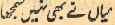 —'even the Mian has not understood it' (Paigham-i-Sulh, March
3 1914). What is more important is the Maulvi Muhammad Ali in his own work,
Kufr
wa Islam, has retained the word even in his reference to this
incident. The omission of the word even from the quotation
in The Split affords, therefore, yet another proof of Maulvi Muhammad
Ali's tendency to tamper with texts.
—'even the Mian has not understood it' (Paigham-i-Sulh, March
3 1914). What is more important is the Maulvi Muhammad Ali in his own work,
Kufr
wa Islam, has retained the word even in his reference to this
incident. The omission of the word even from the quotation
in The Split affords, therefore, yet another proof of Maulvi Muhammad
Ali's tendency to tamper with texts.
This offence of Maulvi Sahib increases in gravity when we remember that
after the death of Khalifatul-Masih I, and before the question of a successor
had yet been decided, Maulvi Sahib, in the course of a conversation with
me, made a reference to this incident, when I duly corrected his version
of it. As the incident was then of recent occurrence, Maulvi Muhammad
Ali did not at the time venture to question my statement. He murmured
an admission, and then quickly changed the subject of conversation. Then
again, sworn statements of those present on the occasion have since been
received and published. There is thus little possibility that Maulvi
Muhammad Ali may have forgotten the incident. All the circumstances,
therefore, point to the inevitable conclusion that Maulvi Muhammad Ali
has been purposely distorting the facts. In addition to the sworn
testimony of several persons present on the occasion, I myself am prepared
to affirm on oath the truth of my version of the incident, and shall be
glad to know whether Maulvi Muhammad Ali, and his friends, who were present,
are prepared to affirm on oath their version of the incident. I am
sure none of them will be so bold as to take such an oath. They will
only make pretences to escape the ordeal.
Maulvi Muhammad Ali's leaflet—Kufr wa Islam—Did Hazrat Khalifatul-Masih Approve it?
The eighth item in Maulvi Muhammad Ali's narrative is the statement
that he wrote a small pamphlet which was read over to Hazrat Khalifat-ul-Masih,
that the latter approved of the views expressed therein, but that the pamphlet
could not be published in the lifetime of Khalifatul-Masih I. There
is no doubt that Maulvi Muhammad Ali did write a pamphlet on the question
of the Kufr or Islam of non-Ahmadis, and read it over to Hazrat Khalifatul-Masih.
But the statement that he approved of the views referred to therein is
what I find hard to believe. There is no written testimony which
could bear out the fact of Hazrat's approval, while, on the contrary, evidence,
both external and internal, goes to prove the reverse. As external
evidence, I quote below statements from Hafiz Rauahan Ali Sahib and Dr.
Khalifa Rashid-ud-din, L. M. S.
"Facts connected with the tract Kufr wa Islam by Maulvi Muhammad Ali, as narrated by Hafiz Raushan Ali Sahib :—
'I remember that towards the close of his life, while Hazrat Khalifatul-Masih was prostrate in his last illness, very likely sometime in the month of February 1914—he was still living in his own house in old Qadian—I was once sitting in the office of the Alfazl in company with Sahibzadah Mirza Bashiruddin Mahmud Ahmad, when there came to us my teacher Hafiz Ghulam Rasul Wazirabadi. He told us that Maulvi Muhammad Ali had writtem an article on the subject of Kufr which he would read out to Hazrat Khalifatul-Masih next Friday after the service, and that he intended to read it out in private. Upon this Sahibzadah Sahib said that he too would be present at the reading, and that as the subject concerned an important question of belief we also should be present at the time. Accordingly, when Friday came, I resolved to visit the house of Hazrat Khalifatul-Masih soon after the Juma prayers, and so I did. When I reached the yard of the house, the following came out of the room of Hazrat KhaIifatul-Masih: (1) Maulvi Muhammad Ali (2) Mirza Yakub Beg (3) Shaikh Rahmatullah and (4) Dr. Muhammad Husain Shah. At that time Maulvi Muhammad Ali held some papers folded in his hand. They inquired of me whether the Juma prayers were over. I answered, "Yes". I felt sure that they had foregone the Juma prayers in order to secure the desired privacy to read out the article to Hazrat KhaIifatul-Masih. I also learnt that Dr. Khalifa Rashiduddin had also been with them, but had left before my arrival. I then went over to the house of the Doctor for further inquiry and asked him whether they had attended the Juma prayers. He said that Hazrat Khalifatul-Masih had to be given a bath, so it was necessary for the doctors to remain in attendance. I said, that Maulvi Muhammad Ali and Shaikh Rahmatulla were no doctors. Why then did they miss the Juma prayers? To this, the Doctor replied that they had waited there in order to read out an article to Hazrat Khalifatul-Masih. I inquired "And did they read out the same to Hazrat Khalifatul-Masih?" The Doctor said, "No, twice or thrice they asked leave to read, but Hazrat Khalifatul-Masih declined saying he was going to rest. Thus they failed in the object for which they had foregone their Juma prayers". After this I came back to Sahibzada Sahib and related to him the whole story. Then I went back to the house of Hazrat Khahfatul-Masih and sat down determined not to leave the place till Maulvi Muhammad Ali had either read the article or returned home disappointed. Maulvi Muhammad Ali waited in the house of Maulvi Sadruddin looking for the time when I should leave Hazrut Khalifatul-Masih, while I looked for the time when Maulvi Muhammad Ali should read out his article to him. At length came the time for the Maghrib prayers. Maulvi Muhammad Ali now departed for his house out of town, and I departed for the Maghrib prayers. After the prayers I said to Sahibzada Sahib, "Friday has passed and Maulvi Muhammad Ali has not read out his article to Hazrat Khalifatul-Masih." To this Sahibzada Sahib replied "Well, when he is determined so far to keep it a secret and does not wish that we should know anything about it, it is better to leave him alone. How long can we keep watch over him? Let us instead pray to God and fast that these troubles and travails may be averted." After this, we paid no further attention to Maulvi Muhammad Ali. The latter, however, did not have the opportunity to read out his article either on Saturdays or on Sunday following. But the night following Sunday or, may be, the night following Monday, he made arrangements to prevent people from coming to Hazrat Khalifatul-Masih's house and had the opportunity to read out the article. He posted some Pathans to guard the doors of the house and told them it was the Khalifa's command that nobody should be allowed to enter in. At this time, Mir Nasir Nawab Sahib called to inquire about the health of Hazrat Khalifatul-Masih. The guards told him that no-body was permitted to enter. Similarly, Sufi Maulvi Ghulam Muhammad B. A., also came to inquire of his health. He also was sent back. Then came Dr. Khalifa Rashiduddin. He too was stopped by the guards. But he said that he was a doctor and nobody could prevent his entrance. He forcibly made his way in. Coming to Hazrat Khalifatul-Masih, he inquired of him whether he had given orders not to allow people to come in. Hazrat Khalifatul-Masih replied that he had given no such orders. Dr. Khalifa Rashiduddin subsequently reported that at that time Maulvi Muhammad Ali was reading out his article to Hazrat Kahlifatul-Masih. When he had finished, Hazrat Khalifatul-Masih asked him whether he felt fully satisfied with the article. Maulvi Muhammad Ali said, " Yes." Thereupon, Hazrat Khalifatul-Masih said that he himself was not fully satisfied with the article. Maulvi Muhammad Ali made, several attempts to get Hazrat Khalifatul-Masih to sign the article, but always remained unsuccessful.'
Written on the 17th August, 1919, by Ata Muhammad, Assistant to.Hafiz Raushan Ali Sahib."
"I attest that the above account has been dictated by me.(Sd.) RAUSHAN ALI."
"I attest the correctness of the account dictated by Hafiz Raushan Ali and state that it is all in accordance with facts and is quite accurate.(Sd.) KHALIFA RASHIDUDDIN,
Civil Assistant Surgeon (Retired),
Physician in attendance on Hazrat Khalifatul-Masih I."
In addition to the above testimonies, there was the testimony of
the late Sahibzadah Abdul Haye, son of Khalifatul-Masih I, who told me
that Hazrat Khalifatul-Masih, did not approve of the article and said that
it required further consideration and that therefore Maulvi Muhammad Ali
must not make haste to publish it. This testimony received confirmation
from actual facts, as we may notice that the article was not published
so long as Hazrat Khalifatul-Masih was alive, although another pamphlet
which Maulvi Muhammad Ali wrote later, in anticipation of the death of
Hazrat Khalifatul-Masih, on the subject of, succession to the Khilafat,
was published during his lifetime. What is the conclusion to be drawn
from all this evidence? This question, which hardly needs an answer,
will be answered .by the conscience of every reader.
Did the Bai'at on the Hand of the Second Khalifa Take Place in Ignorance?
The ninth item in Maulvi Muhammad Ali's account is that Ahmadis accepted my Bai'at under several misconceptions, and that many of them are now openly averse to beliefs held by me. For example, even Maulvi Muhammad Ahsan, the oldest and the most learned living, companion of the Promised Messiah, has issued a handbill declaring that I am not fit for the office of Khalifat, because I have been promulgating the following erroneous beliefs.
(i) That all the followers of the Qibla, professing the Kalima, are Kafirs.In dealing with these charges, I wish in the first instance to state that it is altogether wrong to say that people accepted my Bai'at under any misconception regarding my views. My principles and beliefs had been published long before I was elected to the office of Khalifa. My views on the question of the prophethood of the Promised Messiah had been expounded in a lecture I delivered in 1910. This lecture was duly published in the organs of the Ahmadiyya Movement. They were also to be found in other writings of mine. I had also published a tract on the subject of the Kufr of those who did not accept the Promised Messiah, and, in the words of Maulvi Muhammad Ali himself, I had in 1913 once again announced that those who did not believe in the Promised Messiah were Kafirs. In the presence of so many repeated declarations, how can it be said that people entered my Bai'at through a.misconception? It is true that there are a few who first entered my Bai'at and then renounced it. But, on the other hand, more than a hundred times their number have later replaced these defections. When I was elected there was only an inconsiderable number who accepted my Bai'at. The majority of the Jama'ats in centres outside held back through misunderstandings created by these very people. But God worked on my behalf and gradually gathered the whole community to my side. It is wrong therefore to say that people entered my Bai'at through any misconception. They continue still to enter and from December last up to now (March 1919), about 25 persons from among the followers of Maulvi Muhammad Ali have accepted me as the true Khalifa. All this has happened in spite of the fact that I have refrained from devoting any attenion to my opponents who have been spending the bulk of their funds and energy against me. Wherever our men have gone to preach the truth of Ahmadiyyat, there their men have followed them in order to create an aversion in the public mind against us and often against Ahmadiyyat itself. If I, on my part, had cared to devote to these people even half the time which they have been wasting in their activities against us, then, by the grace of God, we could have had even larger results. It seems to us better, however, that our energy should be devoted to the propagation of Islam and the advance of Ahmadiyyat. Accordingly, all our lecturers are directed to work only among non-Ahmadis and non-Muslims. On the other hand, nearly all the lecturers of Maulvi Muhammad Ali's party are engaged in misleading Ahmadis. Nevertheless, those who have deserted us to join Maulvi Muhammad Ali's party are few, and have been compensated many times over by those who have left his party to join us. I am prepared, in case Maulvi Muhammad Ali desires, to furnish proof. As for his statement that a majority of the enlightened Ahmadis are opposed to my views, it is but a claim for which Maulvi Muhammad Ali has still to, furnish some evidence. Of course, if we start with the assumption that those who belong to his way of thinking are enlightened and those who do not are not, then certainly not a majority but rather all the enlightened members of the community have abandoned my party and joined his. If, however, such an assumption is inadmissible, then there is no evidence for Maulvi Muhammad Ali's claim. For, if there are any men learned in religion whom Maulvi Muhammad Ali can produce from among his followers, then there is a much larger number of them whom I can produce from among my followers. This is, however, a futile method of arguing, useless for the establishment of truth. If, however, Maulvi Muhammad Ali is fond of arguing in this way, we are quite prepared to stand even this comparison of strength.(ii) That the Promised Messiah was a perfect and real prophet and not a partial prophet or Muhaddas.
(iii) That the prophecy about Ahmad in Chapter Saff of the Holy Quran relates to the Promised Messiah and not to the Holy Prophet.
Maulvi Muhammad Ali's narrative seeks also to prove that the enlightened members of the community who still continute as my followers, are opposed to the beliefs held by me. If words used by him, which carry the above sense, are deliberate and intentional, then I cannot but say that he has only attempted to mislead people. For those who are with me agree in my beliefs, and if there is anywhere any stray exception, the case is beyond my knowledge, and such exceptions can in no way serve as the basis of an argument. I do not, of course, speak of those few men who are openly consorting with Maulvi Muhammad Ali, but who still for considerations of expediency are averse to making a public declaration of the renunciation of their Bai'at. These men by their conduct have proved themselves hypocrites. But even they are negligibly small in number.
Now to those statements which Maulvi Muhammad Ali has made concerning Maulvi Syed Muhammad Ahsan. In the first place, I wish to say that the statement made by Maulvi Muhammad Ali that Maulvi Syed Muhammad Ahsan is the oldest living companion of the Promised Messiah is quite wrong. There are among my followers men still living who entered into the Bai'at of the Promised Messiah long before Maulvi Syed Muhammad Ahsan, and who had become attached to the Promised Messiah at a time before the said Syed Sahib had even heard his name. For example, there is Shaikh Hamid Ali Sahib[4] who was the third of those who accepted the Bai'at of the Promised Messiah, and Munshi Rura Sahib[4] retired Tahsildar of Kapurthala, who was the seventh or eighth of those who entered into the Promised Messiah's Bai'at. This last gentleman, some years ago, migrated to Qadian. He is one of those who possessed a special attachment for the Promised Messiah, and about him the Promised Messiah wrote on page 799 of Izala-i-Auham, "He is attached to me by a bond of love." The Promised Messiah entertained a special affection for him, a. fact well-known to visitors to Qadian. Munshi Rura Khan belonged to the Ahmadiyya Jama'at of Kapurthala. With regard to this Jama'at, the Promised Messiah was pleased to remark, " I hope that by the grace and bounty of God you will be with me in this life and the next." (Letters of the Promised Messiah to Muhammad Khan Sahib of Kapurthala, dated the 27th January, 1894—Reproduced from The Badr, October 1st 1908). All members of this Jama'at are in my Bai'at. Similarly, there is Mir Inayat Ali Shah Sahib of Ludhiana who was the ninth of those who accepted the Bai'at of the Promised Messiah. There is also Maulvi Abdullah Sahib of Sanaur, who is the witness of a great miracle of the Promised Messiah, and regarding whom the Promised Messiah made the prophecy, "I am fully assured that, God has filled your heart with sincerity and love. You possess a natural affinity and your love is such that it cannot change with the passing of time." (Extract from the Promised Messiah's letter to Maulvi Abdullah of Sanaur, dated 6th March 1908. This letter will be found fully reproduced elsewhere in this book). This gentleman too is, by the grace of God, among my followers. There is also Munshi Zafar Ahmad Sahib, who was one of the earliest to accept the Bai'at of the Promised Messiah, and who entertains a more than ordinary attachment for the Promised Messiah, and is at present a member of the Kapurthala Jama'at. Similarly, there are Munshi Abdur Rahman Sahib and Munshi Fayyazuddin Sahib, both of Kapurthala. All of them are deeply devoted members of the Movement, and all of them entered into the Bai'at of the Promised Messiah long before Maulvi Muhammad Ahsan. There is also Pir Sirajul Huq Numani who was not only one of the earliest to accept the Bai'at, but had also at several times lived in the company of the Promised Messiah. These gentlemen not only joined the Promised Messiah earlier than Maulvi Muhammad Ahsan, but are mostly such as enjoyed more of his society than was the case with Maulvi Syed Muhammad Ahsan. Thus, it is altogether wrong to say that Maulvi Syed Muhammad Ashan is the oldest companion of the Promised Messiah. The earliest work in which the Promised Messiah enumerated the names of the men who joined him is Izala-i-Auham. Of the persons mentioned therein, there are eighteen now alive regarding whom the Promised Messiah was pleased to record his remarks. Out of this number, fourteen have entered my Bai'at and four have joined the party of Maulvi Sahib. Can there still be any doubt as to which side enjoys the confidence of the majority of the Promised Messiah's Companions?
Nor am I prepared to agree with Maulvi Muhammad Ali that Maulvi Syed Muhammad Ashan is the most learned man in the whole of the Ahmadiyya Movement. It is no easy matter to determine the extent of a person's learning. In my opinion, Maulvi Syed Sarwar Shah Sahib and Qazi Syed Amir Husain Sahib are in no way inferior to Maulvi Syed Muhammad Ahsan in the matter of scholarship. I may also include Maulvi Hafiz Raushan Ali Sahib who, although young in years, may be reckoned among the aged in learning. Thus, neither on ground of years, nor on the ground of learning, does Maulvi Syed Muhammad Ahsan enjoy any such. pre-eminence over the rest of the community as might entitle his pronouncements to any special authority. It is true that by reason of his learning and his age he enjoyed the general regard of both the educated and the ordinary members of the Movement; and, as for myself, I do even now hold him in esteem for the sake of the respect he enjoyed in the past. I am of opinion that the said Syed Sahib is labouring under a sad delusion, and that God willing, when he recovers his normal Self, he will turn again to the Centre. May God fulfil the hope that it is only a passing trial which he is undergoing, and that he will come out victorious in the end, and that God will save him from the fate of the old woman, spoken of in the Holy Quran, who span her yarn during the day and undid it during the night. Amen!
I now proceed to deal with the charges upon the grounds of which Maulvi Syed Muhammad Ahsan claims to depose me from the Khilafat. I would, however, note in passing that the appointment of a Khalifa is the work of God, and that it lies with God alone to depose him. It is in no man's power either to appoint or to depose a Khalifa. Thus my appointment as Khalifa was not due to Maulvi Muhammad Ahsan, nor could I be deposed by his command. It is, indeed, one of the favours of God, that since the announcement of deposition by Maulvi Syed Muhammad Ahsan, further success has come and continues to come to me. From that time up to now (March 1919), some fifteen to twenty thousand new members have joined me and every day brings more and more success. May God add to the success. Amen !
It is not my intention at this stage to enter into a discussion of the charges brought against me by Maulvi Syed Muhammad Ahsan, nor shall I attempt here to prove or disprove the beliefs which he states. A full discussion of these beliefs will be made further on. All I wish to say at this place is that it is hardly proper on the part of Syed Sahib to attack me on the ground of those beliefs. It was certainly open to him to say that the error of those beliefs is now manifest to him, and that he has therefore, decided to renounce them, or he could have said that, in addition to those beliefs, there were some novel beliefs which I had adopted, and that it was on account of these that he would now renounce my Bai'at. But he has no justification to speak of the beliefs held by me, as novel or heretical, or to make them the ground of an announcement against me. I say this because he has been familiar with those beliefs for a long time before now, and was well aware of them, when the Bai'at of my Khilafat was held. For, as Maulvi Muhammad Ali admits, my article on the subject of Kufr of non-Ahmadis was published in the Tash-hizul-Azhan of April 1911 and, as he further admits, I have since been writing regularly on the subject. Thus when even in the lifetime of Khalifatul-Masih I, I had declared non-Ahmadis to be Kafirs, and this was well-known to members of the Movement, I can only wonder why Maulvi Syed Muhammad Ahsan, who knew all this, entered into my Bai'at. If my beliefs were really such that their entertainment rendered me unfit for the office of Khalifa, how was it that on the day of the election, in the Masjid-i-Nur, it was he who stood up to propose me for the Khilafat, and he who made a powerful speech in my support? A more proper attitude for him, on seeing people wish to enter into my Bai'at, would have been to dissuade them from doing so, to point out that I had pronounced all Mussalmans to be Kafirs, and that therefore I was not fit to be their Khalifa. As it happens, I have had no occasion to enter into any elaborate discussion of this question of Kufr of non-Ahmadis, since my election as Khalifa. The most important article I wrote on the subject was the one published during the lifetime of Hazrat Khalifatul-Masih I. Accordingly, if holding this belief is really a valid ground for my deposition from the Khilafat, the blame attaches to Syed Sahib who, in spite of my holding the belief, was so strong in. his support of my election as Khalifa. Besides, it may also be noted that on the eve of the meeting at which God was pleased to decide the question of successor to the Khilafat, Maulvi Muhammad Ali came to pay me a call. There were present on the occasion Maulvi Muhammad Ahsan, Dr. Khalifa Rashiduddin, and Nawab Muhammad Ali Khan, Jagirdar of Malerkotla. Maulvi Muhammad Ali at that time laid stress upon this very question. He pointed out that it was difficult to proceed with the election of a Khalifa, because there was such serious disparity of beliefs prevailing in the Community. One party regarded the Promised Messiah as a Nabi and his deniers as Kafirs, while the other party refused to subscribe to any such doctrine. Upon this, it was Maulvi Muhammad Ahsan who engaged Maulvi Muhammad Ali in argument, and tried to establish the validity of our beliefs. But I restrained him pointing out that the occasion was not one for the settlement of differences of belief. The question immediately before us was how to find a solution of the impasse, and in any case a settlement of beliefs required time. I am prepared to swear to the truth of this incident, and I ask Maulvi Muhammad Ali to say whether he too is prepared to swear that he did not refer at this meeting to our beliefs, and that Maulvi Muhammad Ahsan was not one of those who argued with him in order to establish their validity.
Now, to the subject of prophethood. On this subject also, as I have already stated, I had publicly explained my views in a speech I delivered on the occasion of the Annual Conference of the year 1910. I had there stated in plain words that the Promised Messiah was a Nabi. I have already quoted a number of passages from this speech. Here I shall content myself with quoting one more passage.
"A Nabi from God has appeared among us. If we follow him, we shall reap all the rewards promised to the Companions of the Holy Prophet."In this passage, not only was the Promised Messiah distinctly called a Nabi, but mention was also made of the eminence of his rank by saying that his followers were to be classed with the Companions of the Holy Prophet (peace and blessings of God be on him). When I delivered the speech, Maulvi Muhammad Ahsan was present in the gathering, and no sooner had I finished speaking than he broke out reciting in a loud voice the Quranic verse
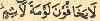
"There was a revelation to the Promised Messiah—Thus, it is impossible to say that Maulvi Syed Muhammad Ahsan had no knowledge of the beliefs which I held.
'I give you glad tidings of a boy, the manifestation of truth and greatness.' The revelation was in accord with the prophecy contained in the Hadith relating to the Promised Messiah—— that he would marry and would be granted sons who would be great. We have, accordingly, amongst us Mirza Bashiruddin Mahmnd Ahmad who, in addition to being the noble son of a noble father, has in spite of his extreme youth disclosed, in the sermon he delivered in explanation of some Quranic verses, such a depth of knowledge and such an insight into truth as is indeed without a parallel. Now if any one were to slight him, and to speak about him saying that he was a child of yesterday, reared by their hands, given to sport and frolic, then one ought to remember that such remarks were the characteristic of the Pharaoh who spoke to Moses saying 'Did we not rear thee in our midst as a child? You lived amongst us many a year of your life'. Well brothers ! if such thoughts were to arise in the heart of any of you, you should seek forgiveness of God, because the end of the Pharaoh was bad indeed. " (The Badr for January, 1911).
He knew all about them. He accepted my Bai'at with full knowledge of their nature. And now, on the ground of those same beliefs, he has renounced my Bai'at. Who is there who, under the circumstances, will look upon his action with approval? One more point to be remembered, in this connection, is that my belief regarding the nature of the Promised Messiah's prophethood is the same as that of Maulvi Syed Muhammad Ashan, as stated by him in the Tash-hizul-Azhan. The difference is merely one of terminology.
Yet a third doctrine, alleged to have been newly promulgated by me, is my belief that the Promised Messiah is the object of the prophecy relating to Ahmad which occurs in Chapter Saff of the Holy Quran. Whatever may be the merit of this belief of mine, it was promulgated long before Maulvi Syed Muhammad Ashan took the oath of Bai'at, and even after its publication the said Maulvi Sahib remained for a long time on friendly relations with me. It was, in fact, during the lifetime of Khalifatul-Masih I, that I wrote an article on the subject of the prophecy relating to Ahmad; only, it could not be shown toHazrat Khalifatul-Masih. My friend Qazi Zahuruddin Akmal published the article in the Tash-hizul-Azhan soon after I became Khalifa, and it was no less than two years after its publication that Maulvi Syed Muhammad Ahsan announced his revocation of the Bai'at. During all this time he consistently supported me and my party, and opposed Maulvi Muhammad Ali and his coadjutors. Thus, it would appear that even this belief could not be the real ground for his revocation of the Bai'at.
Before finishing this point, I wish to cite one written testimony from the pen of Maulvi Syed Muhammad Ahsan himself which shows that all the three doctrines had met with his entire approval, that he had bestowed upon the opponents of these doctrines opprobrious names like Pharaoh, etc. In fact, it appears that it was due to my advocacy of these very doctrines that he recognised me to be the Promised son of the Promished Messiah.
When, towards the close of the year 1914, Khwaja Kamaluddin returned
from England, he delivered a lecture at Lahore at a meeting of the friends
and partisans of Maulvi Muhammad Ali. The lecture was printed and
widely distributed. I published a reply to it in my book called Al-Qaulul-Fasl.
In that book I discussed all the three questions; (i) the
prophethood of the Promised Messiah, (ii) the Kufr
of non-Ahmadis; (iii) the Quranic Prophecy relating to Ahmad.
By way of illustration I shall here quote a few passages from the book,
bearing upon all the three subjects :
"If one were to define Haqiqi Nabi (real prophet) as a prophet who is not an impostor or pretender but a prophet who has really been sent by God, who bears the title of Nabi in the sense of an accredited messenger of God, agreeably to the sense in which the word is used in the Holy Quran and possesses all the attributes requisite in a Nabi, in their proper measure, then in view of such a definition, I would say that the Promised Messiah was a Haqiqi Nabi, but, of course, I would not give him that name if it is understood to mean that he brought a new Law." (Al-Qaulul-Fasl, page 12).Again,
"According to us what is meant by the Promised Messiah being a Zilli or a Baruzi Nabi, is simply this that his Nabuwwat (prophethood) was attained by virtue of his pupilage and obedience to the Holy Prophet Muhammad (peace be on him), whereas the previous prophets attained this rank directly, and the words do not imply that the Nabuwwat (prophethood) of the Pomised Messiah was something of the nature of an honorary title which had no real substance behind it, or that his Nabuwwat did not entitle him to the status and privileges of prophets." (Al-Qaulul-Fasl, p. 18.)
In the same book, there is to be found from page 2 to 26 a discussion
of the question of the Nabuwwat of the Promised Messiah. Therein
light has been thrown upon every possible aspect of the question, and nothing
has been omitted from the discussion. Further on from page 27 to
32, has been discussed the prophecy concerning Ahmad. A few
extracts
from this discussion are now quoted:
" The Promised Messiah has called himself Ahmad, and said that it was he who was the real object of the prophecy, because he said that in this passage (the verse Ismuhu Ahmad in Chapter Suff of the Holy Quran), there is a prophecy concerning Ahmad alone, whereas the Holy Prophet was both Ahmad and Muhammad. " (Al-Qaulul-Fasl, page 27).Again, I wrote on page 31,
"The person who is referred to in Ismuhu Ahmad is the Promised Messiah."In short, in six pages of the book I proved by quotations from the writings of the Promised Messiah and the testimony of Khalifatul-Masih I, that the Promised Messiah was the real object of the Quranic prophecy concerning Ahmad. Regarding the question of Kufr of non-Ahmadis, I wrote on page 33 of the book,
" The other question discussed by Khwaja Sahib is that of Kufr of non-Ahmadis. Regarding this question, I have already published the writings of the Promised Messiah which have a bearing on the subject. Further explanation is unneccessary. My belief continues to be the same as before."Below in a footnote, it was noted 'For details, see Tash-hizul-Azhan for April 1911.' This was the number in which was published my article running over 40 pages on the subject of Kufr of non-Ahmadis, from which several extracts have already been quoted above. I wrote,
" Thus, whatever the Holy Quran says concerning such people as disbelieve in any prophet is applicable to the deniers of Mirza Sahib (the Promised Messiah), " (Al-Qaulul-Fasl, p. 33)From the above quotations, it is evident that the book Al-Qaulul-Fasl declared in the clearest possible terms that the Promised Messiah was a Nabi, and his deniers Kafirs, and that he was the object of the prophecy contained in the Quranic verse relating to Ahmad. The book was published in January 1915, and a copy of it was forwarded to Maulvi Syed Muhammad Ahsan. Maulvi Sahib in a letter to Qazi Zahuruddin Akmal wrote about the book as follows:
"I have had the book Al-Qaulul-Fasl read over to me from beginning to end. I have already expressed my opinion about it that it has given to the opponents of the Khilafat a conclusive argument in proof of their error.''Further, a letter also came to me from Syed Muhammad Yakub, son of Maulvi Syed Muhammad Ahsan wherein he wrote on behalf of his father:
" The book Al-Qaulul-Fasl was read over by me to my father. He was so glad to hear the claims and the arguments that he forgot for the moment the discomforts of age and the pains of the ailments from which he has been suffering, and gave vent to his feelings in the words, ' Praise be to God, I have lived to see the day for which I had been waiting for years'."The writer continued,
" I may mention here on behalf of my father regarding this tribe of the Pharaoh namely, the Lahore party, that it has transpired that one Devil[5] among them, in speaking about the book Al-Qaulul-Fasl, referred to its author saying that he was an evil minded man, a liar, a man of craft, and that he would work to expose all his toils. These foul words are among the least uttered by the man. His condition is in fact similar to that of the Pharaoh. ..... If he will not repent, then, in the end, he will be engulfed in a flood of darkness. Amen!" Dated, February 11,1915.From these letters, written by or on behalf of Maulvi Syed Muhammad Ahsan, it would appear that he had carefully heard the book Al-Qaulul-Fasl from beginning to end, and had found its conclusions both valid and well-demonstrated. In other words, he considered the subject matter of the book to be at once correct and well-substantiated by the testimony of God and His holy men. He was so pleased to hear the book that he forgot his physical discomfort; and moreover its hearing enabled him to discover in me one he had been waiting for, for years. (He was here referring to the prophecy relating to a Promised son of the Promised Messiah, a subject to which he was never tired of referring in all his writings and discourses). We may also note that he regarded the decriers of the book as the followers of the Pharaoh or like the Pharaoh himself—men who were in danger of
" In my opinion, in the discussion on the subjects of Kufr and Kafir, you have fully discharged your duty of conveying the message. Henceforth, there is no more need for you to devote your attention to this subject. As the Holy Quran says, ' They can never do you any harm so long as you are yourself rightly guided'."This latter dealt with the subject of my article on the Kufr of non-Ahmadis, which was published in April 1911. The letter itself was written by Maulvi Sahib on the 6th September 1911 from his home at Amroha.
What the Enlightened Members of the Community Think
The tenth item in Maulvi Muhammad Ali's narrative is that, besides Maulvi Syed Muhammad Ahsan, other enlightened members of the Ahmadiyya community are now realising the error of my beliefs and their dissatisfaction is becoming more and more pronounced every day.
I have already dealt with this subject, but I may mention here once
more that, by the grace of God, all the members of my Jama'at, except such
rare instances as may be known to God alone, are quite at one with me in
the matter of beliefs. It would indeed be surprising if in this age
of free thought and speech, educated men should find themselves opposed
to my doctrines and still remain my followers, and in spite of the fact
that I possess no temporal authority or power. The fact that they
are with me,
is itself a positive proof of the fact that they are at one with me
in their views. But, nevertheless, if Maulvi Muhammad Ali still thinks
that he is right in his statement, then the best course for him is to publish
a list of such educated members as are dissatisfied with my beliefs.
If, however, he has in his mind the few who have gone over to him from
among my followers, then I would request him to compare their number with
the number of those who have left his ranks in order to enter my Bai'at.
The eleventh item in Maulvi Muhammad Ali's account is his charge of
norrow-mindedness against me. This, he says, has led me to condemn
Ahmadis as Fasiqs (rebels). Such a charge comes with very
bad grace from him who, in the very first pages of his book, has been pleased
to call me and my companions by the name of Zaal (perverts).
I ask which is the harsher term, Zaal or Fasiq? Zaal
implies such a bad sense that Mussalmans have been taught to pray five
times a day, that is, in all their daily prayers, that they may be saved
from being turned into
Zaal. But, nevertheless, Maulvi Muhammad
Ali has not scrupled to bestow that title on us. (pp. 3—8 of The Split).
If, however, it is contended that we have been given that name under the
authority of the Quran and the Hadith then our rejoinder is that the name
of Fasiq has been given to Maulvi Muhammad Ali and his party in
conformity with the verse relating to the institution of Khilafat in Chapter
Nur of the Holy Quran, where after promising the advent of Khalifas from
among Mussalmans, the Holy Quran proceeds to say that those who will not
obey such Khalifas will be Fasiqs. Thus, whereas our opponents
possess no justification for giving us the name of Zaal, we have
the sanction of the Quran in our use of the. term Fasiq. Besides
the explicit dictum of the Quran, we possess the precedent of Hazrat Khalifatul-Masih
who openly called them Fasiqs who refused to obey his commands,
and so far as we know Maulvi Muhammad Ali and his partisans still profess
to respect his decisions.
The twelfth item in Maulvi Muhammad Ali's narrative of the dissensions is that I have prohibited my followers from having anything to do with members of the other section; that I have prohibited them from eating at the same table with them, from mixing with them in social intercourse, and from reading any book or tract published by them. Thus my followers have been kept ignorant of the arguments which are being given in refutation of such of my beliefs as are contrary to the views of the Promised Messiah. This last link in Maulvi Muhammad Ali's account of the events which led up to the split in the Community is as feebl and flimsy as any of his other statements. I have never forbidden any of my followers from making friends with any members of the seceding party, or from eating at the same table with them, or from reading their literature. The whole charge is a libel fabricated by Maulvi Muhammad Ali. In fact on the contrary, I find that when in the year 1915, at the death of Maulvi Abdul Haye, son of Hazrat Khalifatul-Masih I., Maulvi Muhammad Ali paid a visit to Qadian in company with some of his friends, I took the opportunity to invite him to my house, and sent Maulvi Sher Ali to escort him to my place, but Maulvi Muhammad Ali was pleased to decline the invitation. Similarly, when earlier in the same year, I had an occasion to pay a visit to Lahore for some medical consultation, some of my friends sent invitation to Maulvi Muhammad Ali and some of his friends. But they declined the invitation. On another occasion, Shaikh Rahmatullah, one of the partisans of Maulvi Muhammad Ali, paid a visit to Qadian and proceeded directly to the Maqbarah-i-Bahishti. Somebody brought the news to me, whereupon I sent somebody to escort him to my house, and also went personally to meet him. I requested him to stop at Qadian, but he declined the request on the plea of urgent work. In a like manner, members of my party make it a point to mix with members of the other party, wherever such meetings are possible. But there are people who are prone to pick quarrels and are intent upon mischief. Their sole object is to deceive others, and they always wait for an opportunity to create trouble. These are the men who sow the seeds of disbelief and dissension. From such people my followers, of course, make it a point to keep away; nor do I myself approve of such association. But, nevertheless, so far as I can remember, I have never as yet issued any pronouncement on this subject. Apart, however, from these considerations, may not one ask of Maulvi Muhammad Ali, what right has he to bring the present charge against me, seeing that he himself declined to accept my invitation? He himself stands charged with departing from the example of the Holy Prophet in declining my invitation. After that it was no longer my duty to accept his invitation. To accept his invitation, under the circumstances, would have been dishonourable, and believers ought never to compromise their honour. I sought long not to cut off relations with thjs opposite party, and to see them return to the fold of truth. But Maulvi Muhammad Ali, from the beginning, saw his advantage in dissension and strife. It was because of this that he departed from Qadian, and founded a new Anjuman of his own, and published various slanders against me. After that, what right has he to expect that I should continue to be friendly with him? In the first place, by their denial of the Khilafat and by their attempt to create a breach in the Community, Maulvi Muhammad Ali and his associates—who were at the bottom of these dissensions—made themselves, liable in the eye of the Shariat, to have all intercourse with them suspended,[6] and to be left severely alone by the Community. But, nevertheless, when as a kind of special concession, I sought to keep up relations with them, they plainly declined to respond to my overtures, and refused to accept our repeated invitations. And now they have the grace to lay the same charge at our door!
Maulvi Muhammad Ali and his associates sometimes point to a certain article by Qazi Zahuraddin Akmal in support of this charge. This article was written after the return of Khwaja Kamaluddin from England, and it contained an exhortation to the Community to beware of him. But my accusers ought to remember that, in the first place, the article was not written by me; it expressed the view of one individual member of my following. In the second place, the article contained an exhortation to Ahmadis generally relating to a leading disturber. It did not speak of the mutual relations of the two sides, or of their leading members. This was apparent from the fact that the writer himself called at their head quarters, in order to see Maulvi Muhammad Ali, but the latter paid no attention to him, and failed to show him the ordinary civility due to a visitor. If the article was intended by the author to have any general application, then there was no reason why he himself should have gone to meet Maulvi Muhammad Ali. The fact is that the charge is merely an excuse fabricated with a view to justifying their own aloofness from me and my jamaat. A careful inquiry will show how my jamaat have all along shown more readiness to mix with his adherents than they have shown to mix with mine. On the occasion of their annual gatherning a good few of my followers invariably go and attend, bat none of his adherents have ever attended our annual gatherings except on the last occasion when some of their members attended in response to a special invitation. Moreover, whenever any one of our members has happened to go among them, everything has been done to show him disrespect and contempt. For instance, only a few days ago I received a letter from one of my friends Mian Abdul Aziz, a P. W. D. overseer, which said that he had gone to those people but they did not allow him to stop with them. In short, they have now increased so much in their animosity to my jamaat and have gone so deep in duplicity that any one of my friends, who goes to mix with them, runs the risk of hurting his self-respect. At present, their general attitude towards my adherents is one of indifference, save towards such people whom they expect to win over to their views or from whom they hope to derive some advantage.
As regards a study of their books, it may confidently be asserted that there will be found more members of my party who have studied their books than members of Maulvi Muhammad Ali's party who have cared to make themselves acquainted with our books.
And lastly, I wish to state that while I have been busy writing this part of my reply there has been yet another opportunity to disprove and expose the utter groundlessness of the charge made by Maulvi Muhammad Ali that I have kept my followers in the dark by prohibiting them from hearing the arguments of his party. This happened as follows. Our annual gathering for the year 1918, which on account of my indisposition could not be held as usual in December 1918, was held in March 1919. On this occasion, I sent a special invitation to members of the other section. In response, some 30 selected members of Maulvi Sahib's party attended our meetings. They requested me for permission to speak at one of our meetings. Seeing ttiat they were our guests, I acceded to the request, and asked them to appoint one of their number, who might explain their views to those assembled, and speak for such time as they granted to one of our members to speak at one of their meetings. To this, they replied that among their number there was none who could speak on the occasion. They, therefore, asked that Syed Mudassar Shah might be permitted to speak on their behalf. They also requested that the time allotted to the speaker should be longer than that which was allowed in their meetings to our representative. I acceded to both these requests. Accordingly, after a speech by Maulvi Hafiz Raushan Ali on the subject of the prophethood of the Promised Messiah, Syed Mudassar Shah was granted one hour in which he explained to the audience, consisting of some 6,000 Ahmadis assembled from all parts of the country, the views of the rival section. After he had finished, his arguments were refuted by Mir Muhammad Ishaq. The arrangement removed once for all the complaint of the rival party that Ahmadis were prevented from hearing the arguments of their side. Praise be to God, the address of the rival party only served to strengthen the conviction of Ahmadis in their beliefs and to expose the weakness and error of the rival views. Mir Muhammad Ishaq's speech, in fact, served as another illustration of the Quranic truth : When truth comes falsehood vanishes.
I have now refuted one after another all those items in Maulvi Muhammad Ali's account which needed refutation. I am confident that whoever goes through my refutation with an impartial mind, will be fully convinced that Maulvi Muhammad Ali in his book The Split has indulged in a whole series of mis-statements, that in his account of the dissensions he has on not less than twenty-four occasions, taken recourse to intentional prevarications entirely oblivious of the awe and fear of God. People who live far away from the head-quarters of the Movement, who are not in direct touch with its affairs, who have.not been eye-witnesses cannot realise the gravity of those prevarications. Nevertlieless, the strong evidences here produced should enable them to arrive at a just appraisement of the truth. And as in the proverb—a few grains from the pot are sufficient to show what the rest of the contents are like—the many prevarications and mis-statements noticed above cannot but serve as index of the nature of the person who had recourse to them. Matters for which I have furnished documentary evidence require no further proof. As for matters for which written evidence is not forthcoming and which must therefore rest upon oral evidence, I challenge Maulvi Muhammad Ali, in case he regards any of them to be false, to say on oath that they are so and that I have deliberately so stated them. But I am certain that Maulvi Muhammad Ali will never adopt this method of testing the truth. He looks upon oaths and prayer trials—as methods of settling the truth—with scorn and scoffing, even though they are fully recognised as methods of evidence by Islam, and constitute one of the signs of its truth. The truth is, he is troubled with a bad conscience and is afraid that such a trial would lead to his undoing.
And our last words are "Glory to Allah, the lord of the worlds".
-----------------------------------------------------
Footnotes:
[1] For a long time I have shown
every deference to Maulvi Muhammad Ali and refrained from making any imputation
ragarding his motives. But moderation on my part has only resulted
in increasing the harshness of his tone and making him forget the necessity
of being mindful of the feelings of others. I therefore think that
now the time has come to expose his real character before the people and
to show how he has been designedly trying to mislead them. Of course,
as I have already stated, it will be far from me to emulate him in his
abusive style. [Back]
[2] These lines were specially underlined
in The Badr. [Back]
[3] This report was wrong.
The Editor of the Al-Hakam had recorded the whole speech which,
after due perusal and corrections by the Khalifatul-Masih, was published
by him in his own paper. Between this authoritative report and the
Zamindar
report there was a great difference. [Back]
[4] Both of them were living
at the time of the writing of the book, but have since died. [Back]
[5] This term Maulvi Muhammad
Ahsan used with reference to Khwaja Kamaluddin. [Back]
[6] Sa'ad who did not acknowledge
the Khilafat of Hazrat Abu Bakr had all relations cut off with him by the
Companions. [Back]