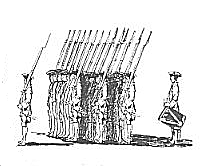
The Regiments at Fontenoy This was the regiment's finest hour etching its name like many heroes of this battle on history forever. At this fight under Marshal Saxe, the regiment were in a crucial part of the fray halting the Duke of Cumberland's column involving deadly hand-to-hand combat with the British, sustaining heavy fire from the redcoats before throwing themselves into combat. They held their fire until their musket barrels were in the face of the enemy. Cries of 'Vive le France!', 'Remember Limerick and Saxon perfidy!' and 'l'arme blanche!' were heard. Vendome called them the 'butchers of the army' due to their love of cold steel. 'The second regiment of English foot guards, who had Bulkeley's Irish regiment to deal with, were almost destroyed. The latter took from them a pair of colours and two pieces of cannon, with the horses belonging to them, which were before the battalions.'
'Clare and the Irish learned from us, t'avenge -
their King's, their country's, and their church's wrongs' Voltaire
At Culloden the Prince was served on the left flank by a Franco-Irish cavalry regiment, Fitz-James's Horse, which had landed in Scotland in late 1745 from Ostend. Under it's commander, Colonel Robert O'Shea, it numbered only 70 at the Battle, many troopers having surrendered on the march northwards out of England. They were further handicapped by their horses having been captured at sea. Nevertheless, they were the only cavalry regiment on the Jacobite side at Culloden to fight the whole battle on horseback. The regiment was clothed in red coats turned up with blue, yellow skin breeches, black tricorn hats laced with silver, and beneath their coats black painted iron breast plates. Their weapons were carbines or muskets, pistols and straight brass-hilted swords.
Of the original four squadrons, only one had landed at Aberdeen, numbering about 120-130 men, the other three along with picquets of five Irish regiments of foot still being aboard transports. Unfortunately for the Prince, two of these transports were captured by Commodore Knowles on Feb 24th. This was a bitter loss, for the regiment had considerable experience in battle, having seen recent service in Italy and on the Rhine with the French army.
While the majority of the Irish picquets and Fitz-James Horse were captured, about 359 and 36 officers in all, a number of men from various regiments of the Irish Brigade did see action in the campaign. About 750 soldiers from the Irish regiments commanded by Brigadier Stapleton and Lord Drummond�s French Royal Scots had landed on the east coast at the end of 1745. The picquets were mainly Irishmen drawn from the six Irish infantry regiments in French service, and they along with their officers had distinguished themselves earlier in the year at Fontenoy against the same enemy. According to one eyewitness of the Irish troops who were captured at sea, �the men are all clothed in red, and the officers have mostly gold-laced hats. To speak impartially the officers are as proper men as I ever saw in my life, being mostly 5 feet 10 or 6 feet high and between 40 and 50 years of age; and common soldiers are very good looking men, and if they had landed might have done a great deal of mischief.�
The Irish picquets who fought at Culloden for the Jacobite cause were formed from three Irish regiments in French service - Dillon�s, Ruth�s, and Lally�s. The men wore red coats with the facings of their different regiments. - Anne S.K. Brown Military Collection.
Osprey Military: Campaign Series 12 : Culloden 1746 by Peter Harrington
Officers killed included Captains Kennedy, Macgennis, Lee, MacCarthy, Geraldine, Wollock and Sweeny. Wounded were Captains Kearney, Macennery, Macmahon, and Lieutenants Bourke (made prisoner), Macmahon, Nagle, Comerford and ensign Butler. It is possible that Charles Edward Stuart may have been present at the battle as a volunteer.
Easy enough question to answer.We are a small group of history buffs for whom reading about history was never good enough.We wanted to also live the history we read,and by doing so better understand it.Reenactment is a hobby where this is possible.For a short period of time during the late spring and summer months,usually on the weekends,we are able to go out and re-live the 18th Century.
On a whole our main impression is that of the Irish soldiers who served with in the Royal Army of France during the mid-18th Century.We have two impressions but one is our central focus.We choose to concentrate in particular on the Irish troops sent with Charles Stuart during the great Rising of 1745 in Scotland and served on the Continent with the main French Army against the English and their allies in the War of Austrian Succession.
We try to be as accurate and authentic as possible.Obviously there are things we cannot do and would not wish to do even if we could.The 18th Century was a brutal age in regards to military discipline,medical needs and basic standards of living but we try to be as close to history as we can.During a weekend encampment in regards to shelter,food and military enviroment we do strive to live as they did.We encourage a new recruit to try it as well but if a hotel and a hot shower are more to your tastes then we do understand this as well
Yes and No.If one looks at the price of needed items it can look very daunting financially.The price tag for a uniform,musket,and other gear that is needed can run into the thousands BUT there are things we do to keep costs to a minimum for any new recruit.We have extra weapons on hand to loan out,and prefer a new recruit is trained in their use before fielding in the line.We also keep the price tag down by making alot of our own gear.By doing this we keep the level of authenticity up and the kit affordable.
Go to the "Join the King's Army" page and use the Email address to contact us.There is a probation period for all new recruits.This makes sure both you and we have a proper fit in terms of personality and goals.We encourage any interested persons to try it out.You might find this hobby as addictive as we have.