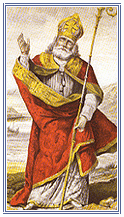
His wishes
were to return to Ireland, to convert the pagans that had overrun the country.
But his superiors instead appointed St. Palladius. But two years later,
Palladius transferred to Scotland. Patrick, having adopted that Christian
name earlier, was then appointed as second bishop to Ireland.
Patrick was quite
successful at winning converts. And this fact upset the Celtic Druids.
Patrick was arrested several times, but escaped each time. He traveled
throughout Ireland, establishing monasteries across the country. He also
set up schools and churches which would aid him in his conversion of the
Irish country to Christianity.
His mission in
Ireland lasted for thirty years. After that time, Patrick retired to County
Down. He died on March 17 in AD 461. That day has been commemorated as
St. Patrick's Day ever since.
Much Irish folklore
surrounds St. Patrick's Day. Not much of it is actually substantiated.
Some of this lore
includes the belief that Patrick raised people from the dead. He also is
said to have given a sermon from a hilltop that drove all the snakes from
Ireland. Though originally a Catholic holy day, St. Patrick's Day has evolved
into more of a secular holiday.
One traditional
icon of the day is the shamrock. And this stems from a more bona fide Irish
tale that tells how Patrick used the three-leafed shamrock to explain the
Trinity. He used it in his sermons to represent how the Father, the Son,
and the Holy Spirit could all exist as separate elements of the same entity.
His followers adopted the custom of wearing a shamrock on his feast day.
The St. Patrick's Day custom came to America in 1737. That was the first year St. Patrick's Day was publicly celebrated in this country, in Boston.   |