 |
| Dancing Injuries |
|
| Disclaimer: The information presented on this page is meant to be a general guide only. If you do have or are concerned about an injury please seek the correct professional and medical advise. |
| Stress Fractures: Injury Prevention Robert Sembler, PT and Jeffrey Sumner, MD BONE STRUCTURE AND DYNAMICS The bones of your body are made of a tissue that is different from all other parts of your body. When a bone is injured it repairs itself with bone, not scar tissue. This process allows healing of fractures and allows each one to remodel itself while it sustains steady stresses throughout the day created on your activity. Each day you replace a portion of your skeleton in response to the microscopic wear and tear of daily activities. The younger you are, the more efficient the process. But ongoing bony activity continues as we age. We think of fractures as failure of the bone to support a given load. Most people think of acute or sudden injuries when they think of fractures, which is often called 'trauma'. Stress fractures typically are not caused by sudden injury. They are not well understood by most people. STRESS FRACTURES DEFINED Just as improper training habits or intense competition can injure muscles and ligaments, bones can be injured in the same way. Repeated stress over a period of time can break down the bony structure and outstrip the body's maintenance program and result in a fracture. This phenomenon was first described in new army recruits subjected to rigors of basic training. The fractures were called 'march fractures' and were first mistaken for tumours. The most common bones involved are the bones of the feet (metatarsals), shin bone (tibia), the thighbone (femur) and pelvis. STRESS FRACTURES, SPORTS AND IRISH DANCING The most common sports that produce stress fractures are running, gymnastics, basketball and dancing. High impact and repetitive activity is the common denominator with these activities. Other common factors are: 1. Poor training habits 2. Back to back competitions 3. Worn shoes or poor running surfaces 4. Rapid increases in training time or intensity i.e.: for competitions Irish Dancers seem to have insufficient training with respect to injury prevention, yet perform activities as vigorous and repetitive as any sport. Dancers wear hard shoes or shoes without cushion and train on hard surfaces. This invites stress fractures. Dancers often do not perform proper stretching (warming up) prior to dancing nor do they keep limber between dances. Irish Dancing is unique in the sense that dancers perform vigorous activity and then often rest for long periods of time before they next dance. Muscles, ligaments and bones need time to cool down and time to warm up prior to activity for optimal performance and to minimise risk of injury. Female athletes (dancers) are more susceptible than their male counterparts because they have inherently smaller bone mass, weaker ligamentous and muscular support and poorer training habits. SIGNS AND SYMPTOMS OF STRESS FRACTURES The symptoms of a stress fracture are unexplained swelling and pain. Stress fractures start as microscopic cracks in the bone. The dancer may have only mild symptoms at first and continue to train, "working through the pain" philosophy that can delay the diagnosis. Eventually the pain will increase to a level that demands attention. If neglected for too long, the fracture can suddenly give way, although this is rare. Usually, increased pain will bring a halt to training. At first stress fractures may not show upon X-ray and may be called a muscle strain. If the fracture persists or extends, repeated X-rays or a test called a bone scan can identify them. If treated promptly with a reduction in activity and appropriate splinting (taping), healing often occurs. If neglected for a long time, there can be prolongation of the healing time and sometimes surgical intervention is necessary. PREVENTION As a physical therapist and an orthopaedic surgeon involved with sports, we know the value of prevention of injuries by performing proper exercise and stretching. We have instructed athletes in stretching, strengthening and proper footwear knowing it will help injury and loss of time from their sport. After observing Irish Dancers and seeing the increasing number of injuries sustained, we realised this is a sport by all definitions. Irish Dancers are athletes. Consequently, dancers should follow good training habits just as athletes do. Some helpful hints are: |
 |
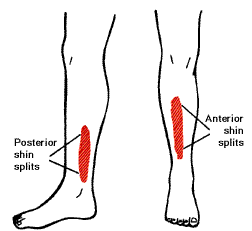
| SHIN SPLINTS Yes the dreaded shin splints..... feared by all Dancers and athletes alike. They are so common amongst those who exercise on a regular basis, as we place so much stress on our legs. As Irish Dancers we should be aware of the symptoms of Shin Splints and know how we can treat them if these symptoms occur. Ignoring pain is not a good idea. Long term, if ignored the injury will eventually affect your dancing ability and performance. The terminology of Shin Splints is widely used for pain that occurs in the lower leg. The pain can occur anywhere from just above your ankle up to just below your knee. The cause of the pain is damage to the tendons and muscles of the lower leg, small tears in the leg muscles at their point of attachment to the shin - possibly by repeated exercise without the appropriate warms ups and stretching. The first sign is of Shin Splints is a pulling or vague aching sensation after hard running or dancing. The pain can also persist after exercise and you may even feel it when you are resting and not bearing weight on the affected leg or legs. From the Diagram you can see that there are 2 types of Shin Splints. ANTERIOR Shin Splints can be caused by insufficient shock absorption and muscular imbalances that accompanies toe running or dancing. Running, dancing or other athletic activity on hard surfaces, such as concrete, increases this stress. Softer surfaces, such as wood floors, mounted on springs or elevated from cement surfaces, are capable of absorbing more shock and therefore transfer less to the shins. These type of Shin Splints can be quite predominant in Irish Dancing as we land on the balls of our feet, which places the gastrocnemius and soleus muscles of the calf in continuous contractions. Sounds like double Dutch??? Well to put it in a less technical term - any tightness in the posterior leg muscles places unecessary strain on the anterior muscles and may contribute to Shin Splints. A handy hint is to try putting shock-absorbing inner soles inside your soft shoes and hard shoes which will help cushion the impact when you are dancing. Another type is POSTERIOR Shin Splints which can be caused by strain from things like running on banked surfaces, or feet that roll whilst exercising. What ever the cause of the shin splints, they can affect new Dancers the hardest, or Adult dancers who have increased their dancing work load during the week as their standard of dancing has improved and they are practising more or taking more classes. Your legs sort of freak out with all the extra work your are asking from them!!!! The first thing that hurts is usually the tendons, which connect muscle to bones; these become inflamed as you are flexing your foot, standing on your toes and landing from jumps whilst dancing. The pain may ease a little after you have been dancing for a while - when you are warmed up - but don't be fooled by this. If you keep going, ignoring the pain, over a period of time, the inflammation can spread to your muscles. Your shins will then become tender to touch and in the most severe cases, the strained tendon can start to peel away from the bone, which can require surgery to fix. If this has happened to you the first thing you need to look at is why and can you change anything you do. 1. Are your dancing shoes fitting you correctly? 2. Have you put padded inserts in your soft shoes and hard shoes or perhaps can you buy soft shoes with the padded inserts? 3. What surfaces are you dancing on? Cement floors are a definite No-No!!!! There is no give in a cement floor and dancing on these type of floors is so hard on your body. Not only on your legs, but your back also!!! Carpet on a cement floor does not cushion your dancing, there is still cement under there!!! 4. Are you warming up and warming down sufficiently before and after classes? THESE ARE ALL KEY FACTORS WITH REGARDS TO SHIN SPLINTS When you have shin splints, its important to remove or at least reduce the source of the problem. Stretching is vital, especially as we are older dancers and our bodies are not as pliable as they used to be. To treat the symptoms of shin splits - apply a cold compress which will help reduce the inflammation. Wrap some ice up in a hand towel or face cloth and hold over the inflamed area for 10 minutes or so after dancing. You MUST seek medical advise if this pain persists, particularly someone who has experience in dealing with problems relating to dancing. You may also need to consider that you may not have shin splints, but stress fractures. Your doctor can usually diagnose Shin Splints based on your symptoms, your history of increased physical activity and the results of your physical examination. During the examination, your Doctor will examine your shin area to confirm that the pain and tenderness are located in your leg muscle(or its tendon) rather than in your shin bone itself. This is because symptoms of shin splints can be confused with the pain of a tibial stress fracture (a small stress related break in the shin-bone). This is another type of over-use injury that can occur in athletes and dancers. EXPECTED DURATION If you rest your legs and take a temporary break from dancing, the pain of Shin Splints will probably disappear within 2-3 weeks. However, once you start dancing again don't overdo it!!! You must start again gradually making sure you stretch and warm up appropriately. There is an old theory about Shin Splints called the RICE rule: R Rest the injured muscle I Ice the injured area C Compress with an elastic bandage E Elevate the injured leg If your legs are really sore and you need an extended rest why not try swimming to try and maintain fitness. References: 98six.com -- Sports Health: Shin Splints PS: I suffered from Shin Splints during my second year of Irish Dancing - they started with a mild ache down the front of my shins - even aching whilst I was lying in bed. They have completely cleared and have been that way for over 3 years. I was advised by a Physiotherapist of a stretch to do that helps the muscles in your shins. 1. Stand on a step backwards - I use my shower recess as it has an elevated section. 2. Make sure you hang onto a wall or railing for balance. Hang both of your feet over the edge of the step - so that they are half way on and half way off. 3. Place all your weight onto one foot so that your heel drops low and hangs over the step - you will feel the stretch in your archilles heel and your shins. MOST IMPORTANT - DON'T BOUNCE THE STRETCH 4. Hold that position for about 20 seconds and then do the other foot. 5. Do this a couple of times before, during and after dancing and it may help. This stretch may not work for everyone - but it certainly help to clear up my Shin Splints!!! |
 |
|
| PUTTING INJURIES ON ICE Ice has magical qualities it can soothe a sore throat, ease an aching head, even help reduce your temperature when you have a fever. As most active people will tell you, injuries happen, this is a given. ICE is nearly miraculous in its ability to ease pain and promote healing. Its one of the most effective, safest and cheapest forms of treatment for minor dancing injuries, reducing the time that you are sidelined. Should you suffer a sprain, strain, pull, tear or other muscle injury, treat it with RICE :>>>>> R est - Resting is important after an injury, your body needs to rest so it has the energy to heal itself I ce - Use ice bags, cold packs, frozen peas. This will reduce the blood flow to the injured area C ompression - Compression limits swelling, which slows down healing E levation - This also reduces swelling, most effective when injured area is raised above the level of the heart HOT OR COLD Yet even though Ice can work wonders to heal dance injuries, many people are confused about whether to apply hot or cold compressions to their injuries. The general rule of thumb is: Ice for the first 48 to 72 hours, heat after. And when in doubt, apply ice. "Cooling the injury, in medical terms, cryotherapy, decreases swelling, bleeding, pain and inflammation" writes sports medicine specialist Lyle Micheli in The Sports Medicine Bible. For maximum effect, ice needs to be applied within 10 to 15 minutes of the injurys occurrence. After an injury occurs, the damaged area will bleed (externally or internally) and become inflamed, icing the injury immediately will help speed recovery, even if you are on the way to the Doctor. Ice will also reduce the firing nerve receptors around the injured area which will decrease muscle painful muscle spasms. This is a good reason to keep an instant ice pack in your dance bag. (Which turns cold when you crush the inner lining). These chemically-activated ice packs are available in sports shops and medical supply stores. There are several popular methods of icing. One is to cover the area with a thin tea towel or tee-shirt, since a dry towel or one thats too thick will insulate the skin from cooling effect. Then, place a plastic bag full of ice, frozen peas, instant ice pack or a frozen gel pack over the injured area. Depending on the injury you may also wrap an elastic bandage over the ice bag, which keeps it place whilst simultaneously applying compression, another effective healing technique. Try not to place the ice directly onto the skin, this may cause damage to the skin and in cases where there has been extended icing - frostbite. THE BIG CHILL At first the ice produces a sensation of aching or burning. But within five to 10 minutes the anaesthetic effect takes over and the area will feel numb. It's important not to leave ice on for too long, since excess could damage skin and nerves. Thats why sports medicine experts advise icing the injury for 10 to 30 minutes, then taking a break of 30 to 45 minutes before the next 10 to 30 minute icing session. The duration of each icing session depends on the persons body type and the kind of injury. The thinner the dancer the quicker the injury cools. An ankle of knee injury might require less icing than a thigh because the joint ligaments lie closer to the skins surface than the deeper muscles. Whilst in the past, icing was recommended for only 24 to 48 hours after an injury, evidence now suggests that intermittent icing may be beneficial for up to 7 days particularly for sever bruises, Micheli says "The first 72 hours are especially critical, and icing should be done as much as practically possible during this period" he notes "Milder injuries with less bleeding and swelling will respond more quickly, so minor injuries may need only 24 hours of icing". Switch to heat only after swelling and redness are gone. Hot towels, whirlpool baths and hydrocollators (moist heating pads) are popular ways to apply heat. If you have an old, chronic injury, such as sore Achilles tendon, you might want to apply heat before you dance, heat will promote flexibility and take the discomfort away in the injured area. Then after you have completed your dancing lesson, apply ice to the injured area. Once the healing process has begun, very light massage of the injured area may cut healing time and reduce the possibility of injury recurrence. You can begin gentle stretching exercises of the injured area once the swelling has subsided. Try to work the entire range of motion of the injured joint or muscle, but be extremely careful not to force a stretch, or you risk re-injury to the area. Keep in mind that a stretch should never cause pain. ONE CAUTION "Ice therapy should not be used by anyone with rheumatoid arthritis, cold allergy, peripheral vascular disease or conditions such as Raynauds phenomenon, vascular problems or decreased sensation" writes Louisiana physician Kim Edward LeBlanc in the American Running and Fitness Association Newsletter, FitNews. But for most active people and Irish Dancers, particularly in the swelter of summer, ICE is nice!!! References: iVillage health,About.com Sports Medicine, PG News |
|
| BLISTERS, BUMPS AND BRUISES Unfortunately these are part and parcel of Irish Dancing. To have calluses from countless blisters, bruises from giving yourself a good kick with your hard shoes or pulled muscles from over doing things a little are all badges of distinction among Irish Dancers. BLISTERS: As we all know blisters are extremely painful. If you are breaking in a new pair of hard shoes - whether they are 2nd hand or brand new - you may find yourself susceptible to blisters. The key word here is 'band-aids' and lots of them. Prevention is better than cure. Carry band-aids with you as part of your dance kit and whenever you feel that rubbing burning feeling on your feet - don't ignore it - get the band-aids out immediately. There are many types of band-aids on the market right now that would be appropriate to use - there are even band-aids specifically created for rubbing shoes. You may particularly notice rubbing from your shoes when your teacher starts you on toe-stands in your hard shoes. Ballet dancers go through this same pain and rubbing when they are en-pointe. You may need to wrap band-aids around certain toes, to prevent blisters caused from the rubbing of your toes when going up and down into toe-stands. Beware - An ounce of prevention is worth a pound of cure. If you do have a blister - if possible, try not to burst it. The 'roof' or bubble of the blister is nature's way of protection against infection. BUMPS AND BRUISES: Once again these will be quite common with Irish Dancing, especially when you are dancing in hard shoes. I think everyone that Irish Dancer has given themselves a good kick at one time or other. There is nothing more painful that attempting to do a 'click-through' in your hard shoes and instead of connecting your heels - the heel of one shoe connects with your other foot, or when you have a cut-up at the front in your hard shoes, and the heel of one shoes connects with the shin of your other leg. OUCH!!! When you have done this once or twice suddenly your 'click-throughs' and cut-ups will improve vastly - as this can really hurt and will no doubt leave a bruise. The lesson here is practise, practise, practise - if you are unsure of executing your steps in the correct manner, then dance them in your soft shoes initially, until you gain more confidence. Nurse your bumps and bruises carefully - cover them with padded bandages if need be, wear stretch bandages. If your ankle or injury is swollen - then rest the injury, ice packs are wonderful for dancing injuries. If it doesn't improve within a couple of days - get yourself to a doctor. |
|
| PUT YOUR BEST FOOT FORWARD Our feet help us balance, and carry us the equivalent of five times round the earth in an average lifetime. In return, we rarely give them the attention they deserve, hiding them away in shoes and forgetting about them until they rebel. Along with our eyes and hands, your feet do more work than most parts of our body, so it's little wonder that things sometimes go wrong. Our feet are also mirrors of our general health. Signs of diabetes, arthritis, circulatory and neurological diseases, often appear first in the feet Like many dancing or athletic past times Irish Dancing has its hazards and these are often physical. Irish Dancing is a very physical art form and at times can be extremely hard on a dancers feet. Did you know that a foot has 19 muscles, 28 bones, 30 different joints, 31 tendons, 117 ligaments and also 125,000 sweat glands. Complicated creatures arent they?? When an Irish Dancer is leaping about the room, full of fitness, stamina, agility and strength, dancing to their hearts content they are hitting the floor at more than 3 times their own body weight. This certainly places a lot of stress on our 'tools of the trade'. Female Irish Dancers dance on the tips of their toes in their hard shoes, which is also not a natural way to move and puts a lot of strain on a very small area of the body, as well as on the ankles and the bones in the foot called metatarcels. There are many injuries and complaints that plague the foot - Bunions, Ingrown toenails, Swollen tendons, Stress fractures and Shin splints - to name a few. Even the way we point our toes when dancing can injure our feet. Craig Coussins designer and manufacturer of Hullachan Pro dancing shoes says: "When I ask a dancer to point their feet and they point their big toe and curl all the other toes under, I tell them you weaken the foot and put unnecessary strain on the big toe". "When you bend your toes, you may think you are pointing your feet, but straighten your toes, and this tightens up all the muscles and tendons in your foot, which then strengthens the whole foot and creates a much better arch". BUNIONS A bunion is an enlargement of the joint at the base of the big toe joint that forms when the bone or tissue at the big toe joint moves out of place. This forces the toe to bend toward the others, causing an often painful lump of bone on the foot. Since this joint carries a lot of the body's weight while walking, bunions can cause extreme pain if left untreated. The joint itself may become stiff and sore, making even the wearing of shoes difficult or impossible. Bunions affect women more than men, due to their body shapes. Girls have wider hips and a narrowing down to the knees, which leads down to the foot so it rolls in to balance. Another culprit for women is the "Fashion shoe". We cram our feet into pointy toes, high heels and tighyly fitting shoes all in the aim of 'High fashion' meanwhile our feet are suffering at times irrepairable damage. Symptoms Development of a firm bump on the outside edge of the foot, at the base of the big toe. Redness, swelling, or pain at or near the big toe joint. Corns or other irritations caused by the overlap of the first and second toes. Restricted or painful motion of the big toe. Soreness of the joint near the big toe when you dance on demi-point. What Can You Do For Relief? * Apply a commercial, non medicated bunion pad around the bony prominence. * Wear shoes with a wide and deep toe box, make sure your hard shoes are wide enough near the toes. * If your bunion becomes inflamed and painful, apply ice packs several times a day to reduce swelling. * Avoid high-heeled shoes over two inches tall. * Call a podiatrist if pain persists. INGROWN TOENAILS Symptoms The most common cause of ingrown nails is trimming the wrong way or picking at your nails. Usually it's the big toe however any toe can be affected and sometimes both feet get the problem. What Can You Do For Relief? * The nails should be cut straight across. * Never dig into the corners. * Don't pick or tear at the nails because they will rip down into the corner where the nail meets the skin. Don't make the nails too short. * The ingrown nail is under the skin. You don't see it. But as the nail grows, the pointy ingrown part acts like a knife stabbing from the inside. Soon an infection develops. You might want to soak your foot in a warm solution of white vinegar and water. That's 1/2 cup of vinegar for every quart of water. Soak three or more times a day. Apply some antiseptic like neosporin or bacitracin and a bandaid. If this gives you no relief - call a podiatrist |
| FOOT CARE FOR DANCERS Dancers place tremendous stress on their feet through hours and hours of training and performance, making them especially prone to injury. Therefore, for anyone taking part in dance classes or performance, proper foot care is imperative. According to Dr. Suzanne Belyea, Medical Director for Foot.com, The Foot Health Network, a web site that provides comprehensive information on foot health, dancers especially have to watch out for such foot conditions as metatarsalgia, plantar fasciitis, and achilles tendonitis. Metatarsalgia is a general term used to denote a painful foot condition in the metatarsal region of the foot (the area just before the toes, more commonly referred to as the ball-of-the-foot). This common foot disorder affects the bones and joints at the ball-of-the-foot. The first step in treating metatarsalgia is to determine what is causing the pain. If improper fitting dance shoes or other footwear is the cause, the footwear must be changed. Your ultimate goal should be to unload pressure on the ball-of-foot to allow your condition to heal. When not dancing, you should wear shoes with a high, wide toe box that allows your foot to spread out. Plantar Fasciitis is an inflammation caused by excessive stretching of the plantar fascia. The plantar fascia is a broad band of fibrous tissue that runs along the bottom surface of the foot, attaching at the bottom of the heel bone and extending to the forefoot. Excessive stretching of the plantar fascia causes Plantar Fasciitis, which can also lead to heel pain, arch pain, and heel spurs. The key for the proper treatment of Plantar Fasciitis is determining what is causing the excessive stretching of the plantar fascia. When the cause is over-pronation (flat feet), an orthotic with rearfoot posting and longitudinal arch support can effectively reduce the over-pronation and allow the condition to heal. If orthotics cannot be worn while dancing, they should be worn in everyday shoes. Achilles Tendonitis causes inflammation and degeneration of the achilles tendon. The disorder can cause shooting, burning, or even an extremely piercing pain. Achilles tendonitis should not be left untreated, as there is a danger that the tendon can become weak and ruptured. If this or any foot problem persists, Dr. Belyea recommends that you consult your foot doctor. For more information on these or other foot conditions, visit www.foot.com |
|
 |
| 1. Warm up and stretch for at least 10-15 minutes prior to your practise or competition. Stretch your ankles, knees, hips and trunk. 2. During competitions you often dance hard then rest for extended periods of time before dancing again. Your muscles get cool and stiff and you should warm up again before each dance. 3. When beginning Irish Dancing or increasing time spent practising, you need to progress slowly. If you try to do too much too soon or only practise vigorously prior to competitions, you are more susceptible to stress related injuries including fractures. 4. Proper fitting footwear while dancing is essential. If the bones of your feet are getting too much stress from the shoes and/or the floor, problems will often result. Proper fitting and supportive shoes worn throughout the day are important, too. Although we all want to have 'cool' looking shoes, try to get sneakers, shoes or sandals that offer good arch support. Avoid unsupportive, high heeled shoes if possible. 5. If areas arise, reducing activity, more stretching, ice, massage and supportive wraps may eliminate a problem before it worsens. If a problem persists or worsens, you should seek medical attention |
|