 |
|
Dr. Jafarian
is a specialist in the field of Oral and Maxillofacial Surgery. The specialty
of Oral and Maxillofacial Surgery (OMFS) is the part of dental practice
that encompasses the diagnosis, surgical and adjunctive treatment of diseases,
injuries and defects affecting the oral and facial region.
The scope
of our practice includes teeth extractions, wisdom
teeth surgery, placement of dental implants, facial trauma and
infection, orthognathic and reconstructive surgery, TMJ treatment, oral
pathology and treatment of facial tumors and other adjuctive procedures.
Many adults have one or more of their teeth missing through accident or disease and there may now be a perfect solution - Dental Implants.
A dental implant
is a small device that substitutes for the root portion of the lost natural
teeth. These devices are anchored to the jawbone to provide a stable foundation
on which replacement teeth are firmly attached.
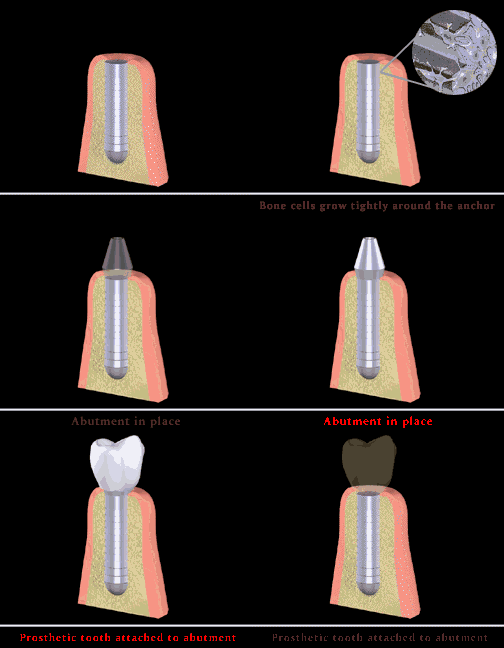
A dental implant consists of
two main parts; a fixture which is a titanium screw inserted surgically
into the jaw; an abutment, which is made of titanium and forms a link between
the fixture and the overlying bridge, crown or denture.
Implants
are ideal if single teeth are missing, avoiding the prospect of wearing
a removable denture which is often unacceptable. A single dental implant
can provide the perfect healthy solution, restoring the gap without cutting
or damaging adjacent healthy teeth.
They are
equally effective for large gaps caused by several missing teeth. Missing
molar teeth can also be replaced - even though their loss may not be visible,
it can result in considerable eating difficulties and long term dental
problems.
Implants
are commonly used in patients without any teeth in their lower jaw. A denture
is secured by two or more implants, which serve as supporting pillars providing
firm anchorage and reducing the worries of denture movement.
|
|
This
is a root form implant. These are typically put into place in the bone
and covered for 6 months, then re-exposed and a bridge is placed at that
time.
The long term
success of an implant depends largely on scrupulous oral hygiene and our
highly skilled Hygienists can assist you with this. As is the case with
your natural teeth, any lack of care can lead to inflammation of the jaw
with consequent bone loss and ultimately the removal of the tooth or implant.
|
|
One of the most beneficial
uses of dental implants is in conjunction with existing natural teeth.
If only the front teeth are remaining in the upper or lower jaw there are
only two ways to replace the missing back teeth. One method is with a removable
partial denture, with clasps, wires and plastic over the gums and the other
more natural method is with implants and fixed porcelain bridges. The bridgework
over the implants eliminates all the hardware that is part of a partial
denture. In addition to being more comfortable and stronger than a partial,
the implant supported bridge stimulates the bone which helps preserve it
and strengthens the remaining natural teeth by its splinting effect. Implant
bridges are as close as possible to restoring the mouth with natural looking
and feeling non-removable teeth.
Fitting an Implant
Implantology
is a team effort, between the Restorative Dentist, Oral Surgeon and Dental
Technician.
An initial
examination will decide whether implant treatment is the appropriate solution
in an individual patient’s case. This will then be discussed with the Surgeon
and Technician as to the suitability and practicality of the planned procedure.
For a single implant the operation
may be carried out under local anaesthetic and lasts around an hour. Longer
procedures are best carried out with the benefit of intravenous sedation,
which enables a patient to remain conscious, yet relaxed and often unable
to remember the whole procedure.
|
|
After the Operation
There is
a healing period, during which time the titanium screws take firm root
in the jaw bone. This period is usually three months for the lower and
six months for the upper, due to differing texture of the bone.
The fitting
of the abutment - the second part of the implant - is a smaller operation,
which usually lasts about 15 minutes. After a further healing period of
about a week, the surgical treatment is complete and the restorative phase
- the actual fitting of the crown bridge or denture, can go ahead.
|
Main Page |