| |
As part of the scheme of reorganization of the
Railway Board -- as recommended By the Acworth
Committee (1921) -- the Financial Commissioner for
Railways was appointed in April 1923. Pursuant to
Separation Convention of 1924, the Railway finances
were separated from the General Finances of the
Government of India. The process of the separation of
the Accounting and Auditing functions on the
Railways were completed in 1929, with the
responsibility for compilation of all the Accounts for
the Indian Railways, passing on Railway budget,
separation from the Auditor General to the Financial
Commissioner/Railways. This, incidentally, marked
the beginning of the Indian Railways Accounts
Service (IRAS) as a cadre, distinct from that of the
Indian Audit and Accounts Service (IA & AS).
1.2. The Financial Commissioner/Railways
represents the Ministry of Finance & functions as ex-
officio Secretary to the Government of India (GoI) in
the Ministry of Railways in financial matters. In this
capacity, the FC/RIys. is vested with full powers to vet
Railway expenditure, subject to the overall guidelines
of the Government of India. FC/Rlys. has direct access
to the Hon'ble Finance Minister in case she/he needs to
keep him informed of any development(s) and seek his
intervention.
2.1 Organisationally, the Finance and Accounts
functions are integrated with the executive at all the
three levels: (a) Railway Board (Apex) level; (b)
Railway Zonal level; and (c) Railway Divisional level.
(At the apex level of policy formulation, the Financial
Commissioner/Railways is assisted by the Additional
Member (Finance) Additional Member (Budget),
Adviser (Finance) and Adviser (Accounting Reforms)
and Executive Directors in-charge of Budgeting,
Expenditure, Earnings, Accounting (and Accounting
Development/Reforms aspects), is there to aid and
guide the Ministry of Railways (Railway Board). At
the Zonal level, the General Manager is aided and
assisted by the Financial Adviser and Chief Accounts
Officer along with a team of Officers. At the
Divisional level, which is the Executive unit of the
Zonal Railways, an identical arrangement exists to
assist the Divisional Railway Manager in accounting
and finance matters.
2.2 Besides, there are major Production Units to
manufacture locomotives, coaches, - wagons, wheels
components; repair workshops for maintenance of the
assets. These units have an in-house finance and
accounts set-up. The stores organization, which is
responsible for procurement of stores and materials
worth thousands of crores of rupees, is also assisted by
Finance & Accounts set-up. In short, there is hardly any
sphere of railway activity with which the Accounts and
Finance organization is not directly associated in the
decision-making process. In addition, officers of the
Service also occupy managerial posts such as Divisional
Railway Managers, Additional General Managers etc.
3.1 Indian Railway Accounts Service (IRAS) is one
of the Group A Services in the " Government of India,
for which the candidates are recruited through Civil
Service Examinations, conducted every year by the
UPSC. The other Group A Services in the same field are:
(i) Indian Audit and Accounts Service (IA&AS) (ii)
Indian Defence Account Service (IDAS) (iii) Indian
Postal and Telecommunication Finance and Accounts
Service (IP&TF AS) (iv) Indian Civil Accounts Service
(ICAS) (v) Indian Cost Account Service.
3.2. The candidates recruited into IRAS belong to
passenger and goods - to other modes of transport,
particularly Road - has been one of the biggest
challenges facing the Railways. Exploring both
traditional and non-traditional sources of revenue to
augment the revenues, rightsizing the human resource to
contain the cost to remain cost - competitive with other
modes of transport are the crying need of the hour.
various disciplines of study; but are trained at LBS
National Academy Association/Mussorie, Railway
Staff College/Vadodara and National Institute of
Financial Management (NIFM) (under Department of
Expenditure in the Ministry of Finance) at Faridabad.
The officers are exposed to the various aspects of
management, law, public administration, Accounting
and Financial Management, IT working environment
in the Government of India and Railways, during the
probation and the in-service training.
4.1 IRAS officers are exposed to a variety of
assignments to acquire a thorough and varied
experience, an incisive professional expertise, which
will do credit to anyone, whether within the Railways or
outside it. A number of IRAS officers have performed
themselves creditably, serving/having served outside
the Railways with distinction, be it a department of the
Government of India or a Public Sector Undertaking or
to a multi-lateral lending institution like the Asian
Development Bank or World Bank.
5. Within the Railway itself, the officers of the Service have a legitimate sense of satisfaction in playing a pioneering role ,in the field of computers, introduction of, technique of modern financial management like Discounted Cash Flow (DCF) and exception reporting; exchequer control as a tool in budgetary control; restructuring of the budgetary and accounting system, including institution of a system of performance budgeting and responsibility accounting, traffic costing, implementation of incentive schemes in workshops, taking over of pension work ~ from the Auditor General etc. The list is merely illustrative and not exhaustive.
6.1 Railway Accounts Service Officers are to be
alive to the Strengths, Weaknesses, Opportunities and
Threats (SWOT) in the system to enable them to play
their role effectively. Diversion of traffic - both passenger and goods - to other modes of transport, particularly Road - has been one of the biggest challenges facing the Railways. Exploring both traditional and non-traditional sources of revenue to augment the revenues, rightsizing the human resource to contain the cost to remain cost - competitive with other modes of transport are the crying need of the hour.
6.2. The wholly Government-owned financial
institution, Indian Railways Finance Corporation
(IRFC), which is the financing arm of Indian
Railways, is managed fully by officers of IRAS. This
institution has set exemplary standards in low-cost
commercial borrowing at national and global level.
7. IRAS is also one of the first Central Service to
have its own website (http://www.irastimes.org),
managed entirely in-house. The website, along with the
associated Message Board, enable the IRAS officers,
spread all over India, to remain in touch with each other
and keep themselves posted of the latest developments
concerning professional and other Issues.
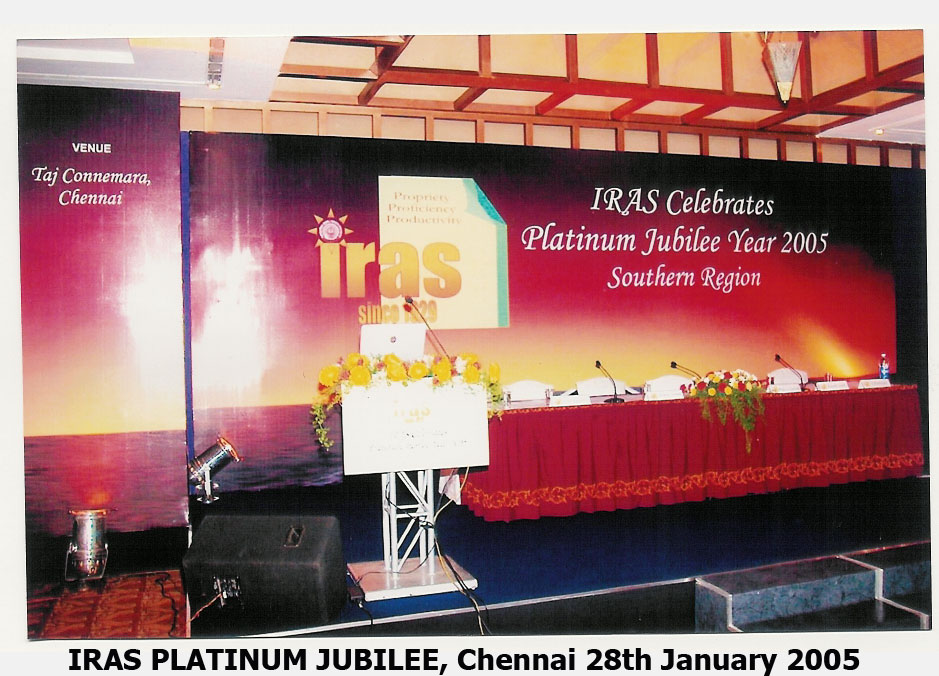
8.1 The members of the IRAS (now about 550 in number approximately) take pride in belonging to what is both a Railway Accounting Service and a Finance service. It has served in both the spheres with dedication, earnestness and distinction. As the service enters its 75th year, it is time we took stock of the varied achievements, reflected on the emerging role amidst the challenges faced by the Railways and discover how to discharge the facilitating role expected of us effectively.
8.2 Railway Accounts officers, particularly those
belonging to IRAS, have to constantly and
continuously update their knowledge, skills and
expertise thro' continuing Professional Development
programmes to help Railway to survive the threats
and exploit the opportunities and to fulfill the
aspirations of the Rail Users.
|