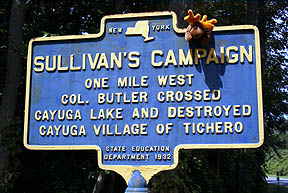
Ira with Marker
N 42° 56.810 W 077° 42.660
Ira with Marker
N 42° 56.810 W 077° 42.660
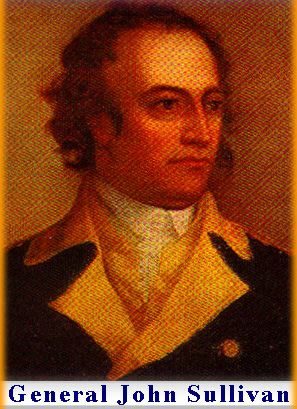
So frequent had been the forages of the Indians which had always been conducted with much cruelty, that it was decided to make an expedition into the land of the Iroquois and "pay them off in their own coin." Washington made his dispositions as early as January, 1779. John Sullivan, the New Hampshire lawyer chosen to command the expedition, had proved his competence as an improvised major general.
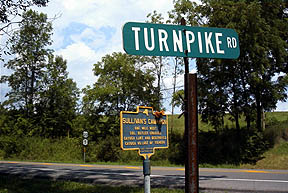
Historical marker located on the corner of Turnpike Road and NYS Rts. 5 & 20.
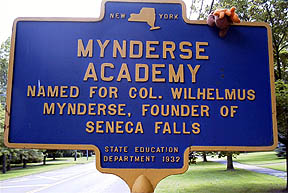
N 42° 54.787 W 076° 47.724
Ira with Marker
Wilhelmus Mynderse, the earliest resident proprietor of a large portion of the site of Seneca Falls - owning a one-fifth interest in the Bayard Land Co., then the owners of the land and water power where Seneca Falls village stands and of which company he was resident business agent for thirty years - located here permanently in 1795. No other single individual had as much to do with the beginning of the settlement here, its subsequent growth to a prosperous village and the location here of early industries as Wilhelmus Mynderse.
The year he came here he erected a grist and a saw mill and a double log house, the latter being located next to where Trinity Church now stands. He lived in one end and kept store in the other. The mill which was put in operation in 1796 stood on the present site of Chamberlain's mill. In 1807 he erected the red mills on the lower rapids near Rumsey's. He also erected a fulling mill and other small industries. His various investments proved profitable and he was a man of strict business methods. His was the very first industry here. The entries of his milling and merchandise business date as early as April 20, 1796. The first entry of sales from his grist mill dates Oct. 22, 1796. In 1801 he was appointed lieutenant -colonel in the militia of which he soon became colonel. In 1807 he was commissioned brigadier-general.
During his residence here Col. Mynderse lived in four towns as they were successively organized, Romulus (first in Cayuga County), Washington, Junius and Seneca Falls, and held many public offices.
He was born in at Albany, July 11, 1767, and died Jan. 31, 1838, in the house he built and for years occupied.
Mr. Mynderse lived to see a flourishing village spring from a forest. He did much to encourage its growth. The village park was his gift to the village and he was a generous patron of the Academy which bears his name - now part of the public school system. He contributed the site and furnished the greater part of the means for building the original building.
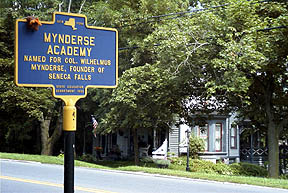
Sign is located across Cayuga Street from the Hubbell House Bed & Breakfast on VanCleef Lake. There is a geocache (GCG87W) hidden in the small park near the sign. There is also a benchmark (NB0556) nearby.
N 42° 54.673 W 076° 47.737
Ira with Marker
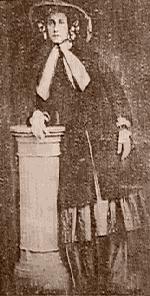
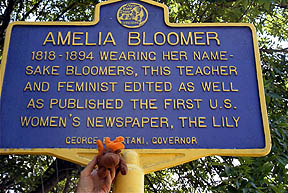
Amelia Bloomer lived in Seneca Falls in 1848, but was not an active participant in the Convention. In 1850 or 1851 she introduced fellow temperance worker Susan B. Anthony to Elizabeth Cady Stanton, initiating a collaboration that would last half a century.
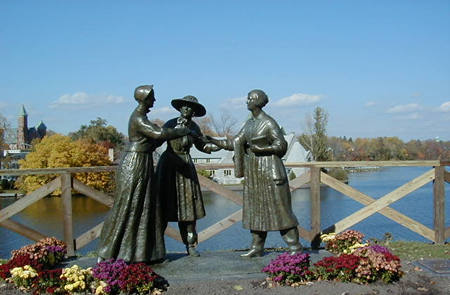
In 1849, Bloomer began publication of The Lily, a monthly temperance paper. The paper soon became a voice for Stanton and other advocates of women's interests. The paper became an active voice for change in women's dress, and the abandonment of restrictive clothing in favor of shorter skirts and knee-length undergarments that came to be known as Bloomers. (The outfit was actually designed by Elizabeth Smith Miller, daughter of Stanton's Cousin Gerrit Smith).
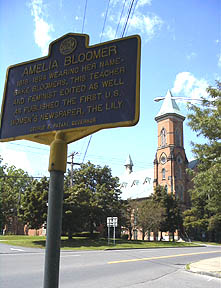
Sign located across Cayuga Street from the Presbyterian Church.
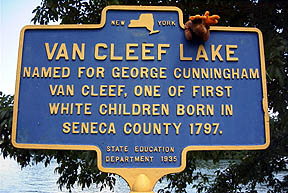
N 42° 54.632 W 076° 47.652
Ira with Marker
In 1915, the State widened the old Cayuga-Seneca Canal and replaced the old smaller locks with the larger two-lock combination that exists today, in the process flooding what was once known as "The Flats", thus erasing from existence over 116 industrial buildings and over 60 homes. Van Cleef Lake was created during this project as a reservoir for the locks and the Cayuga-Seneca Canal is of increasing importance to Seneca Falls.
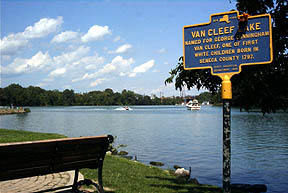
Sign located at juncture of Trinity and Falls streets.
Boats and jet skis waiting to be locked through.