
New Economy
Future Look
Ibrahim Qazzaz
Institutionen f�r Ekonomi
H�gskolan i G�vle
March 2004
Executive Summary
This paper is projection trial for economy. The PEST model for analysing new economy is used. Attempt is to base forecast on facts of today. Changes are enabled by different parameters of PETS. However development nowadays is complicated and needs sometime. Evolution therefore is hard to be done secretly (at least the technical development should give a product that supports common standards accepted by all game players). This allows for making realistic prediction for ~3 years.
Last century witnessed several technical revolutions (Mobile Communications, Internet, Satellite Communication, Biomedicine, etc) which enabled many changes we see in our daily life. It is expected in this study that no imminent revolution but a follow up evolution, most probably in (Mobile Internet) which will pave way to Mobile-Commerce.
1.1 Scope
The assignment did not specify the time span of study. Neither did it identify region or country. Therefore it is assumed that time span is 5-7 years with global analysis. It might be however add some Swedish touches.
It is beneficial to make it clear that this subject could look like science fiction (going far without limits), therefore future forecast should be based on concrete facts of toady to be realistic. Visionary thoughts are also important.
2 Business: Future Look
2.1 Methodology
The model presented in (Eriksson & Holt�n, De Nya Aff�rssmodellerna) is adopted in this report. Model is redrawn below.
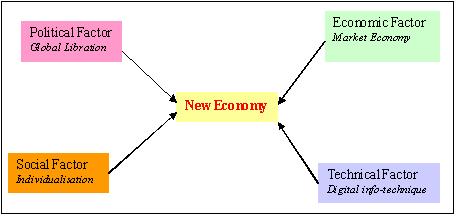
The only remark on using this model is the difficulty of studying each of these four factors separately. Strong correlation is hard to ignore.
2.2 Social Factor: Individual and Society:
2.2.1 Expected problems
* Human rights and freedom got a setback after terrorist attacks of 11/9. USA (at least current admin) violates international agreements (e.g. Geneva Code, etc) as well individual freedom through (Patriotism Code).
* Human life is going longer due to development in medicine, etc. Population growth on the other hand is decreasing (already negative in some European countries). Pressure on governments to sustain enough pension allowance is increasing.
* Stress is a new health threat has aroused. (Work-life) balance is a new sought need for top executives.
2.2.2 Confrontation:
Violence takes new forms. Attacks on websites of opponent groups, ideologies, etc are expected to increase.
Nuclear-power communities are vulnerable to terror that proved not be costly. Deep analysis and wise measures are needed. Success is not assured.
2.2.3 Labour:
Will we see change of work environments? Many enterprises had already moved to open landscape (for lowering area cost, although claiming other reasons!). Many people working in design more people are working partly from home. Many data entry and help desk support are moving to countries with cheaper labour cost. All this may continue to increase.
2.2.4 New Culture
* Instead of a postcard, send an MMS. The technology enables the development of message communications between mobiles by adding images and even sound to text. Europeans and Americans will probably soon behave like Japanese, who use their mobile phones for many services like gaming on line .
* Price fall is expected to have positive implication on social welfare through savings increase .
2.3 Political Factor
2.3.1 International
2.3.1.1 Vacuum:
The uni-polar status after USSR collapse will not sustain! Nature is against vacuum. Today we are witnessing the madness of power used by USA in many aspects. It is inevitable that we will soon observe the birth of a new super power that could be China or EU (or even something else). In the light of that it is not easy to know the impact. While writing this report and two years after WTO authorisation, EU imposed tax sanctions against American goods in response to tax exemptions donated by American authorities to American exporters. May be more escalations could occur. It is not completely unexpected anyhow that a new power in the world would not go to previous type of conflicts we had in 20th century (World War I and II). Impact on economy has both positive (creating new innovations for civil use and quickening changes) and negative (loss of humans and assets) angles.
2.3.1.2 Role of UN and international agencies:
Trade liberation as such is a positive thing, however when it overshadowed by unbalanced power; it would lead to widening the rift between rich and poor communities. WTO stipulates for example refusal of protectionism on its codes, however this issue is not in favour of poor communities as it directly killed local agriculture of essential products (wheat). The more general bitter fact is violation of international agreements whenever they collide with their short term interest (e.g attacking Iraq without UN authorisation). This may leave a question mark about the role (and may be existence) of UN (League of Nation collapsed in 1946 as a result of failure to protect international peace!).
2.4 Economic Factor: Market & Business
2.4.1 Specialization and Restructuring
More and more companies are deeply going to a narrow area of specialization. For example, Ericsson (less than halved compared to 3 years ago) terminated many business development units and focused on most profitable ones. Likewise new concept of complementary industry had already emerged. Examples are many: an obscure Chinese company (Yue Yuen) manufactures sport shoes for (Puma, Adidas, Nike, etc). This ODM (Original Design Manufacturing) concept is generalised for many industry sectors. Flextronics is the manufacturer for telecom equipments of Siemens, Ericsson, etc which opt to work mainly in design as well as CRM. Some other companies even granted the design to others (e.g Arima of Taiwan and Microcell of Finland for mobile terminals) and do specification task for sourced products.
While telecom operators are buying telecom products from vendors, some European operators have chosen to buy equipment as well Operation and Maintenance (O&M) from suppliers, while others were even interested in leasing products to avoid big investment.
This restructuring trend is expected to continue as far as feasibility is sustained.
2.4.2 Web-business
More business will be Internet/ IT driven. Today there are different categories of business models on the web (with blending possibilities), like :
1. Brokerage
2. Advertising
3. Infomediary
4. Merchant
5. Manufacturer
6. Affiliate
7. Community
8. Subscription
9. Utility
These will be aggregated, promoted and new forms may emerge.
2.4.3 Ubiquity of Internet, E-Commerce and E-Business:
Several reflections about this question:
1) Market turbulences: Similar to other cases (e.g TV, computer industry, etc), many investors with and without well defined business model thrust upon new area causing the primary overshooting. E-commerce is no exception; market of e-commerce is overcrowded with two types of investors : Breakthrough applications and Re-formed applications. This is valid for all nine segments of web-business. Few of them which are really customer-oriented will survive after the shakeout. Follow up of customer requirements and behaviour in addition to offering �rich service� content are important enablers. Yahoo and eBay have interesting experience with positive prospect of success.
2) E-commerce segments may vary from retail to B2B. The boundaries are not very clear nowadays, but expected to have distinct definition in the near future.
3) Web commerce lowered buyer�s search cost (and may be delivery). Furthermore it lowered marketing and logistic cost for suppliers. Web commerce in that sense lends itself to further pressure on price. Will it surprising that some retail suppliers will merge, and others will disappear?
4) Depending on government measures, cross boarder global trade fooling custom system may increase.
5) Many business sectors need steering. Media and newspapers are examples . Bookstores need on the other hand to align themselves to fierce competition from web based bookstores. Likewise copyrights (for books, music and songs) have to be re-envisaged.
6) Internet imposes transparency. Double-side messages towards investors from one side and towards customers in another side can not be hidden and thus should be adjusted. One common message saluting human values will be acceptable by both. Philips has already chosen (Let�s make things better), Nokia: (Connecting people), Ericsson (Make yourself heard), etc.
2.4.4 Human factor in business:
Scandals in big companies (Enron, MCI among others in USA, Skandia, ABB, etc in Sweden) will hopefully drive setting ethics for business making.
Some expect that HR, IT and facility management will merge.
2.5 Technical Factor
2.5.1 Orientation
One important angle to consider while describing where we are now compared to one or two decades ago, is orientation. Services we got (e.g in telecom area) used to be technology oriented, but today it is more and more going to be human need oriented. It is no wonder that technical developers used to have one or two person working in the so called Man-Machine-Interface (MMI). Today it has been expanded a lot and one will find full departments working on this issue under a new name (e.g Usability) in order to investigate Use Cases, simplify interfaces, ease menus.
ISDN (Integrated Service Digital Network) was launched in early 80�s of last century to allow users to have video calls and data communication (Multimeia) over fixed telephone lines. Not being user-friendly, this service has seen very limited success until Internet was publicly accessible. Internet was the catalyst for people to use ISDN, which did not fulfil the desires of bandwidth-thirsty users who moved quickly to broadband access.
Internet got a new dimension and won more publicity through Java creation which enabled interactive user interface (send and receive processes).
2.5.1.1 Case Study:
3rd Generation of Mobile Telecommunications (UMTS): Five M�s are considered to be killer applications for UMTS : (Human orientation is visible on those M�s ):
- Movements: Being global.
- Moment: expanding time (multi-task, plan, catch up, real-time, etc).
- Me: Expanding of (personals, customised, community, etc).
- Money: expanding financial resources.
- Machines: expanding devices.
2.5.2 Market shuffle
It is true that many companies and some businesses have vanished aftermath information revolution, however new business opportunities were created. Web business model are example. Taking telecom example following remarks are noted:
� In the light of deceleration of number of subscribers, fixed telephony operators are struggling to stay alive. Price pressure due to hard competition is another nightmare. Recreating a new business model (rich package of services and application accompanied by broadband access to all subscribers) is a must. Merger between operators may be a useful alternative.
� The winner is mobile business with a diversity of provisioning players (virtual operators providing with rented infrastructure is already there) including access, content, messaging, and broadcasting.
� Nokia CEO expects capabilities of today�s PC will be available in mobile phones will be available in smart phones. With the exception of display size limitation, it could happen even faster.
� It is important not to mix up things. Dot com sabotage should not lead to neglect high-tech really changed our life and created new culture for large segment of people in their daily life (reading e-news, working from home, e-shopping, e-entertainment, finding spouse over internet). Next to expect on commercial use (already prototypes today in technical exhibitions) is to connect everything to everything. All again energised by human need use cases.
2.5.3 Conclusion of Technical Factor: M-Commerce
Internet was the bulldozer that paved way towards many positive changes in Economy (E-Commerce and E-Business) during last decade. Given that and knowing that new wave to technology drive would be mobile data and mobile Internet, I believe that M-Commerce will be the result.
2.5.3.1 What should one expect from M-Commerce?
For individual: all money transaction can be done anytime anywhere using the mobile phone. The phone can be a (bar-reader) for bill payments, and direct payment while doing shopping in stores. It should also enable making orders for many kinds of shopping. Location based services (LCS) is another enabler for M-Commerce.
For Business: One step above E-Business will be reached: M-Business. Employees do not need to be at office to do their tasks. Many activities should be done through connecting to the corporate network via mobiles (Mobile VPN ). Supply chain is an example .
For Financial Sector: Banks and stock markets should adapt themselves to the leap.
References:
1. Eriksson & Holt�n, De Nya Aff�rssmodellerna, 2001.
2. Contact, Ericsson Employee publication.
3. The Emerging Landscape for Retail E-Commerce, Yannis Bakos, New York Uinveristy. Journal of Economic Perspectives, Jan 2001.
4. WTO documents. www.wto.org
5. BBC website www.bbc.co.uk or http://news.bbc.co.uk/1/hi/business/default.stm
6. Professor Michael Rappa, Business Models on the web, NC State University. Paper available on www.digtalenterprise.org
7. Aftonbladet website: www.aftonbladet.se
8. Global Change e-magazine, www.globalchange.com with presentation from Dr. Patrick Dixon
9. T.Ahonen & J.Barett, Services for UMTS, J.Wiley, 2002.
10. GSM association resource, http://www.gsmworld.com/index.shtml .
11. Bitpipe resource for White Papers: www.bitpipe.com
12. Shakeouts in Digital Markets. G. Day (University of Pennsylvania) & A. Fein (Pembroke
Consulting Inc).