Change-ing.com
 
Home >>
Change >>
Personal Info >>
Research >>
Whatis ERP >>
ERP Vendors >>
Blog >>
Books >>
Goldratt's Goal >>
Articles >>
Wicca >>
Convertor >>
Mutual Fund >>
Clickon URL >>
WWF>>
Contact Me >>
Models of Change (DRAFT)

One of the most common change models is: ADKAR model for change management. This diagnostic tool helps employees understand where they are in the change process. The term ADKAR is an acronym for the Phases of change for employees: Awareness, Desire, Knowledge, Ability and Reinforcement.

The ADKAR model can be used to:

Diagnose employee resistance

Help employees transition through the change process

Create a successful action plan for personal and professional advancement during change

Develop a change management plan for your employees

This model helps us in understanding "why changes are not working". We can take necessary remedial steps to sort out the bottlenecks during implementation. It helps us in breaking down the whole initiative into smaller parts, understands where the change is failing and then addresses the impact point. It also helps in creating smaller achievable goals and boosts the transformation.

Effective management of the people dimension of change requires managing five key phases that form the basis of the ADKAR model:

Awareness of the need to change

Desire to participate and support the change

Knowledge of how to change (and what the change looks like)

Ability to implement the change on a day-to-day basis

Reinforcement to keep the change in place

Successful change happens when both dimensions of change occur simultaneously (McKinsey 7-S Model Elements). Since many change projects experience resistance from managers and employees, their progress on the people dimensions stall. This is why change management is often cited as the most important success factor for large change projects.

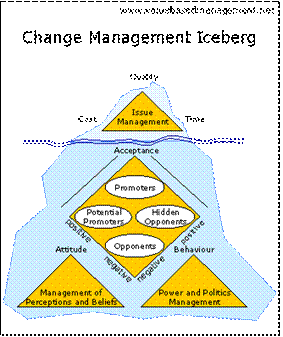
The Implementation and Change Management Iceberg of Wilfried Krüger is a strong visualization of what is arguably the essence of change in organizations: dealing with barriers .

According to Krüger many change managers only consider the top of the iceberg: Cost, Quality and Time ("Issue Management"). However, below the surface there are 2 more dimensions of change and implementation management:

Management of Perceptions and Beliefs, and

Power and Politics Management

What kind of barriers arise, what kind of Implementation Management is consequently needed, depends on:

The kind of change

Hard things (Hard S McKinsey) "only" (information systems, processes) just scratches the surface,

Soft things (Soft S McKinsey) also (values, mindsets and capabilities) is much more profound

The applied change strategy

Revolutionary, dramatic change as in Business Process Reengineering

Evolutionary, incremental change as in Kaizen

Below the surface of the Change Management Iceberg:

Opponents have both a negative general attitude towards change AND a negative behavior towards this particular personal change. They need to be controlled by Management of Perceptions and Beliefs to change their minds as far as possible.

Promoters on the other hand have both positive generic attitude towards change AND are positive about this particular change for them personally. They take advantage of the change and will hence support it.

Hidden Opponents have a negative generic attitude towards change although they seem to be supporting the change on a superficial level ("Opportunists"). Here Management of Perceptions and Beliefs supported by information (Issue Management) is needed to change their attitude.

Potential Promoters have a generic positive attitude towards change, however for certain reasons they are not convinced (yet) about this particular change. Power and Politics Management seems to be appropriate in this case.

According to Krüger dealing with change is a permanent task and challenge for general management. Superficial Issue Management can only achieve results at a level consistent with the Acceptance that is below the surface. The base of the Change Management Iceberg is rooted in both the interpersonal and behavioral dimension and the normative and cultural dimension, and is subject to Power and Politics Management and to the Management of Perceptions and Beliefs.


Change Management Iceberg

The Change Model (also: Change Formula, Change Equation) of Beckhard and Harris (1987) is actually attributed by them to David Gleicher. It is a simple yet powerful tool that gives you a quick, first impression of the possibilities and conditions to change an organization.

The move to employee involvement in change, and the use of internal or external consultants to manage reactions to change, represents a shift in thinking from earlier management theory, such as Charles Taylor's scientific management approach, which became known as Taylorism. This "command-and-control" approach drew a sharp line between managers and employees. The underlying philosophy was that "workers work, managers think." Taylor 's method was a reflection of the times, i.e., the industrial age with its factories unions, and assembly lines - environments that needed tight management control.

Taylor 's view was eventually complemented (replaced) by the human relations movement, as organizational psychology and group dynamics evolved, paving the way for more worker involvement and benefits, and the theory of worker motivation.


The Change Model Formula (Change Equation) is:

D x V x F > R = Dissatisfaction x Vision x First Steps  > Resistance to Change

It is important to note that the three components must all be present to overcome the resistance to change in an organization: Dissatisfaction with the present situation, a Vision of what is possible in the future, and achievable First steps towards reaching this vision.

If any of the three is zero or near zero, the product will also be zero or near zero and the resistance to change will dominate.

In their book 'Managing Change for Competitive Success' (1991), Pettigrew and Whipp distinguish between three dimensions of strategic change:

1. Content (objectives, purpose and goals) - WHAT

2. Process (implementation) - HOW

3. Context (the internal and external environment) - WHERE

Pettigrew and Whipp emphasize the continuous interplay between these change dimensions. The implementation of change is an "iterative, cumulative and reformulation-in-use process." Successful change is a result of the interaction between the content and what of change (objectives, purpose and goals); the process or how of change (implementation); and the organizational context or where of change (the internal and external environment). Based on substantial empirical research, they also present five central interrelated factors belonging to successfully managing strategic change:

Environmental assessment (continuous monitoring of both the internal and external environment [competition] of the organization through open learning systems)

Human resources as assets and liabilities (employees should know they are seen as valuable and feel trusted by the organization)

Linking strategic and operational change (Intentions are implemented and transformed through time, bundling of operational activities is powerful and can lead to new strategic changes)

Leading change (Move the organization forwards; creating the right climate for change, coordinating activities, steering. Setting the agenda not only for the direction of the change, but also for the right vision and values)

Overall coherence (a change strategy should be consistent (clear goals), consonant (with its environment), provide a competitive edge and be feasible.

Kotter - Change Phases . Often, creating value requires significant change. John Kotter concluded in his book "A force for Change: How Leadership Differs from Management" (1990) that there are eight reasons why many change processes fail:

Allowing to much complexity

Failing to build a substantial coalition

Understanding the need for a clear vision

Failing to clearly communicate the vision

Permitting roadblocks against the vision

Not planning and getting short-term wins

Declaring victory too soon

Not anchoring changes in corporate culture

To prevent making these mistakes, Kotter created the following eight-change phase's model :

Establish a sense of urgency

Create a coalition

Develop a clear vision

Share the vision

Empower people to clear obstacles

Secure short-term wins

Consolidate and keep moving

Anchor the change

According to Kotter, it is crucial to follow the eight phases of change in the above exact sequence.

When planning organizational change, there are three key dimensions which have an enormous influence.  The magnitude of change can fall along a continuum ranging from incremental changes that involve fine-tuning the organization to quantum changes (what Sumantra Ghoshal calls Radical Change - the whole culture of the organization is touched and modified) that entail fundamentally altering how it operates. The second dimension is the degree of organization . If a change is over organized, situations can be highly mechanistic, bureaucratic organizations, various dimensions such as leadership styles, job designs, organization structure, and policies and procedures are too rigid and overly defined for effective task performance.  The third dimension involves whether the organization contains domestic or international settings .  Planned change efforts traditionally have been applied in North American and European settings but increasingly are used outside of those cultures.  These cultural values need to be kept in mind when planning organizational change.

Once the diagnosis has been made and the main problems have been detected, the implementation of changes is necessary. This step is fundamental to overcome the organization's troubles. Cummings and Worley (1993) define five activities to be implemented in the managing change process

1. Motivating change. This includes creating readiness for change and overcoming resistance to change. It is to create an appropriate organizational environment to start the process of change.

2. Creating a vision. This step aims to create directions for evaluating the process.

3. Developing political support . The support from powerful individuals and groups assures a successful implementation of the measures for change.

4. Managing the transition . In this phase plans to accommodate the change are made, especially in the transitional period.

5. Sustaining momentum. This includes gathering resources and reinforcing the organization for the changes needed.

(Draft Copy. Do not quote without references. Some of the information are from PROSCI and www.12manage.com)

Updated On. October 2007. Contact. Ipshita Novonil Guha ([email protected])
Google


Hosted by www.Geocities.ws

1