 |
| * It may be getting here even faster than we thought! Click here for a mind-boggling synopsis of the most significant science and technology stories of 2001, as compiled by Ray Kurzweil. |
 |
 |
| Science News |
| The Future is Coming at Warp Speed * |
| AI is getting smarter every day A San Diego software development firm says it has solved one of the hardest problems in artificial intelligence (AI), successfully extracting hierarchical categories from streams of sensory data. (story 12/13/01) |
 |
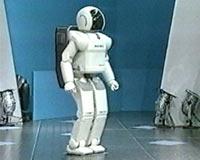
| Honda builds a full-size walking, talking robot Japanese automaker Honda Motor Co. has demonstrated an upgraded version of its walking humanoid robot "Asimo" that can recite programmed phrases and maneuver on stairways. (story 12/31/01) |
 |
| Intel announces "TeraHertz" transistor structure Intel Corp. has devised a new structure for transistors that cycle on and off one trillion times per second -- a development that could lead to microprocessors that run at blazing speeds and consume far less power than conventional ones. (story 11/25/01) |
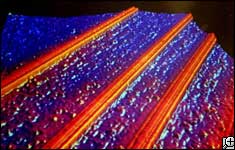
| A brave new world is being built atom by atom and molecule by molecule inside laboratories around the world. Nanotechnology like these tiny wires promises to touch everything from medicine and biology to engineering and electronics. |
 |
 |
| FOR MORE ON Click Here YOUR FUTURE |
| Great progress on "nanocomputers" in 2001 Researchers at Harvard University, Penn State, Bell Laboratories, IBM, and elsewhere have reported making the equivalents of switches, wires and transistors on a molecular level within the past year. (story 1/1/02) |
| Thanks to John Smart (see his site at www.SingularityWatch.com) for alerting us to several of these exciting developments. |
| Scientists track down human longevity genes DNA analysis of exceptionally long-lived siblings has enabled scientists to find the location of genes that appear to give certain people the ability to live to age 100 and beyond. The next step is to figure out the biochemical pathways that the responsible gene or genes impact in order to foster longevity. This could lead to the development of drugs that imitate the action of longevity genes, the researchers said. (Reuters 8/27/01) |
| Researchers grow "artificial eyeballs" A group of researchers at Tokyo University have succeeded in growing eyeballs in tadpoles using cells taken from frog embryos, a development that in the future might help enable blind people to regain vision. (story 1/5/02) |
| Tiny sensors to be implanted in hearts Researchers in Cleveland will soon begin implanting tiny, experimental microchip sensors into the hearts of patients, hoping the wireless, battery-less devices will provide early warnings of danger. (UPI Science News, 1/23/02) |
| Patent for molecular computing awarded Hewlett-Packard and UCLA have received a U.S. patent for technology that could make it possible to build very complex logic chips -- simply and inexpensively -- at the molecular scale. (announced 1/23/02) |
| Scientists fabricate microscale "bicycle chain" Scientists have manufactured a microscale bicycle chain comprised of silicon links thinner than a human hair that behaves just like its regular-sized counterpart. The tiny chain system could one day help power microscopic devices. (story 1/16/02) |
| Tiny silicon grains for lasers on a chip Nanoscale silicon grains that emit laser light may in the future serve as the backbone of an optical computer network light years faster than today's Internet. (story 1/11/02) |
| Vivid insight provided into workings of the brain Researchers in London have developed Vivid (virtual in-vivo interactive dissection), a system that noninvasively detects patterns of nerve connections inside the brains of living people. (story 1/18/02) |