|
|
T A I J I |
|

Tai chi is known as a practice or meditation in motion, which consists of 24 to 108 elements, and which has beneficial effect on human organism in general. There are few who haven’t seen Chinese people in parks practicing Tai Chi by deliberately making slow, rhythmic movements and moving as if dancing on air.
Not many people know that Tai chi is originally a martial art and that it’s a part of Chinese martial arts (Wu Shu). Translated Tai chi means something immense or infinite. Depending on the form, there is a suffix, for example: Tai chi Chuan (for Forms without use of weapon) or Tai chi Sabre Form etc.
Origins
The origins of Tai chi are obscure. There are many legends concerning the origins of this martial art, the most popular legend is the one that names Chang San-feng as the founder of Tai Chi.
He is believed to be born in 1247, and the date of his death is unknown, according to legend he lived 200 years. Like his parents, Chang was a clerk. After the death of his parents, he goes to the famous Shao-lin Temple where he devotes himself to Buddhism and martial arts, which were in full expansion in the temple at the time.
There are three legends of Chang’s creating Tai chi. According to the first, it happened while he was meditating on the Wu Dang Mountain. The second legend says that Tai Chi came to him in a dream, and the third legend says that Tai Chi originated in a fight between a snake and a crane. Impressed by the white crane’s skill in attacking the snake and the snakes skill in avoiding the attacks by swift, circular movements, Chang creates Tai Chi by adapting these movements and combining them with his knowledge of harmony between Heaven, Man and the Earth.
Chang also laid basic Tai Chi principles: force and aggressiveness are overcome with tranquillity and slow movements. Tranquillity overcomes force.
Stilovi
u Tai Či-u
Chen
style
The oldest known Form of Tai Chi begins in Chen family (and with it ‘modern’ history of Tai Chi as well). The founder of this style is Chen Wang Ting (1600-1680). This style is characterized by sudden, explosive movements, swiftness in the change of tempo (yin/yang), hitting the ground hard with your feet, jumps and low postures.
Yang style
The originator of this style is Yang Lu Chan (1799-1872). He was the first disciple to a founder of Chen style Chen Wang Ting not coming from Chen family. Being taught everything from Chen Tai Chi and having previous martial arts knowledge, he creates Tai Chi Yang style, which is the most popular in the world today. This style is characterised by slow motions and soft circular movements.
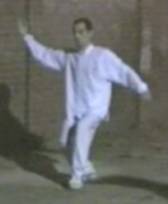
Yang style – "white crane spreads its wings"
There are two Wu styles. The founder of the first one is Chuan You (1832-1902).
Characteristics of this style are compact forms, slow movements and mild forward stooping of the body in such a way that head, spine and back spread leg form straight line.
The founder of the second style is Wu Yuxiang (1812- 1880). This style is characterised by compact forms, high postures, body held straight. Arms do not cross and they are not spread wider than feet.
The founder of this style is Sun Lutang (1861-1932). As the master of the other two inner styles, he puts in key elements of those styles. This style is characterized by high postures, uniform tempo, minimal number of strikes and small but spry steps
There is a question how come that a single martial art has become so popular among all generations and almost lost its fighting character and was assigned a therapeutical- healing one. This topic requires a lot of space and that’s why I’ll state only some crucial things that make Tai Chi a path to healthier living.
All of the Chinese martial arts are based on Qi (chi), the inner energy, and Tai Chi is one of the representatives of the so called soft school, that pays special attention to this life energy and its equilibrium and harmony with the environment.
Slow movements in Tai Chi forms help people breathe regularly and deeply, and they stabilise heart beats.
The movements themselves help muscles to stretch, ankles and wrists to twist, which makes an efficient worm up exercise, and circular waist movements provide a massage for the internal organs and induce them to activity. Focusing on the movements relaxes mind and releases from stress that piles up during the regular daily activities.
These are only some of the benefits of the regular Tai Chi practice, and today Tai Chi is literally a path to health.
Nowadays, Tai Chi is practiced all over the world. There are dozens of different forms that came to being directly from one of the styles or by mixing of the five main styles. The most popular are the Yang style and then the Chen style forms.
Realizing the importance of Tai Chi, and wishing to introduce it to as large number of people as possible, the government of China with the help from the Tai Chi masters creates more simple forms (24 moves) and introduces them in schools as a part of the regular physical education.
Outside China there are also competition forms that again came to being out of wish to introduce Tai Chi to greater number of people. The most popular competition form consists of 42 moves and it will represent Tai Chi as a part of Wu Shu on the oncoming Olympic Games in Beijing in 2008.