|
|
K U N G F U |
|

Wu Shu and/or Kung Fu?
As soon as Chinese Martial Arts are mentioned most people instantly think of Kung Fu and legendary Bruce Lee, although the term Wu Shu can often be heard lately. Before I give any other explanation I'll briefly explain these two terms.
 Kung
Fu (or more correctly Gung Fu) is the most usual term used outside of China
for all of the martial arts that have developed on the territory of China. The
term was used for the first time in the sixties of the previous century and it's
used as a synonym for all Chinese martial arts. The term itself has no direct
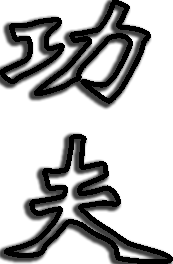
connection to martial arts, translated it means: Gong (功) - virtue, merit, accomplishment; Fu
(夫) - man.
Kung
Fu (or more correctly Gung Fu) is the most usual term used outside of China
for all of the martial arts that have developed on the territory of China. The
term was used for the first time in the sixties of the previous century and it's
used as a synonym for all Chinese martial arts. The term itself has no direct
connection to martial arts, translated it means: Gong (功) - virtue, merit, accomplishment; Fu
(夫) - man.
 Wu
Shu is more correct term for Chinese martial arts and on the territory
of the People's Republic of China far more inteligible.Translated it means: Wu
- militant, martial, warlike i Shu - method, technique, skill (art). Therefore,
freely translated Wu Shu means Martial Art. This term becomes more and more
popular although sometimes it is unclear weather it refers to all of the martial
arts or just to so called ‘Modern Wu Shu’.
Wu
Shu is more correct term for Chinese martial arts and on the territory
of the People's Republic of China far more inteligible.Translated it means: Wu
- militant, martial, warlike i Shu - method, technique, skill (art). Therefore,
freely translated Wu Shu means Martial Art. This term becomes more and more
popular although sometimes it is unclear weather it refers to all of the martial
arts or just to so called ‘Modern Wu Shu’.
Therefore although both of these terms are used for Chinese martial arts, the term Kung Fu is used to refer to traditional martial arts, and the term Wu Shu is used for modern ones.
History
It is very difficult to determine the exact place and time of the origin of Kung Fu. The arrival of the Indian Buddhist Bodhidharma (who was also known as Da Mo) to Sao-lin Temple in 520 is often mentioned as an important moment in the development of Kung Fu. (Sao-lin is the name of the Monastery in Honan province in China. Many consider it to be a cradle of Kung Fu. Translated Shao-lin means Young Forest.)
When Bodhidharma came to the Temple, he found that monks, although spiritually strong, were physically exhausted by endless meditations. In order to help them to improve their physical condition, he devised an exercise system called '18 hands of Lo Han' ("18 Movements of the Arhan Hands") (practice consisting of 18 moves). Many people consider that this exercise system that also contained some defence techniques is the first step towards what we today call Chinese martial arts.
Bodhidharma has very important place in the history of the Shao -lin Temple, and in the history of martial arts, and as such a character he inspired many legends. One of them says that Bodhidharma meditated so long in a cave near the Temple that his shadow became imprinted onto the cave wall, and the trace of his shadow still exists there.
The exercise that Bodhidharma showed to the monks served as the base for many styles among which is one of the first styles called 'The style of five animals' (tiger, leopard, snake, crane and dragon). Many famous Kung Fu styles from so called Shao-lin school came from this style.
One of characteristics which makes Chinese martial arts famous and recognizable is imitation of movements of different animals while performing certain techniques.
The position of the Temple, the fact that it was often exposed to the attacks from the outside, while at the same time providing shelter to many people forced its inhabitants to perfect martial arts with and without weapons in order to protect themselves. The Temple was destroyed several times, and the result of it was that many monks left it. Scattered all over China, they spread their knowledge of martial arts.
Although Bodhidharma’s and Shao-lin monks’ efforts are undoubtedly important, large number of Kung Fu styles originated independently from it. A lot of people never heard of the existence of so called ‘Southern Shao-lin’, (a monastery in the Fujian province) which was also one of the places where martial arts originated and developed.
There are hundreds of different Kung Fu styles, varying from those that are mutually very similar to those that are mutually very different.
Chinese martial arts had long been kept secret in China, taught only to family members or to chosen individuals. That’s the reason why, until recently, not much was known about Kung Fu, and this martial art is still shrouded in secret. That’s why some of the ‘new’ martial arts and those that have developed out of certain Kung Fu styles (karate) are more popular, better known and wider spread in the world.
The first important improvement in this field is the appearance of Bruce Lee and the movies he made during 1960s. Although these movies don’t show real Kung Fu, they brought Chinese martial arts under the spot light. Another important thing Bruce Lee did was that he broke centuries old tradition and started teaching Kung Fu to strangers.
Opening of the People’s Republic of China to the world marked the beginning of spreading of Wu Shu and growing of its popularity. The fact that it’s made for the physically weaker (people with Asian body build) brings it special popularity with women and children as an efficient self defence method.
All those who like martial arts are always impressed and awed by martial arts performances of Shao-lin monks.
For the purposes of popularization of Wu Shu, it is classified into three large groups in modern China:
.Nan Quan (southern fist) - includes Southern Chinese martial styles
Chang Quan (long fist) - includes Northern Chinese martial styles
Tai Ji (t’ai chi "immense”) - this style is focused on inner energy (qi-ch’i) in the first place, and nowadays it is very popular as a means of improving and maintaining physical and mental health.
This classification enabled standardization of the competition rules (unique competition system), it also enabled standardization of assigning rank and advancements and passing tests for different levels. And the standardization enabled Wu Shu to be accepted as an Olympic Sport and it will be one of the martial disciplines on the Olympic Games in Beijing in 2008.
On the other hand popularization has its negative effects. One of the side effects is that numerous Wu Shu styles that were not able to fit in above mentioned classification and per scripted rules were discriminated, and as a result of such discrimination we have a large sub-group that can be called traditional Kung Fu- Wu Shu.
Many people believe that styles belonging to this sub group are the real representatives of the original Chinese martial arts, that is to say representatives of the original Kung Fu because they remained true to their own training system.
There is a question: should Wu Shu as a real martial art be introduced into sports as one of the disciplines and should it be popularised?
Anyway Chinese martial arts are assuming their place in the world of martial arts and they are becoming more and more popular.