Trial Scenarios
IPDL,Title "A"
(Each team must pass 70% of the
obedience phase to be successful!)
The Obedience phase will be off-leash
and will include the following.
(1.) Obedience
(60
points) (left, right, about turns, down in motion -with return to
heel, sit in motion,sit, down, and recall with a down, heal threw of 4-6
people.) The ring steward will call this entire exercise.
(Note - # of paces are approximate.) The handler and dog (sitting in heel
position) will begin by heeling 40 paces, will make a right turn, 10 paces,
and will halt. (The dog should automatically sit.) The team will then continue
10 paces, will make a left turn, 10 paces, will make an about turn, 20
paces, and the handler will do a down-in-motion with their dog. The handler
will continue 5 paces without their dog, and will then do a walking recall
into heel position. The team will continue 5 paces, will make an about
turn, 20 paces, and the handler will do a sit-in-motion with their dog.
The handler will continue walking 25 yards without their dog, and will
then turn and face their dog. The handler will down, sit, and recall their
dog. (The dog should return into heel position and automatically sit.)
The team will then continue towards a group 20 paces away, will heel through
the group, continue 5 paces, will make an about turn, will heel back into
the group, and will halt, for approximately 6 seconds. (The dog should
automatically sit.) The team will then continue 5 paces and will halt again.
(The dog should automatically sit.) END OF EXERCISE!
(2.)
A-frame (about 5’ in height, the interior width of the A-frame at the very
bottom from one side to the other is about 7') / Jump (about 36”
in height, 4' to 8' in length).The distance between the "A" frame and the
jump will be 6 paces
A-frame (10 points) or jump
(10
points) may come first.The handler and dog (sitting in heel position)
will begin by facing the A-frame (8’ from the obstacle.) Upon the judge’s
signal, the handler (who must stay at the 8’ mark) will send their dog
over the A-frame “there and back”. (The dog should then return to the handler
into heel position and automatically sit.) The handler may give their dog
only three commands to complete this exercise.[The team will complete the
jump exercise in the same manner.]. END OF EXERCISE!
(3.)
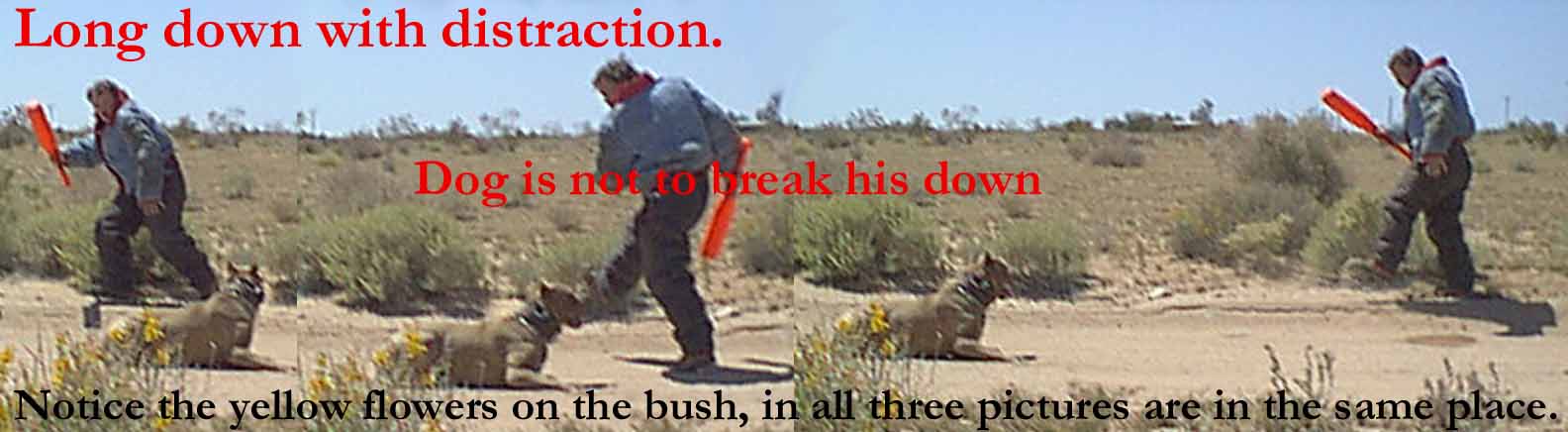
Long down (2 minutes - with decoy distraction) (20
points)
Upon the judge’s signal, the handler will leave their
dog (on a down) inside an 8’ circle. The handler will walk 45’ behind an
object (out of site from their dog.) After 30 seconds, a decoy will come
out from at blind 40’ from the dog, and will run across the field into
another blind 50’ away. After being in the second blind for 40 seconds,
the same decoy will come out from the blind and will jog straight towards
the dog. The decoy will jog around the circle and continue back into the
other blind. (The decoy will be allowed to only make noise with a stick.)
The dog may bark but must stay down. Upon the judge’s signal, the handler
will return to their dog into heel position and bring their dog into a
sit. END OF EXERCISE!

Each team must pass 80% of
the protection phase to be successful!)
The PROTECTION
phase
will be off-leash and will include:
Courage test / Call-off (The handlers
will not know which will come first until the day of the trial. The judges
will announce which exercise will come first at the handlers meeting.)
(Call off) (20 points) The
handler (dog must be sitting or down in heel position) will call-out to
a decoy down the field 50 yards. The decoy will yell back and start running
away from the team, upon the judge’s signal, the dog will be sent. (The
handler must stay at this location.) When the dog reaches the 25-yard mark,
the call-off will take place. (The handler may call
the dog off ANYTIME after the 25-yard mark. but before the dog engages
the decoy. The dog may touch the decoy but can not bite, nor put a single
tooth on the decoy. If the dog touches the decoy it must be because the
verbal call was done 8 yards or less before impact) Only voice commands(
up to three words) are permitted. (The dog should then return to
the handler into heel position and sit or down.)
(Courage test) (20 points) The
handler (dog must be sitting or down in heel position) will call out to
a decoy down the field 50 yards. The decoy will yell back and start running
away from the team, upon the judge’s signal, the dog will be sent. (The
handler must stay at this location.) The decoy will then turn and run at
the dog when the dog reachs the 10 yard mark. The dog must engage the decoy.
After a brief fight, upon the judge’s command, the dog will be “outed”
by the handler. (The dog should then return to the handler into heel position
and sit or down.) END OF EXERCISE!
Of the following 6 scenarios,
only 3 will be ran on the day of the trial.
(1.)
Area Search (20
points) (for a hiding decoy)
A decoy will be hiding in one of 4-6 vehicles in the
back seat, out on the field. All vehicles will have one door open. The
handler (dog must be sitting or down in heel position) will make two warning
announcements, “Bad guy, come out or I will send the dog!” Upon the judge’s
signal, the dog will be released to search. (The handler must stay at this
location but amy use up to three commands for searching.) The dog must
find and engage the passive decoy inside the vehicle within two minutes.
After a brief fight, upon the judge’s command, the handler will approach
the vehicle out the dog. (The dog should then return to the handler into
heel position and sit or down.) All the vehicles will be in a area no greater
than 20' x 15' per vehicle. 4 vehicles would = 20' x 60', 5 vehicles would
= 20 x 75, 6 vehicles would = 20 x 90'.Vehicles can be placed in any fashion
within these perimeters.
END OF EXERCISE!
(2.)
Handler protection
(20
points) (dog left in vehicle / 1-3 “innocent” joggers will pass
by the vehicle and handler before the handler is attacked. The handlers
will not know which jogger will be the attacker until the day of the trial.
The team will get inside a vehicle with the windows down. Upon the judge’s
signal, the handler will ‘pop the hood’ and exit the vehicle without their
dog. The handler will proceed to the front of the vehicle and open the
hood. (The handler must stay at this location.) An “innocent” jogger will
run by the vehicle and handler (once or three times individually) and ask
if any assistance is needed (it is not). The jogger will then continue
on his way or attack the handler from behind. If attacked, the dog must
exit the vehicle and engage the decoy. After a brief fight, upon the judge’s
signal, the dog will be “outed” by the handler. (The dog should return
to the handler into heel position and sit or down.) END OF EXERCISE!
(3.)
Guard and bark (20
points) (send into a blind)
Upon the judge’s signal, the handler will send their
dog into a blind 40’ away with a decoy inside. (The opening to the
blind will be facing away from the handler.) The dog must guard and bark
at the decoy without biting him. Upon the judge’s signal, after approximately
10 barks the handler will go to the blind and down their dog. The handler
will ask the decoy to step out from the blind and to raise his hands.The
decoy will step out of the blind to their right, facing the dog. The handler
will pat down the decoy and take his stick.The handler will position themselves
on the right side of the decoy and place their left hand on the decoys
right shoulder. The handler will then call their dog back into heel position.
The dog should automatically sit or down in-between the handler and the
decoy in heel position. The team will then escort the decoy (dog heeling)
to the judge and will halt. The handler will give the judge the stick.
END OF EXERCISE!
(4.) Passive bite (20
points) (decoy will also be covered with a blanket)
The handler (dog must be sitting or down in heel position)
will call-out to a decoy 25 yards away (standing still and wearing a blanket
over his shoulders.) The decoy will not respond or move. Upon the judge’s
signal, the dog will be sent. (The handler must stay at this location.)
The dog must engage the decoy. After a brief fight, upon the judge’s command,
the dog will be “outed” by the handler. (The dog should then return to
the handler into heel position and sit or down.)
END OF EXERCISE!
(5)
Send with gunfire (20
points) (decoy will shoot at the dog 2 times with a blank pistol)
The handler (dog must be sitting or down in heel position) will call-out
to a decoy down the field 50 yards. The decoy will yell back, upon the
judge’s signal, the dog will be sent. (The handler must stay at this location.)
The decoy will shoot 2 times (no more / no less) at the dog as soon as
it is released. The dog must engage the decoy. After a brief fight,
upon the judge’s command, the dog will be “outed” by the handler. (The
dog should then return to the handler into heel position and sit or down.)
END OF EXERCISE!
(6)
Send after two decoys
(20 points) (the dog
must engage both decoys) The handler (dog must be sitting or down in heel
position) will call-out to two decoys down the field 25 yards. The decoys
will yell back and will start running away from the team, upon the judge’s
signal, the dog will be sent. (The handler must stay at this location.)
After the dog engages one of the decoys, the second decoy will remain still
for approximately 4 seconds. The second decoy will thin begin running at
the handler. The handler must “out” their dog and redirect the dog towards
the decoy running at the handler. The handler may not "out" their dog to
redirect until the second decoy begins running at the handler. (The dog
should engage the second decoy running at the handler before the decoy
reaches the handler.) After a brief fight, upon the judge’s command, the
dog will be “outed” by the handler. (The dog should then return to the
handler into heel position and sit or down.) END OF EXERCISE!
All scenarios are
approximate. Due to locations and field size. The scenarios cannot be duplicated
exactly. The above scenarios are a solid rough draft of what you will expect
at any given trial.Your team should be prepared to adequately adapt to
any changes that may occur. The I.P.D.L. will make each trial as fear as
possible, this is why the scenarios are posted prior to each trial.
Each handler / dog team who is
successful in both phases will earn an International Protection Dog League
(IPDL)Titel"A"