
The Federal Executive Branch consists of fifteen departments at last count with a multitude of independent agencies. Navigating among federal agencies and departments, as well as identifying relationships between executive agencies and congressional committees is difficult for the average citizen. Consolidation of agencies with similar or overlapping functions serves the needs of the citizenry, both through lessening confusion and through lessening the perception of the government as a sprawling monster out of control. The creation of the Department of Homeland Security is an example of the kind of consolidation that lessens the appearance of governmental sprawl. Continue this principle until a government structure that the public understands is achieved. Having less departments gives the average citizen the impression that the cabinet secretaries actually talk to the President. The current organization does not convey this impression.
Form an inter-branch committee to reorganize both branches in a consistent manner. This group considers changes to congressional committee structure and the reorganization of executive branch agencies. Harold Seidman and Robert Gilmore, authors of Politics, Position and Power, suggest that any reorganization of the legislative branch consider the organization of the executive branch, and vice versa. They have the right idea.
The following listing of agencies and the attached high level organization chart are suggested as a starting point for such an effort. Each post-reorganization executive department is listed, followed by the department or independent agencies transferred to it. The main aggregating departments are the Department of Human Resources, which hold the agencies reporting to what was the Senate Education and Labor Committee, and the Department of Science, which hold the agencies reporting to the old Senate Committee on Commerce, Science and Transportation. Quasi-judicial agencies are linked to the department for administrative purposes, while budget requests, regulatory activity, and judicial activity remain independent. At the end of the list are the agencies that are to remain independent.
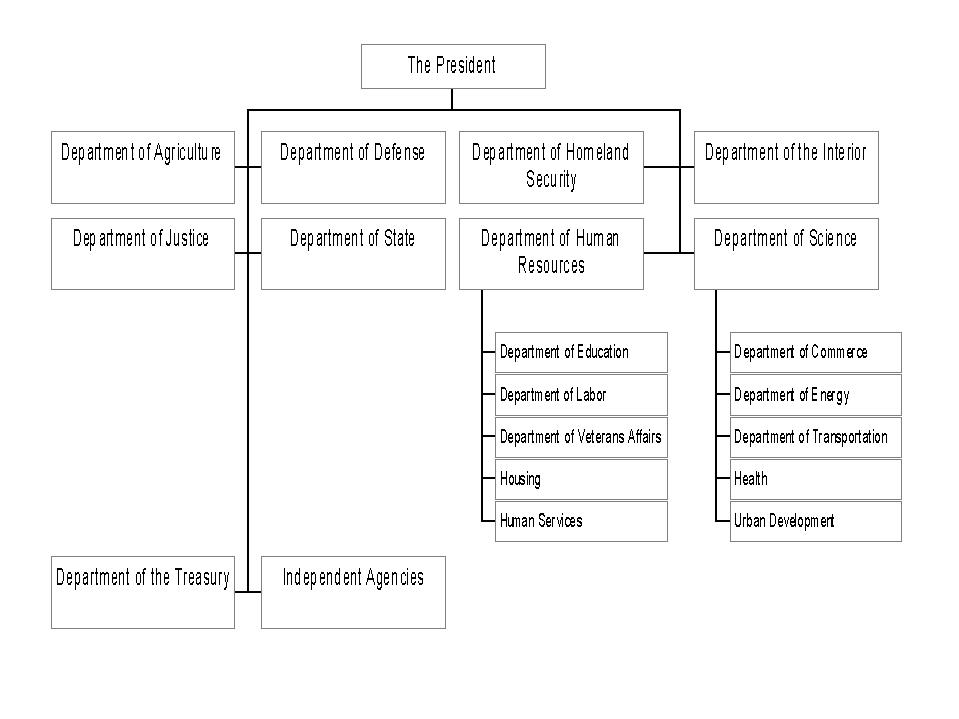
Department of Agriculture
Commodity Futures Trading Commission
Farm Credit Administration
Department of Defense
Selective Service System
Department of Homeland Security
General Services Administration
Department of Human Resources
Department of Education
Department of Labor
Department of Veterans Affairs
ACTION
American Battle Monuments Commission
Appalachian Regional Commission
Food and Nutrition Service (USDA)
Housing (HUD)
Pension Benefit Guarantee Corporation
Federal Mediation and Conciliation Service
Federal Labor Relations Authority
Merit Systems Protection Board
National Labor Relations Board
National Mediation Board
Office of Personnel Management
Department of the Interior
Environmental Protection Agency
Forest Service
Department of Justice
Equal Employment Opportunity Commission
Department of Science
Department of Commerce
Department of Energy
Department of Transportation
Consumer Product Safety Commission
Federal Communications Commission
Export-Import Bank of the United States (EXIMBANK)
Federal Maritime Commission
Federal Trade Commission
National Aeronautics and Space Administration
National Highway Traffic Safety Commission
National Transportation Safety Board
Nuclear Regulatory Commission
Overseas Private Investment Corporation
Public Health Service (DHHS)
Tennessee Valley Authority
Urban Development (HUD)
Department of State
Inter-American Affairs Foundation
Peace Corps
United States International Communications Agency
U.S. International Trade Commission
Voice of America
Department of the Treasury
Health Care Finance Administration
Social Security Administration
Agencies Remaining Independent
Federal Reserve Board
Federal Deposit Insurance Corporation
National Credit Union Administration
Securities and Exchange Commission
Postal Rate Commission
United States Postal Service
Adoption of Executive Reorganization along these lines makes congressional oversight easier to follow for the players and the public. It also makes the Federal bureaucracy more understandable to the average citizen who uses its services. Overall, these changes help the cause of representative government and greater accountability.
Go to Iowa Fiscal Equity Index
Contact us
(c) 2004, Iowa Center for Fiscal Equity, Cedar Rapids, Iowa and Alexandria, Virginia