Dear Colleagues,
Recent events in France indicate an escalation of problems mainly induced by poor economic performance and high unemployment. This includes the results of the EU constitution referendum, riots in outskirts and universities. The principal force driving all these problems is a high unemployment. The power behind the unemployment is the ECB price stability rule as I can demonstrate now numerically. There was a long-term linear relationship between the labor force change, inflation and unemployment. The labor force change is an independent variable defining behavior of the other two parameters. The labor force change was accommodated during the years before 1993 via two channels - some people entered the club of employed and correspondingly induced inflation, and some dropped into unemployment. These linear relationships are observed in all developed countries with different coefficients and time lags between the labor force change, unemployment change, and inflation as demonstrated in two my papers:
1. Kitov, Ivan O. (2006). "Inflation, unemployment, labor force change in the USA," Working Papers 28, ECINEQ, Society for the Study of Economic Inequality, http://www.ecineq.org/milano/WP/ECINEQ2006-28.pdf
2. Kitov, Ivan, (2006). The Japanese economy,
Russian Academy of Sciences - Institute for the Geospheres' Dynamics, Date posted to database: March 2, http://papers.ssrn.com/sol3/papers.cfm?abstract_id=886663
Currently I am working on a paper devoted to European countries, but the issue is hot I would like to add some sense in the discussion on unemployment and labor force market.
What I found is a dramatic change in the relationships for France starting from 1996, when a strong growth in the French labor force started. Since inflation is fixed by the ECB's monetary mechanisms (I guess constraints on M3 are the most importan) the only way left to accommodate the labor force growth is the unemployment growth. If no monetary policy constraints applied, the observed value unemployment would be only 5% with inflation as high as 7% to 9%. I can not judge what is better for France economically, but the high unemployment is obviously a bad thing for society and demography. In addition, inflation does not harm economic growth, as the ECB recognizes in description of its monetary policy (see ECB web-site). In turn, the high unemployment also affects the current political discussions severely.
Since the concept is already published and demonstrated its predictive power for the USA and Japan, I would like you just to know the facts and future development of inflation and unemployment in France. There is no improvement expected in the situation of the labor force growth and inflation fixed. The authorities liberalizing the labor market push the unemployment up since no other channel is possible to the people entering the labor market.
So, the students' protests are absolutely right as well as "No" for the draft EU Constitution since it punishes the labor market.
Thus, the current social tension will only increase if no measures undertaken to reduce the labor force growth or to increase inflation.
absolutely agree. But I think that it is not my problem, but conventional economists including people from the ECB. They do not have even my simple relationships to predict what will happen in the short run. Actually, they are blind with all their assumptions not justified by standard scientific methods.

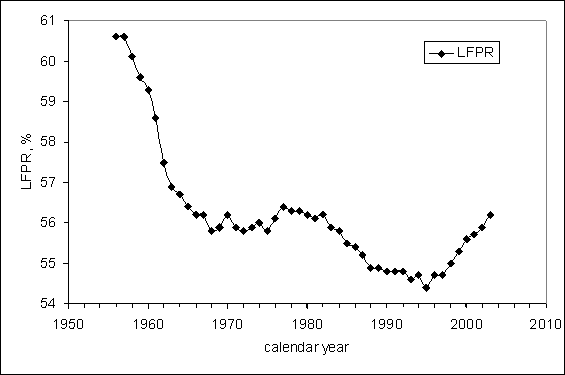
Labor force participation rate in France [OECD, 2006]. Notice a period of strong growth started in 1996.

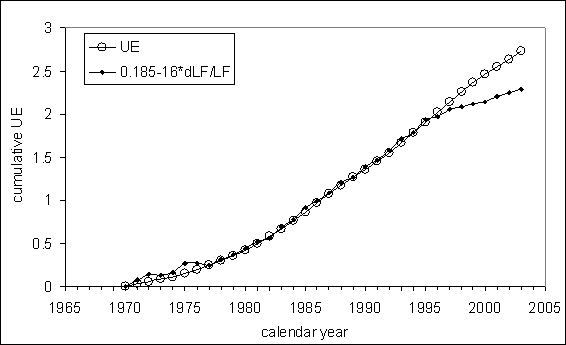
Comparison of the observed and predicted unemployment in France - cumulative unemployment since 1970. Notice the discrepancy started in 1994 – one year after the Banque de France obtained a new status and introduces a new monetary policy - the price stability [Banque de France, 2005]. The predicted unemployment is about twice as low as the observed one.

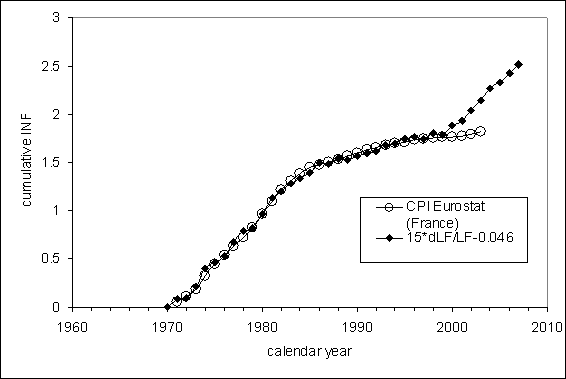
Comparison of the observed and predicted inflation in France: cumulative unemployment since 1970. The predicted values are shifted four year ahead to synchronize the observed peaks and troughs. Notice the discrepancy started in 2000 – four year after the start of the labor force growth and six after the Banque de France obtained a new status and introduces a new monetary policy - the price stability. The predicted inflation is about 7% in 2005 and grows to 9% in 2007.