
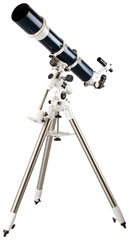
The first thing that strikes you about the XLT 120 when it arrives is just how good it looks. The finish quality of both the mount and the scope are superb.
Assembly is a breeze taking only 30 minutes To see how a beginner would get on my long suffering partner was press ganged into assembling the scope and mount from scratch. She took just under 1 � hours praising the instruction manual for the use of photos and not basic line diagrams.
When assembled you realise how much you are getting for your money. The XLT is a 120 mm achromatic refractor with 1000mm focal length (F8) and is mounted on Celestrons CG-4 German equatorial mount with a built in Polar scope for easy setup, the tripod has 45mm stainless steel legs and an accessory tray. It comes with a 6 X30 finder scope, a 25mm Plossl eyepiece, 1 � inch star diagonal and a simple but very useful planetarium software programme.
With the head on the tripod it weighs in at just under 16 kgs which makes it easy to carry in and out and, attaching the scope in the dark was simple as it uses the standard Vixen dovetail mount.
As you would expect from a refractor the XLT 120 gave crisp clear images of the moon using the supplied 25mm lens at X 40 magnification, and Saturn was also sharp with the rings shining bight. Using a 10mm eyepiece (X100) some of the structure of the ring could be seen and the Cassini division was easily identifiable, Lunar craters leaped out in glorious detail.
On deep sky object such as the Andromeda galaxy M31 the higher powered eyepiece produced a clear tight image and its satellite galaxy M110was also visible. Globular clusters appeared as bright clouds with some stars discernable at the edges.
Turing to the Pleiades the whole field fitted in the 5mm lens shining like jewels in the sky. In a quick test all the main double stars could be easily split into their individual components.
However on all bright objects the drawback of an achromatic scope was obvious with a violet halo present which was to be expected and did not spoil the view. This effect can be almost eliminated with a fringe killer (minus violet) filter.
There were a couple of small niggles when using the scope, locating the RA and DEC controls is difficult in the dark using the small knobs supplied and although they can be mounted on either side of the CG-4 it would be easier if long flexible cables were included which would make tracking easier. Also the finder scope although easy to use especially as it is sits high on a stalk is a little small for finding some of the fainter stars and it would benefit with an 8 X 50.
To sum up the XLT 120 is tremendous value for money and would be hard to beat. The CG � 4 mount which with its standard dovetail fitting will accept most optical tubes and is a sturdy and stable platform which should give many years service.
Celestron could make this a more attractive package by including a 10mm lens and supplying flexible axis control cables however I have no hesitation in recommending this scope.