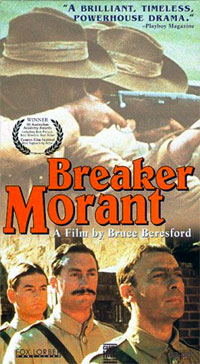
Breaker Morant can be described as an Australian film of patriotism as most of the scenes cast the three Australian protagonists � Harry �Breaker� Morant, Peter Handcock, and George Witton � in a heroic light. In contrast, the British, in spite of their superiority, are portrayed as pompous, contemptuous men, lacking in courage. We must, however, keep in mind that there are inherent biases in the production of a film. To say that Morant and Handcock are �scapegoats of the empire� would be too simplistic. Although pressing external factors may have led them to commit the atrocities they have been accused of, they have also had a certain amount of control in determining their own course. Young Witton, however, is a different story.
Director Bruce Beresford first introduces us to Harry Morant�s crimes with several close-up shots taken from different angles, signalling that a momentous declaration is about to be made: �I take full and entire responsibility for� the events� at Fort Edward. I was however, acting under orders.� That, in a nutshell, is Morant�s excuse for the killings he has committed in the upheaval and confusion of the Boer War. He shows no remorse for the �events� � the killings of Visser, the six Boer prisoners he believed to be �part of the group that killed Captain Hunt�, and the German missionary, Reverend Hesse. Despite his claim, however, Morant�s �impetuosity� � his �greatest failing� which he admits is �most un-British� � must be allocated some blame. His order for the execution of the Boer wearing Captain Hunt�s jacket, for instance, is rash. Before even questioning Visser, Morant forms his judgement: �You killed Captain Hunt, the British officer.� Although, one can argue that since Hunt is Morant�s brother-in-law-to-be and a very close friend, his death by the purported mutilation with a knife must surely have caused Morant a lot of trauma. As Major Drummond so readily provides, �He was like a madman.� However, Morant�s decision to kill Visser cannot be simply apologized for as a spur-of-the-moment decision, because Morant continues to avenge Captain Hunt even after the killing of Visser. The fact is that after Hunt�s death, Morant loses some of his humanity, his clemency, and his thirst for vengeance grows, leading to the execution of the six Boer prisoners by a firing squad, despite the glaring fact that they had come in �under a white flag�. Morant, who �never gave a damn for orders if [he] didn�t agree with them�, this time uses those very same orders to further his own need for retribution, evident in Harry�s belligerent rage to Witton: �It won�t bring [Hunt] back, but it�s the next best thing.� For the �Breaker� then, it is not just a simple matter of following orders. Although Morant does not have in him an �intrinsically barbarous nature�, he cannot be simply glorified as a hero.
What of Peter Handcock then? The classic Aussie ocker, despite his anti-authoritarian streak and his swaggering pride, seems to be one most easily led by the nose, the perfect instrument for those who perpetuate the war. Unlike Morant, he follows orders unquestioningly (�Don�t argue what�s wrong with me, [George]. I just follow orders.�), and perhaps because of his trust and respect for Morant, steadfastly follows Morant�s lead, even as Morant commits some unjustified killings after Captain Hunt�s death. Handcock also jumps to conclusions easily, evident immediately in the beginning of the film when the ambush on the Boer farmhouse fails; he surmises that because the Boer�s clearly knew they were coming, Botha must be the traitor: �How many sides are you fighting on, mate?� This impulsiveness links both Handcock and Morant, and leads them finally to their death. Handcock is perhaps, also the most pragmatic of the three protagonists. In a revealing bathroom scene, Handcock reveals that unlike Witton, he did not join the war to �keep the empire together�. No, nothing as noble as that. Instead, he joined �because there was a depression back home� and he had a family to feed. This matter-of-factness allows Handcock�s conscience to go unscathed in following the �unorthodox� orders of the British Army. For him, it is the way of the world, the way of the war, and what are men but part of that world, part of that war? Moreover, Handcock is not a man who gives credence to morality. There is, perhaps, integrity in the way he chooses not to involve the two Boer women he had intimate relations with in the court-martial to save them their reputations � despite the fact that it could mean his execution (�I made a promise. Two promises.�) � but otherwise, he is not a man defined by his morals. Just because he is fighting the Boers does not mean that Boer women are off limits. A man has to do what a man has to do to make life bearable on the edge. That is very much Handcock�s attitude, and one suspects that he justifies his actions by the mitigating circumstances of war he finds himself in. He is an excellent soldier and a good man, but one who easily succumbs to the pressures of the changing nature of the war.
As for George Witton, his sentence to �penal servitude for life� is most disproportionate with his charge of shooting a Boer prisoner. What the court so conveniently overlooks is that Witton shot the Boer prisoner in self-defence. Young and idealistic, Witton is the one who takes the moral high ground against Morant�s and Handcock�s realist view of life and war. He is the only one who protests to the execution of the six Boer prisoners (�It�s wrong, [Peter]. You know it is.�), only to have the older, world-weary soldiers overrule him. As Captain Taylor tells him, �This is a guerrilla war, not a debutante�s ball. There are no rules here.� And when a Boer in his hour of death runs towards Witton and shoves him to the ground � perhaps to attack him � he shoots, and in that crucial scene we see in Witton�s face the horror and disbelief, and perhaps the terrible, dawning realization that maybe Morant, Handcock, and Taylor are right. Perhaps in war, one has to cast away one�s morals and ideals in order to survive. Sensitive to young Witton�s idealistic world-view, Morant and Handcock choose not to tell him that it is in fact, Handcock, who has killed the German missionary, and on Morant�s orders. When Witton finds out, he seems to bear the weight of the world upon his shoulders, and guilt manifests itself in him, a guilt that �Major Thomas has been pleading justifying circumstances and now we�re just lying!� In the defence�s closing argument, Major Thomas appeals that Witton is a �junior officer, who had no reason to question the instructions of his superiors.� Witton is the real scapegoat of the British Empire.
To be fair to Morant and Handcock, however, the Boer war is indeed, as Morant described, �a new war for a new century.� The Bushveldt Carbineers, a unit that Hunt and Morant headed, was formed specifically to counter the unconventional guerrilla tactics of the Boer commandos in defending their territory in the remote reaches of the Transvaal. As Morant so eloquently articulates to Witton, �this is the first time the enemy hasn�t been in uniform. They�re farmers� some of them are women, some of them are children� and some of them are missionaries.� To survive, one must live under �Rule 303�: it is either kill, or be killed. Moreover, the Bushveldt Carbineers were intentionally given �hazy, vague instructions� to protect Lord Kitchener, �the most senior soldier in the British Army�, against any culpability for the anarchic military practices he sanctioned. For instance, Lord Kitchener issued orders that Boers caught wearing khaki are to be shot, but the Court President Colonel Denny infers that the order only applies if they are wearing khaki �with an intention to deceive�, to which Morant responds, �First time I�ve heard of that.� The casualties of war, truth and the men who fight in it, are simply, as Colonel Hamilton describes, �a sideshow of the war.� The British are indeed using Morant, Handcock, and Witton as sacrificial lambs for a �demonstration of [their] impartial justice� to help bring about a peace conference, but that does not justify some of Morant and Handcock�s actions. The arguments posited above may seem somewhat conflicting, but things are seldom black and white. No doubt they all add some complexity to the central dilemma posed by the film: if Morant, Handcock, and Witton and neither scapegoats nor villains, what then are they? Perhaps Major Thomas said it best in his closing statement: �The tragedy of war is that these horrors are committed by normal men in abnormal situations.� |