They were a hardy, frugal, and determined group of people, those forefathers of ours, who came from Scotland and Central Ontario to settle the land south of Mission Lake. They were not the first in the area, by any means. Years before, Thomas Cavanaugh had built a log cabin across the road from George (& June) Edwards, where John Oosterloo farmed many years. Mr. Cavanaugh received the first homestead patent issued in Saskatchewan. Paddy Swan had a homestead one-half mile south of Kalvin Horsman's* home (now part of the "home place"). Napoleon Blondeau also homesteaded on property now farmed by Keith Horsman. Many families lived where Kirk & Cathy Cochrane* now have a pasture (behind Gorgichuks).
On February 1, 1-913, a meeting was called to form a school district (Invercauld), which would be carved from the Village School District #26 (Fort Qu'Appelle) and part of the Wideawake School District #54. Present at the meeting were:
T.A Farquharson Thomas Irving Charlie Booth James Stanger Andy Machan D. Stewart Dan McLay Bert May Jim Harrison Fred Mclntyre William L. Orman Albert Rolley Alf Bliss Guy May
The Cargo's and the Radcliffe's belonged to the area, but their children attended school in Fort Qu'Appelle and Indian Head. A Mr. Horsfall came later in the year, as did the Dave Yorston family, Georgina Binnie-Clark, the Charles & Sarah Horsman family, and the S. A. Hepburns.
It was unanimously decided to proceed with the formation of a school district. A strong letter of protest by the Hockley's of Wideawake in March was overruled by the Deputy Minister of Education.
In April the Municipal Council for Fort Qu'Appelle opposed the formation. The Deputy Minister wrote them that the Council had no say in the land of the Village School district #26. On May 1, William Thomson wrote the Deputy Minister that Orman's and May's children were outside the district and Mr. Horsfall was closer to Wideawake. "Consider the boundaries changed to include them," replied the Deputy Minister.
On May 30, 1913, Tom Farquharson wrote the Deputy Minister giving the area statistics of children who would attend the new school as:
Charlie & Arthur Horsman Eileen & Ronald Horsman Tom & Bill Farquharson John & Hector Irving Bert & Mabel Orman Dave Yorston Jr.
In a few months there would be four others; namely:
Dave Horsman
Eva Irving
Rita Yorston
Eric Farquharson
Apparently the May's had now decided to attend the Fort Qu'Appelle school.
On July 11, 1913 the school board (Tom Irving, Tom Farquharson, and Andrew Machan) wrote the Deputy that:
a) sixteen will be taxed for school purposes,
b) eleven children (5-16) would attend, and
c) area to be 12,400 acres and 60 acres of CPR land
On July 23, 1913 the Deputy Minister gave final approval to the formation of the Invercauld School District #3100. Letters to that effect were sent to Tom Farquharson (secretary), W.G. Hocldey and William Thomson. A notice of a meeting on August 9, 1913 to nominate trustees was posted. Ten minutes to elect them, and twenty minutes to count the votes. Eligible voters were:
John & Dan McLay on Sec. 30
Tom Farquharson on Sec.28
Andrew Machan on Sec. 27
Albert Rolley on Sec. 24
Dave Stewart on Sec. 19
Dave Yorston on Sec. 22
Georgina Binnie-Clark on Sec. 18
Stanley Harrison on S. 1/2, Sec. 18
Fred Mclntyre on Sec. 17
James Stanger on Sec. 15
Tom Irving on W. l/2, Sec. 14
G. Horsman on E. l/2, Sec. 14
Guy May on Sec. 7
Charlie Booth on Sec. 6
Prof. Maule on Sec. 5
M. H. Orman on Sec. 18, Twnshp 20, Rg 20
On February 3, 1914 the Deputy Minister wrote the board to open a school, or lose land appropriated from Wideawake.
By February 15, 1914 there were thirteen children of school age; four more by the time it opened. There were seventeen taxpayers. The tax was .05 to .055 per acre.
In February and March of 1914 strong letters of protest were mailed to the Deputy Minister against the erection of a school by James Rolley and Lyons Cargo. Both were rejected. On April 28, 1914 the board approved:
$1100 to build the school
$ 426 for furnishings
$ 100 for the site (granted by Allan Radcliffe)
$ 100 for the stable
$ 50 for a well (the water couldn't be used)
They still didn't have a site. In July the board agreed to the Municipal Council's idea of leaving it up to Inspector W. E. Stevenson of Balcarres. The present site was selected.
A temporary school opened on November 2, 1914 with nine children in attendance on the first day. It was held in Charles Horsman's kitchen with Emerson Knipe as teacher. As more children were due in the spring, and the quarters were too small, a new building had to be found. Because of the war, they couldn't sell debentures to erect the new school, so what were they to do?
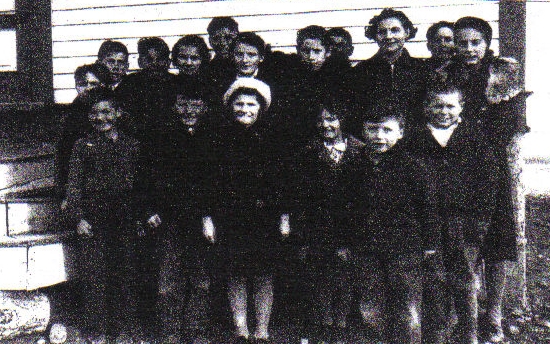
(Left to right - Back Row - Henri Partridge, Dick Partridge, George Partridge, Dorothy Hoffarth,
Lawrence Reynolds, Evelyn Reynolds, Melrose Craig, Alan Craig, Doreen Verner, Fred Slater, Ellen Hardie.
Left to right - Front Row - Jim Hoffarth, Phillip Schill, Marjory Schill, Clara Hoffarth, Ernest Verner, Roy Horsman)
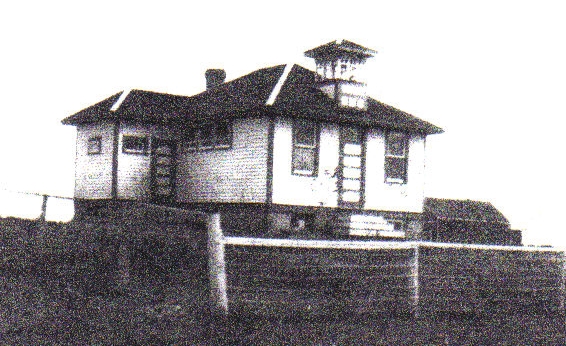
In November, Emerson Knipe wrote A. Ball, Deputy Minister, to ask if it was permissible to rent a building from the Secretary-treasurer (Tom Irving). No copy of the reply can be found, but it was apparently approved and the building was moved to the present site before school opened in the fall of 1916.
In the meantime, Mr. Knipe decided to burn the prairie grass on the new site that spring. The fire was soon out of control and raced across the dry, un-grazed prairie. Andy Mann's barn was razed and there was "hell-a-poppin" for poor old Knipe. The trustees (Irving, Farquharson, and McLay) convinced Mann to let him "off the hook" and a "bee" was organized to replace the barn. Your writer, then four years old, can still remember with awe the horror of that fire, visible for miles. In May, 1916, thanks to the help from the Deputy Minister of Education, debentures for $1406.40 were sold to Keir, Fleming Co. of Ontario.
By 1916, Dave Wilson, who should be remembered by the "Old Timers", had become the auditor for the school books at $3.00/year. He was a most kind man, who knew the name of every child who attended school here or in the Fort, and who made sure no one was forgotten at the Christmas Concert, when small gifts were handed out. Mr. Knipe, apparently forgiven for his fire episode, got a raise in November of 1916 to $65 a month.
In May, 1917, Mr. Knipe informed the board he would resign in September to take extra courses to improve his qualifications. But one more crisis(?) faced him before he left. He wanted the summer holidays in the summer; some parents wanted them in the fall, so the children could help with the harvest. R. F. Blacklock, Deputy Minister, replied, "the teacher must decide." We, the younger ones, blessed him for that decision.
In June, 1917, Mr Tom Irving as Secretary-treasurer wrote Mr. Blacklock, that he had hired a Mr. Mitchell of Lebret to do some repair work to school property. The board had been billed for 360 hours at forty cents an hour. "A gross overcharge" they claimed. "Pay", answered the Deputy Minister.
Before the opening of the new school in August, 1917, a picnic and dance were organized as a sort of "house-warming"party. Races for the children, baseball for the grownups, a picnic dinner and then the dance. But the "event" that created the greatest stir was when Cecil McLay, whose breath smelled of spirits, was ejected as company unfit for the young people present. Apparently the fathers were as naive as they thought we were, for many a time we had snitched an ounce of liquor from the bottle kept for curing colds, and replaced it with an ounce of water,
In June, 1917, one more confrontation for Mr. Knipe. He wrote the Deputy Minister that his contract called for $65 a month or $780.00 a year. As he was resigning at the end of September, wasn't he entitled to $780.00? "You are," answered the Deputy Minister and Mr. Knipe got $780.00 for 1917, even though school was open for only eight months. "Another gross overcharge," muttered the school board, but they paid what he demanded, to a most able teacher. It would appear the school year now moved from January 1-December 31 to September 1-June 30.
In October, 1917, Barbara Mclntyre of Fort Qu'Appelle was hired as teacher for $80.00 a month. Two events stand out in my mind during that year. "Archie", the boy from Dr. Barnard's Home in England, washed his feet in the drinking water well. I don't remember who administered the beating, but he sure "got it". The other event, was the installation of the telephone in December of 1917 for $ 172.00. Another highlight was the closing of the school by Dr. Hall in October of 1918, due to the outbreak of Spanish flu. The death of young Dave Yorston from the flu was a tragedy most of us still remember. He was an able student, a good friend to everyone, and sorely missed by district residents.
Social events in the early days centred around the local school district. Undoubtably, the most popular event was the box social. The ladies prepared a box of delicacies for the midnight lunch period. At 11:30 p.m. the dance stopped and the master-of-ceremonies conducted the bidding for the boxes. When it was known that some young "buck" had his eye on a certain girl, spirited bidding was assured, sometimes as high as $5.00 (a phenomenal sum in those days!). The proceeds of the sales were used to pay dance expenses.
It was around this time that Sanford Shore bought his first car. He really caused a stir when he drove over country roads. He really impressed the young people. It scared the living daylights out of horses and more than one "run-away" resulted when his motor backfired. Irate teamsters used well-rounded vocabularies to warn him to get off the roads, and to stay off them.
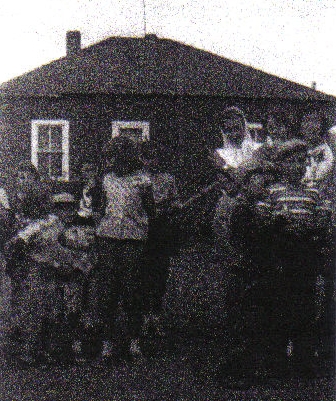
(Left to right - Back - Barb Edwards, Linda Edwards,
? McLay, Sharon Strudwick, Merna Kew, Joan Irving
Left to right - Front - Lorraine Partridge, Lee Edwards,
Marlene Partridge, Daryl Strudwick, Harley Strudwick)
During the hungry Thirties, when no one had any spare cash, the school district again became the centre of social life. During the winter regular dances were held in the school house, with Erickson's Orchestra providing the music, and Frank James or Peter Schill doing the "calling". Softball games were organized in the summer months, giving the young people and many of the older ones the opportunity to get together. Competition necessarily had to be with nearby school districts, as the "Bennett Buggy" didn't permit traveling great distances.
Judging by the records still available, nothing really interesting happened in the forties, fifties, and sixties. A more affluent society lost interest in "local" affairs, and the town or city became the centre of interest. Cheap gasoline and reasonably priced cars made travel easy. Unfortunately, it also resulted (in Western Canada) in farmers moving to the local village or town and driving out to the farm to perform the necessary work. No such movement is apparent in Eastern Canada or in the United States. There the "district" is still strong, farm homes much more attractive, and the local town a thriving centre for trade.
Another unfortunate result of cheap cars and gasoline is the failure of young people to "belong" to an area. Instead of being participants in baseball, hockey, skiing, etc., they are now observers; cruising in their own jalopies, always on the move, and seldom happy with where they are, and moving on, hoping to find something to interest them, but never really succeeding.
Undoubtably, all of these changes came with the disappearance of "horse power". There was no longer the need for young people to help with the "chores". Freed from that burden, it was only natural that they moved farther afield. With no "willing hands" to help, the practice of producing one's own milk and butter also vanished. Thus the high cost of milk, cream, and butter today since the dairy side of farming has become more specialized.
During the past few years there appears to be a trend back to the farm, and the school district may once again be the social centre for the next generation. We can dream, can't we?
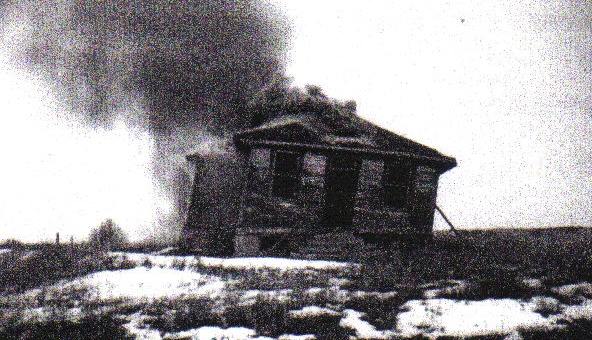
Invercauld School was demolished in November of 2003.
* Some names were changed to reflect current ownership.The painting of Invercauld School on the main page is by Shaune Irving Marchtaler 2005
Last Mountain Design
Webmaster: R. Isherwood