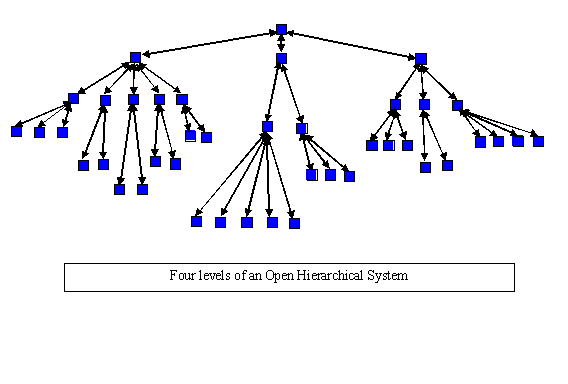
"The Ghost in the Machine" by Arthur Koestler (review)This is actually two reviews (first more recent) which haven't yet been merged Review of “The Ghost in the Machine” by Arthur Koestler and comparison with ideas in “The Web of Life” by Fritjof Capra The Ghost in the Machine proposes a model of biological organisation (how different components interact) called Open Hierarchical Systems It is important to make a distinction between two kinds of hierarchy – I suspect that Koestler confuses the two; at any rate he does not make any such distinction explicit. The first kind is a hierarchy based on the concept of levels of organisation. A level of organisation comprises a set of elements which have relations between them such that no element is part of another element or vice-versa no element is composed of other elements. So protons, electrons and neutrons exist at one level of organisation, DNA, proteins, sugars and lipids at another, brain cells and liver cells at another, and populations of humans or wolves at another. But electrons, DNA, brains cells and wolves are all entities at different levels of organisation. The other kind of hierarchy is a cybernetic decision making and feedback hierarchy, where there is a branching tree corresponding to levels of decision making or feedback. It is this kind of hierarchy which Koestler is (mostly) writing about – it exists at a single level of organisation, which is not to say that it is not paralleled at multiple levels. However this has nothing to do with parts versus the whole (a between levels analysis) – an atom does not “cause” its electrons, protons etc to do anything; it is simply the name given to a particular bounded system of sub-atomic particles (whose interaction may lead to systemic properties) Arthur Koestler calls his basic unit of organisation a holon – and most of Ghost is an attempt to abstract properties of holons and their relationships with holons above and below them in the decision making hierarchy. So an example of the basic model of an Open Hierarchical System looks like this: |
|
I know this diagram isn't very clear - until I fix it, you can see it much more clearly in Windows by right-clicking, choosing copy, and pasting it into Windows Paint or a similar program. Similar procedures apply for Linux or Mac users.
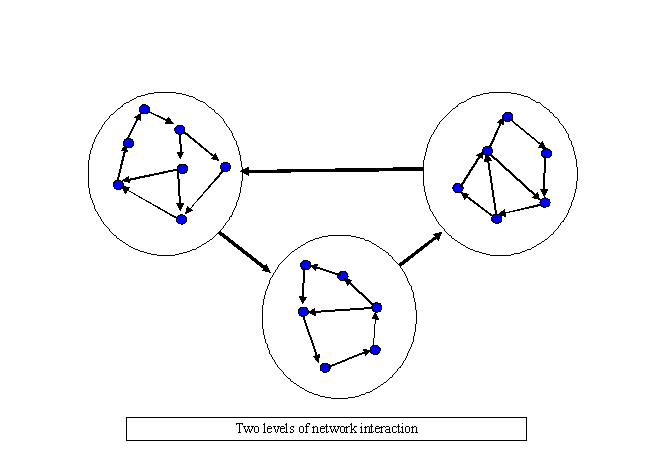
The properties of holons that Koestler identifies include: • fixed rules and flexible strategies. The fixed rules are the identity of that particular holon – the function it fulfils. So for example a neuron must be a neuron, but it can be various different kinds of neuron, depending on its environment. • a balance of autonomous and of integrative tendencies, in which an imbalance can arise: for example a developing cancer could be an example of an overly autonomous tendency, in which the cancer cells have become dis-integrated from the organism as a whole the problem with this whole abstract model of organisation is whether it can produce any verifiable predictions in physical reality. The difference between Ghost and the Web of Life is that in Capra’s model, entities at a higher level of organisation emerge through the complex interaction of elements at a lower level of organisation, which looks something like this: |
|
I know this diagram isn't very clear - until I fix it, you can see it much more clearly in Windows by right-clicking, choosing copy, and pasting it into Windows Paint or a similar program. Similar procedures apply for Linux or Mac users.
Compare the two diagrams. We are looking at the same entities, but this time it as though we are looking at the first diagram from above, do that instead of a hierarchy which branches to lower levels of organisation now we have a network of system components, with networks within each network. Note that all the arrows only act in one direction (which may be positive or negative feedback) but they form circular feedback loops. Instead of some sort of cybernetic control system at the same level of organisation, we have entities at a higher level of organisation emerging from the nonlinear interactions of components at different levels of organisation – atoms emerging from the interaction of subatomic particles, life emerging autopoietically from the interaction of molecules etc etc. Second ReviewI first read "The Ghost in the Machine" 25 years ago when a student and it had a major influence on me. I've meant to re-read it for many years and have finally done so in connection with an article on mental health that I am writing. Writing a review is a way to sharpen my thinking about Koestler's ideas - I found it quite a struggle. However, I'm still struggling, so what follows is a bit rough
The subject of "The Ghost in the Machine" is organisation of living organisms, considered from biological, psychological and social perspectives. Koestler puts forward a model of how organisms coordinate the functioning of their component parts in a coherent and cohesive way. His model, called 'Open Hierarchical Systems' attempts to describe the relationship between parts and wholes in organisms and societies. Terms in italics are terms used in the model The first part of the book, entitled 'Order' develops this model to analyse control and coordination of the living organism and the control and coordination of societies. The second part, 'Becoming', uses the model to analyse the contol and editing of random mutations. In the third part of the book, entitled 'Disorder' he uses this model to suggest that when human beings express unquestioning support for a cause that this demonstrates a biological fault in the way that human brains are constructed. Personally, I find 'Open Hierarchical Systems' to be a powerful model, but I am dubious about his theory that the neo-cortex is not connected appropriately to the older parts of the brain, for reasons I will try to develop later. The theory of 'Open Hierarchical Systems' uses the 'holon' as its basic organisational unit. A holon can be any discrete living structure - cell, tissue, organ, person This can get very abstract. Something that caused me a great deal of confusion is that while 'Open Hierarchical Systems' is a theory of control and coordination Koestler does not differentiate between the biological structures providing a mechanism for control and coordination e.g. the nervous system or DNA, and the biological structures controlled and coordianted by them - cells, tissues, organs etc. His theory implies these structures of control and coordination but he makes absolutely no attempt to say what their physical expression is. In my description of 'Open Hierarchical Systems' I am going to use 'holon' to refer to the control and coordination structures, even though Koestler does not differentiate between these and what is being regulated. I think it's clearer. O.K. So in that case I am going to say that a holon is an information processing structure of some kind - a structure in the nervous system or a particular group of genes which control gene expression or the range of possible gene mutations. At least that's what I assume he is thinking of - I don't know of any other control centres in particular organs or some kind of distributed network of feedback regulation through the metabolic web - other than the Endocrine system, of course. Holons exist at particular 'levels of organisation' and in relation to holons at the level above, the level below, and at the same level. Each holon relates to only one holon above, but more than one below. A diagram of a particular Open Hierarchical System thus looks like a pyramid, as below. (Insert diagram)The relationship of a holon to the holon above it and to the holons below it is different in quality. The operation of a particular holon is set according to fixed rules by the holon above it. However the role defined from above is implemented using flexible strategies i.e. which holons are used for implementation may vary.
Information travels up and down the pyramid - information from the internal and external environments travels up the pyramid to be processed by a decision making holon; that decision is turned into a response by information flowing down the pyramid - causing muscles to contract, hormones to be released - RNA or gene-binding proteins to be manufactured. But each holon is semi-autonomous; the decision is not referred to the level above if it can be processed at that level. Successive levels of sensory holons filter out more and more information, abstracting only a tiny proportion of all the information from the senses which is considered relevant. A single instruction from a high level holon can result in the triggering of vast numbers of holons at lower levels which are responsible for the coordinated response of the initial instruction For Koestler holons show two opposite tendencies; one autonomous and self-assertive, the other integrative. There is always a tension, and a balance between the two. If one or the other tendency becomes dominant, or imbalance results - for example cancer in the case of the self-assertive tendency - an unquestioning adherence to a political ideology is an example of the over-dominance of the integrative tendency. Later in the book Koestler uses this concept to categorise the range of emotional expression from the self-assertive emotions of rage and laughter, the balanced scientific Eureka!, to integrative weeping. An idea central to the book is 'reculer pour mieux sauter' - for you that don't speak French that means 'draw back the better to leap forward'. What Koestler is getting at here is that when a course of action has been blocked or ended up in a dead end e.g. over-specialisation - it is necessary to go back up the decision making hierarchy to a more basic or fundamental level. He gives as examples the phenomenon of paedomorphosis - where a new branch of the evolutionary tree shoots off from the larval stage of development of an organism rather than its developed adult stage - for example chordates originating from the larval stage of the echioderms, or the overthrow of scientific paradigms As I said earlier, the problem with using holons to model biological control and coordination systems is that his holons are pure abstractions. These control systems must have an actual existence in the body and operate through biochemical structures and processes. These structures and processes must be in the nervous system and our DNA - possibly in local metabolic webs of chemical messengers. So it's a nice theory, but do our nervous systems or control of gene expression actually operate like this? A theory is only scientific if it is capable of being tested in experiments to see if it is true or false. There is no mention of this, or suggestion that it might be a good idea. Koestler wrote a successor book to this, called "Janus, a summing up" which I also read 20 years ago but I can't remember a damn thing about. I'm not sure if he says anything about actual processes or mechanisms in it or if there has been any attempt since to correlate this theory with empirical observations. I suspect the next bit may be wrong, and that I have confused two different things: 'levels of organisation' with 'levels of description' but I'm typing it in for now because it is an important area of confusion and I'd rather have something on it than nothing. But I may have made what Lucy Johnstone would call a 'category error' here. OK I have earlier quoted a term used by Koestler: 'level of organisation'. This needs some discussion because it has caused me major conceptual difficulties - which I think I have now resolved; well, this is my provisional resolution of it. One objective of this review is to help me work out the relationships between 3 different writers: Koestler, the physicist Fritjof Capra and the neurobiologist Steven Rose. The subject matter of these writers overlaps and their ideas are inter-related. It's been difficult trying to puzzle out where their ideas complement each other and where they are in contradiction. I think that I can best outline the problem by first discussing the approach of Steven Rose in a paper of his with the ironic title of "Disordered Molecules and Diseased Minds" - Steven was concerned at the imprecise and slipshod way the idea of causation was used in psychiatric research, leading to erroneous conclusions. He points out, for example, that a change in some kind of biological marker like a neurotransmitter cannot be said to 'cause' a behavioural change in a sense which is epistomologically valid. This is because causation properly describes a sequence of events - e.g. biochemical reactions, depolarisation of the post-synaptic membrane etc - in time ... However a biochemical event cannot meaningfully be said to 'cause' cognitive or behavioural events that take place at the same time - or even afterwards. The reason for this is that both the biochemical and cognitive descriptions are descriptions of the same event but at different levels of organisation/description? What Rose is saying is that there are many ways of studying a single phenomenon - and that each is an autonomous area of knowledge - it has its own language and defined terms relative to its objects of study, whether that language is that of biochemistry, physiology, cognitive psychology or whatever. You can certainly correlate two or more descriptions at different levels of organisation/description?, but you can't say that one causes the other. The idea of causation is only valid within one level of organisation/description? in desribing a sequence of events with the language proper to that level of organisation/description? Now this is quite different from Koestler's use of the term 'level of organisation'. Any particular hierarchy of holons 'holarchy' that Koestler describes is in fact a description within a single one of Rose's 'levels of organisation'/description i.e. despite Koestler's lack of anything scientifically verifiable causation is meaningful in describing the relationship between holons, and a language appropriate to biochemistry, physiology, psychology etc is appropriate to describe it. As should be clear from my description of 'Open Hierarchical Systems', Koestler uses 'levels of organisation' to describe different levels of holons in his organisational pyramid - within one level in the Rose model. However he refers to these 'levels of organisation' as if they represent different levels of organisation/description in Steven Rose's sense.
I'm a bit burnt out now, trying to work out this kind of stuff while eating the kind of 'nutritionally challenged' food you get in homeless centres is tough. My brain needs more amino acids! I had to sign off and sign on again recently, so I've got no money yet - will have a proteinaceous feed in a caff when I do. but: To be continued Yet another bit follows below which needs to be integrated with the main text In the chapter entitled "The Strategy of Embryos" Arthur Koestler describes ontogeny in terms of a developing branching hierarchy of cells, where as the organism develops over time, the function of particular cells becomes steadily more specific and exact. He describes, in a similar way to Steven Rose in "Lifelines", how the 'atomic' view of the gene - where one gene codes for one trait, has been shown to be inadequate - because in fact one trait is the result of the interaction of many genes and by contrast one gene may exert an influence on many traits. In fact it is now understood that most genes interact to some extent - no - to write this I need concentration and the cleaner, God bless her, has just come in, accompanied by someone who is bullying me to eat sandwiches - although thank god they haven't threatened me with the comfy chair. And I wanted to write about causation. Intrepid Carpets Home Page |