INTIJALSU TOUR presents:
TECHNICAL CHARACTERISTICS
INTIJALSU TOUR has set the goal of offering a tourism service of very high quality, as much in the attention to the visiter, as in the cultural and information content and the technology available for observing the sky.
Our objective is met through the following steps:
1/ Transportation : modern, and safe: a minibus Kia Besta 2.7 ecological (year 1998) with air conditionning and system of television/video, and 9 seats for passengers. Our drivers are very experienced, even in mountain drives. The vehicle is registered with the Chilean Automobile Club. Our drivers know very well the region and will take you where the sky is clearest (90% of the year, we will find a superbe sky after a drive of 1h20 maximum away from La Serena, depending on the weather).2/ The guides : they are people trained and amateur in the areas they speak about: astronomy, history and nature are their hobbies. We also have a group of external advisers to help us in the night-time observing: all are amateur astronomers and have true experience. We can show cultural videos during the trip: culture of the Sky and culture of the Earth, Astronomy and Nature in the Andes. Intijalsu Tour has several sources of bibliography at disposition of the tourists before of after their tour. Intijalsu Tour is accessible on the internet with this web page and email for answering and taking reservations from people abroad. Besides, Intijalsu Ltda., a group of investigation in archaeoastronomy, brings support to us for the cultural, scientific and educational content of our message. 3/ The observing instruments:
3.1
.Our eyes: everybody will learn to use his/her own eyes! This is the first step to learn about the sky: be in a site without light pollution to see the constellations and the Milky Way, the apparent motion of the celestial bodies, know how to locate planets,... We have indicidual sky maps for this learning phase and a virtual planetaiurm program in a field notebook computer.3.2.
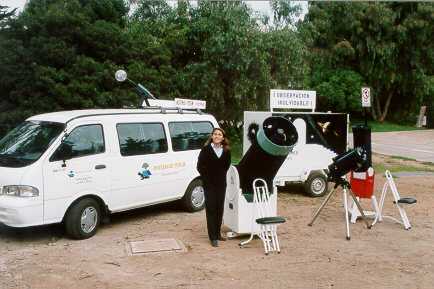
Dobson Telescope of Ø8" (f/6): this instrument is manual (no motor). This is a Newton design and a zoom-ocular gives the conveniency of observing objects quickly with different magnifications. The alt-azimuthal mount allows a simple handling and the observer can learn quickly how to point objects in the sky, through the 8x50 finder, and do his/her own trip across the Universe.3.3.
Telescope Meade LX10 of Ø8" (f/10): this instrument is computerized. It has 2 motors t o follow automatically the celestial bodies and a Magellan I computer to read digitally the coordinates in the sky and be able to point in a blind way 8000 objects available through a database. This is a Schmidt Cassegrain design. This instrument is sometimes dedicated to take digital images with a CCD camera SBIG ST5. In just a few seconds or minutes of integration, one can get a contrasted and detailed image of faint objects. The images are transmitted directly to a notebook PC (Compaq 1210) where the images can be displayed and transformed. The telescope also allows taking traditional images in parallel (taking advantage of the guiding) or in the focal plane. It has a focal reducer (to f/3.5) to see larger stellar fields.3.4.
Dobson Telescope of Ø16" (f/4.6): this instrument, originally manual, soon with a motorized azimuthal platform and a motorized focus. It has digital encoders and a 8000-objects database to point quickly too. Its design is Newtonian with an alt-azimuthal mount similar to modern major telescopes like the VLT. It is equipped with Nagler eyepieces, the best on the market (some very bright, 2" in diameter), to see field of view of up to 1°5 (3 times the full moon size). This instrument is a great light collector (it was the first amateur telescope of this size in Chile, now there are no kore than 4) and it will enable you to see numerous objects invisible to the unaided eye and difficult to observe in small common telescopes. As for the Dobson 8", the tourist can use for drawing what he/she sees, like planets and nebulae, with observation sheets provided by Intijalsu Tour. The planetary drawing is a very powerful way to register details in the atmosphere of the planets, taking advantage of brief moments of stability in the atmosphere.This telescope is so big that people (unfamiliar with telescopes) sometimes ask us whether one has to get inside the tube to observe!
In preparation: binocular telescope 2xØ3" and Dobson Ø12".