The Incredibly Sad Tale
of Philippe
The Shoemaker
(The Politics of the Baguette)
It was a pleasant Parisian spring afternoon circa 1775 when Philippe Cordelois was woken from his siesta by a knocking on the door. Kicking, actually. His visitors first reduced the building's main entrance to splinters. Then they charged up to his third floor garret shouting, "In the Name of the King!" Philippe, a 28-year-old apprentice shoemaker was puzzled; was his master in trouble with the police? The cops burst into his room and threw him against the wall. They knocked over the table, ripped open his mattress. Finally, the officer rummaging through his cupboard gave a shout and grabbed the shoemaker by the collar. He had found a piece of stale bread wedged into the back of one of the shelves. Nothing to hide, eh? shouted the officer. He shook the week-old crust in Philippe's face. Then what, may I ask Monsieur, is this?"The history of bread," wrote historian Piero Camporesi, "is the dietary expression of a long battle between the classes." The earlier scandal over mollet had centered on the questions of yeast, nationalism and ancestry. But the classic battle was all about color and class. Italians, for instance, have historically only had two real classes, according to Camporesi. There were "fodder mouths," peasants who lived on dark brown bread, and "bread mouths" who dined only on white, a social marker so important that the Roman elite physically attacked anyone who dared offer them a slice of brown bread. Caesar actually made the inappropriate serving of dark bread a crime punishable with prison time.It wasn't merely a question of violating the rules of social standing.
The darker the bread, the easier it was for unprincipled bakers to hide adulterations like acorns, bark, mud, sawdust, dog weeds and God knows what else. Some even added poisons like bay leaves, which produce a narcotic high, or the herb darnel which made so-called "dazed bread." Dark rye loafs were often infected with the mold ergot, the base for the drug LSD, which people like Camporesi believe caused some of the bizarre "dancing" hysterias that swept through medieval Europe.
Rendition of medieval "dancing" hysterias.
By the time Philippe the shoemaker was arrested in 1775, the issue of who got to eat white, and who brown, and at what price, had become one of the touchiest political issues in France. Like the Italian peasants, most of the French choked down coarse rye and barley breads that sometimes required an axe to slice. The aristos thought this fine and natural. Peasants, after all, were believed to be only marginally more evolved than pigs. Hard bread breeds hard workers, was the nobleman's motto. Police warned that allowing the lower classes to eat fine white would corrupt their morals with a "creeping flaccidity creating sensuality and sloth," and routinely arrested workers seen eating white. It was clear that God and nature had reserved good wheat bread for the aristocrats because their refined digestive systems could process nothing but the most meltingly delicious of baked goods, well buttered.There were, however, a few concessions made to the real world. The army had been on a white-only ration since an attempt to foist rye on the boys had led to an open revolt. Riot prone Parisians also received special treatment, with even the lowliest gamin dining on the snowiest of breads, a sight so bizarre that when Napoleon Bonaparte arrived in the capital for the first time he noted with outrage how the beggars of Paris ate better bread than the wealthiest farmer.
Needless to say the French countryside was passionately discontented with the situation. It finally blew up when a baker in the teeny village of Beaumont-Sur-Oise tried charging white prices for rye. Housewives hog-tied the villain and threw him into the pond, which would have been the end of it had the village's notoriously shy police chief not let the situation get out of hand. Before you knew it, the ladies had embarked upon a daring, but popular, program of economic reform. After they'd given away all the baguettes in Beaumont, the girls headed over to the neighboring village of Meru, where their fiscal reforms were again warmly received. Within ten days over three hundred bread riots broke out; Markets were raided,
bakers were forced to sell their loaves at one-tenth the market price, and whole barges were relieved of their flour. The uprising kept creeping closer and closer to Paris but the police did nothing. They claimed so many people had participated that in all fairness they'd have to arrest all of France.
The rioters finally reached Paris and gathered
outside the office of the Minister of Finance, Anne-Robert Turgot, chanting "Give Us Bread!" At least that's the popular version of the event. A more accurate translation of their plaint would probably be, "Give us a light yet savory bread with a crisp, honey colored crust and a pleasantly chewy, but not tough, interior at a reasonable price." They emphasized their point by threatening to clobber the riot police with stale baguettes. Stale, green baguettes, to be precise-they claimed the bizarrely colored monstrosities, which ranged from very dark brown to gray to green to black, were now being sold by Parisian bakers as a result of Turgot's free trade policies. This was too much for Turgot. He responded that the green baguettes were actually "Turkish bread" made from ashes and rye to serve as propaganda tools in a campaign to topple the government. Turgot's supporters then implied that the riots were not started by peasant housewives but bands of sexual transvestites "perverted men who were strangers to the villages which they had come to destroy." It was they who had made the green bread weeks earlier, Turgot claimed, so it would be nice and moldy in times for the riots, at which point they'd handed it out to real peasants who'd been paid off to say it had been purchased at the marketplace. It was obviously all a lie, the story went, because no one had seen a slice of brown bread in Paris-not to mention green- in centuries.Enter poor Philippe. The Shoemaker. Turgot had assigned the entire Parisian police force to arrest anyone possessing bread that was "bien brune" (quite brown) and bring the conspirators to justice. Hundreds were arrested, interrogated and probably tortured. The transcripts of their "confessions" can still be found on a dusty shelf in the French National Archives, a foot-high stack of handwritten, crumbling papers liberally decorated with doodles, a number of which finger Philippe. One informant told the police he'd seen the shoemaker with a group of suspicious looking country-women. Another put him drinking with bakers believed to part of the conspiracy. The most damming report claims he was seen with a subversive baguette in his hands the day of the riots. Inspector Jean Baptiste Charles LeMaire was in charge of the investigation and when he finally located Philippe's digs-only a block from Paris' central marketplace Les Halles! - LeMaire struck. Philippe was charged with "possession of a crouton of bread
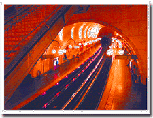
that was absolutely brown" and taken to the sadistic interrogation chambers below Place du Chatelet (now an equally annoying metro station of the same name).
Philippe's Interrogation chamber today.
INSPECTOR LEMAIRE: Is it not true that you told the shop keeper that this bread, this dark bread, was being sold in the central market of Paris?Philippe's story seems to have checked out because LeMaire released him after half a dozen interrogations. There are, however, no records of him ever having married. Perhaps he died in the upcoming revolution, or returned to his village of Cambray where people ate brown bread and were glad of it. The treasonous crouton found in his room was sent to the royal crime lab where forensic experts determined that, contrary to Minister Turgot's theory, it had been baked the day of the riots and "turned green and black because of its ingredients." Turgot's theory, however, was probably right because Louis XVI was so horrified by the informationPHILIPPE THE SHOEMAKER: Mais, oui! Yes, it is true I said that. But Monsieur, I was only repeating what a man from the country had told me. He said that they were selling this bread in the market. It is he who gave me the dark bread!
LeMaire must have been pleased since his job had been to find proof that the peasant rabble-rousers from Beaumont were also behind the disturbance in Paris.
LEMAIRE: This is the one you met with the country "ladies"?
PHILIPPE: I saw three or four women who were showing everyone some round loaves, yes.
LEMAIRE: Did they speak to you?
PHILIPPE: I think they were selling bread. But in truth, Monsieur, it was the man with them who approached me with the aforementioned bread that you found in my chamber.
LEMAIRE: And it is true, is it not, that those three or four women also gave you some bread that was quite dark?
PHILIPPE: No.
LEMAIRE: I think you are not telling the truth Monsieur. It is not a reasonable story. For instance, why were you in the market when there was all the tumult going on if you were not involved?
PHILIPPE: Oh, I was only curious.
LEMAIRE: Just curious! A likely story. Do you know where you are? Do you know what happens to people in these places? People who are "just curious" about rebellions against the King of France?
PHILIPPE: God Save The King! Oh, mercy Monsieur�
LEMAIRE: Are you sure these so-called women did not give the bread to you?
PHILIPPE: Yes, no, no. I tell you it is the truth! It was the man who gave me the aforementioned bread. It was completely black! I remember he said to me, "This bread, eh? It is not so good, non? Not even a dog should eat such stuff!"
LEMAIRE: The rogue! Describe this man.
PHILIPPE: He was maybe five feet three inches, about thirty-six to forty years. Brown hair. I swear that I have no idea of his name. I had never seen him before.
LEMAIRE: And his clothes? What was he wearing?
PHILIPPE: I couldn't say. I remember thinking he had very poor fashion sense. Tres paysan.
in the final police report that he burned it himself (apparently it indicated his relative the Prince of Conti had been behind the whole thing). Still incensed, Turgot banned the powerful bakery guild. It was to be one of his last acts in office and the king soon demanded his resignation. Some years later Marie Antoinette rendered her famously ill-considered suggestion relating to baked goods and on July 14, 1789, the day the price of bread reached an all-time high, the people of Paris went shopping for her head.
Turgot regards his nemesis.
Someone once said (or they ought) that bread is the perfect belle-weather for the French psyche.Usually phallic, a la the baguette, once the revolution got into full swing people chose their toast based on its political flavor. White was out. Proletariat brown became the toast of the town, and nary a marquis could be seen dunking his mollet in his au lait. Scholars quoted Pliny's praise of rye. Generals reminisced how Roman gladiators scarfed down barley biscuits before battle. Even London's elite took note of the volatile situation and showed their solidarity by swearing to eat "no wheaten bread of any finer quality than that produced from meal." King George III went so far as to limit the amount of wheat in his morning pastry. But the Parisian bureaucrats took the cake (not that they wanted any). Committees railed against the class separation caused by "la mollesse" (luxury white breads) and urged that it be banned to "create a just uniformity." Court records from the era are full of bakers arrested for subversion or cheating or simply politically incorrect baking. Some were lynched. The mayor of Paris publicly condemned pastries that "honored the shades of tyrants" and urged the people to hunt down royalist patissiers. The debate took up so much time in the early days of the revolution that one of its leading journalists, Pru'dhomme, furiously questioned whether the revolution had been simply over who was to have "more or less white bread?"
The answer, of course, was yes. In November of 1793, only a month after Marie "let 'em eat cake" Antoinette had lost her head, the National Convention voted to create a "National Bread of Equality." It was to be made of three parts wheat, one part rye. "Wealth and poverty have no place in a regime of equality," opined the committee, "(so) there shall no longer be produced a bread of the finest flour for the rich�but this single and good type of bread, the Bread of Equality." This egalitarian loaf was passed on Nov. 15 and sent on for final ratification. But it never came-apparently even the French couldn't swallow this one. Instead, six weeks later the Parlement came up with what they thought was a better solution to the endless bickering over white and brown and luxe and mollet and your-bread-is-better-than-mine. They ordered every able-bodied Frenchman to start growing potatoes.
To purchase
Click here to visit Soup Song, a site dedicated to soups and food lore. .