| TRAVEL GUIDE TO ALL OF CAMEROON |
Cameroon is often referred to as "Africa in miniature" because in many ways it is a microcosm of the continent: It has mountains, volcanic highlands, coastal plains, jungle rivers, rain forest and savanna. Its jagged boundaries, drawn up arbitrarily by German colonizers during the 19th century, enclose more than 150 different ethnic groups, scattered around five distinct geographical regions. For adventurous, experienced African travelers, however, it offers a remarkable range of attractions. Once a sleepy colonial capital, Yaound� is now a bustling urban centre of meandering streets and undulating hills, offering excellent museums and a cool climate. In the lively African quarters of Messa, Mokolo and Briqueterie you'll find the best grilled chicken this side of the C�te d'Ivoire. A few kilometres north of the city centre is the Benedictine Monastery's Mus�e d'Art Cameroonais. Despite its small size, it has one of the best collections of Cameroonian art in the world, including masks, bowls and Bamoun bronze pipes. The monastery's chapel is also beautifully decorated. Buea Buea, capital of the German protectorate for all of eight years, is now a sleepy place best known as the stopping off point for Mt Cameroon. The town's main sight is the Mountain Hotel, which has a rustic English charm. It's a great place to wash down the atmosphere with a cold drink. Shortly after independence, Buea became the capital of Western Cameroon - a distinction that was to last barely 11 years before the federation was made a republic and Yaound� the sole capital. Just an hour northwest of Douala, Buea offers a refreshingly cool climate. Douala Douala has done a lot to earn the sobriquet 'armpit of Africa' - dull architecture, stifling humidity, crime and economic chaos. So why go? The main reason is that it's a good base for exploring much more interesting places nearby. Kribi, Limbe and Mt Cameroon are all within a few hours' journey. Douala does have a couple of interesting sights of its own, including the landmark H�tel Akwa Palace, located in the heart of town. It's the perfect spot to hang out on the terrace with a morning coffee and croissant, sizing up your fellow travellers. Foumban Though touristy, Foumban is one of Cameroon's major attractions and an important centre of traditional African art. Its jewel is the Palais Royal, seat of power for the Bamoun people. The ruler of the Bamoun is known as the sultan, and the Bamoun can trace the lineage of their sultan back to 1394. The palace, completed in 1917, resembles a medieval chateau. It houses the Sultan's Museum, which contains a multitude of royal gowns, arms, musical instruments, statues, jewellery, masks and colourful bead-covered thrones carved in the shapes of the men who sat on them. Mt Cameroon Buea is the starting point for the invigorating 3000m (10,000ft) climb up Mt Cameroon. On the mountain, you'll pass through dense tropical forests and sub-alpine meadows. Bear in mind that, while it can be 20�C (68�F) at the foot of the mountain, it can be below freezing up top, so pack accordingly. It's a fairly easy climb, about 27km (17mi) round trip, and though you can make it in one day if you're in good shape, most people prefer to take two days and stay overnight in cabins, most of which are located above the 2000m (6600ft) mark. Parc National du Waza Waza has some of Central Africa's best wildlife, though its scrubby, flat terrain isn't particularly scenic. The major attraction is the hundreds of pachyderms that congregate at Mare aux El�phants, the main watering hole. Lions, giraffes, hippos and many other birds and animals can be seen. The best time of year to see animals is from March to May, which unfortunately is also the hottest season. |
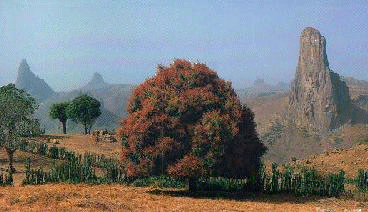 |
| Cameroon Environment About the size of Spain or California and shaped a bit like a boot, Cameroon is bordered by Nigeria to the north and west, Chad and the Central African Republic to the east, Congo, Gabon and Equatorial Guinea to the south and the Atlantic Ocean to the west. Cameroon is one of the most geographically diverse countries in Africa, comprising three major zones: the northern savannah, the southern and eastern rainforests, and the north-western hill region near Nigeria. Rich volcanic soils near the towns of Bafoussam and Bamenda in the west have permitted much higher rural population densities than elsewhere in the country. The west is coffee and cocoa country and home to nearly a quarter of the population. The hot, dry north is home to Lake Chad, the major game reserves, rocky escarpments and the broad B�nou� River. The country's game reserves teem with elephants, lions, giant eland, bongos, chimpanzees, crocodiles and birds galore. There are a few remaining lowland gorilla families in remote pockets of the underdeveloped south-east. |
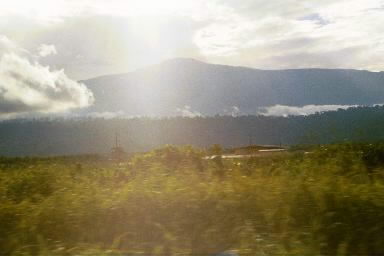 |
| Buea & Mt Cameroon Just about an hour north-west of Douala, Buea offers a cooler climate and an great view up Mt. Cameroon. It is home to Buea University and many shops and restaurants. As you climb the mountain, you'll pass through dense tropical forests and sub-alpine meadows. Some people choose to climb the mountain, it about a 17 mile round trip and they say you can make it in one day if you're in good shape. Although most people take two days and stay overnight. |
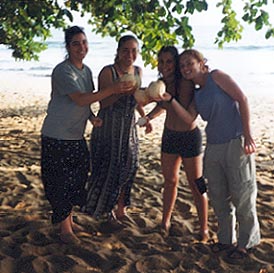 |
| White sand beaches make Kribi Cameroon's best seaside resort. Aside from some restaurants and a disco, there's little to do in town, but there are some inviting fishing villages nearby with excellent fresh seafood. If you make it during the dry periods of mid-October to November or March to May you'll miss the rain and the crowds of expats from Douala. The best nearby villages are Eboundja and Londji. With pristine sand and palm trees Kribi is great for lying back and enjoying some grilled fish and palm wine with the locals. Kribi is about two hours south of Douala by bush taxi. In a day trip you can also travel and visit the Pgymy tribes that live in the area. Spend some time seeing how they live, walking through their emmense forest and witnesses one of the few forest people left (below left). |
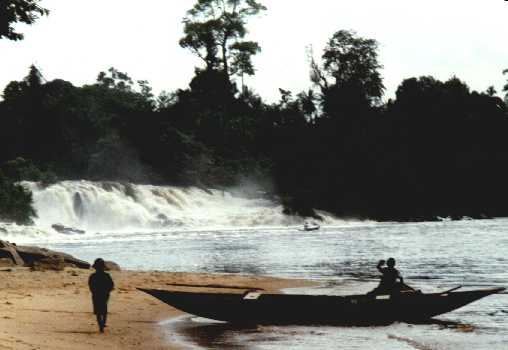 |
| Seven km south of Kribi, just before Grand Batanga, you�ll see a sign pointing the Chutes de la Lob�, one of a very small number of waterfalls in the world that empty into the sea. With a nice beach nearby and a small restaurant where they prepare the best shrimps I ever tasted it is worth the trip. The waterfall is not very high, but very easy to reach from the beach and quite broad. And it is interesting to see how there is a river above and the sea beneath it. |
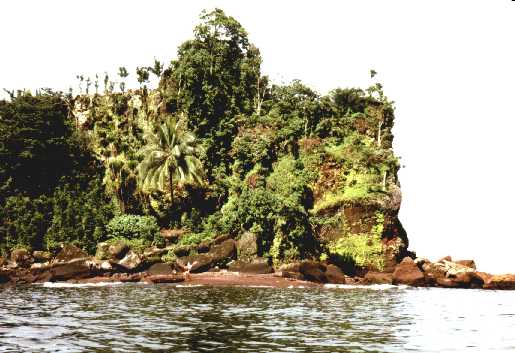 |
| On weekends during the dry season, beach lovers in Douala head for Limb�, founded in 1857 by Alfred Saker, a British missionary. The beaches here are of black volcanic sand and are not as scenic as those in the area around Kribi. |
 |
|
 |
 |
 |
 |
 |
 |
 |