|
Information, Consultantship and it Guides in Uruguay! Republica Oriental del Uruguay |
|
|
|
|
Information, Consultantship and it Guides in Uruguay! Republica Oriental del Uruguay |
|
Uruguay: Garden of America
|
Uruguay
officially the Eastern Republic of Uruguay or the Republic
East of the Uruguay (River) Spanish: República Oriental
del Uruguay.
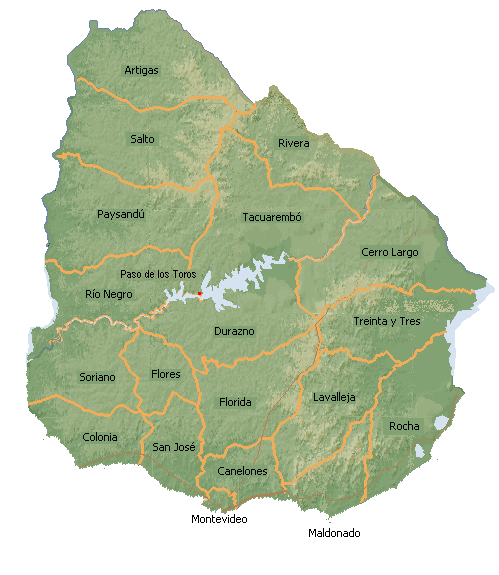
Politics Politics of Uruguay takes place in a framework of a presidential representative democratic republic, whereby the President of Uruguay is both head of state and head of government, and of a pluriform multi-party system. Executive power is exercised by the government. Legislative power is vested in both the government and the two chambers of the General Assembly of Uruguay. The Judiciary is independent of the executive and the legislature. Uruguay consists of 19 departments (departamentos, singular - departamento):
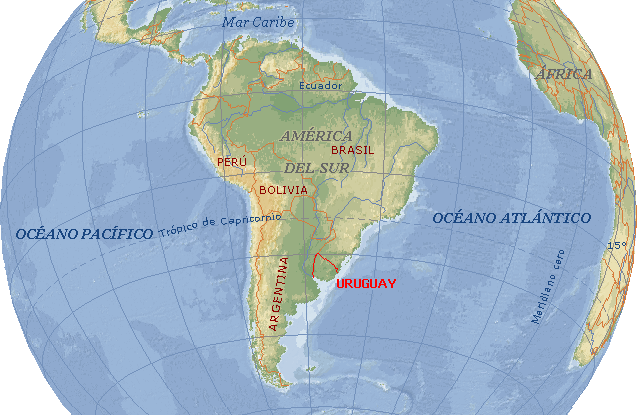
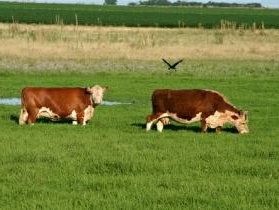
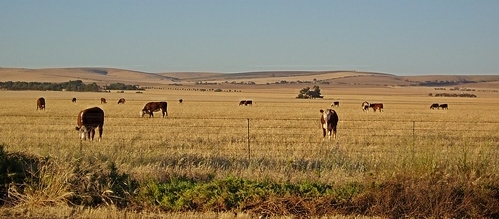
Geography of Uruguay Uruguay is the third smallest country in South America, after Suriname. The landscape features mostly rolling plains and low hill ranges (cuchillas) with a fertile coastal lowland, most of it grassland, ideal for cattle and sheep raising. The highest point in the country is the Cerro Catedral at 514 metres (1,686 ft). To the southwest is the Río de la Plata (River of Silver), the estuary of the Uruguay River, which forms the western border, and the Paraná River, that does not run through Uruguay itself. The only other major river is the Río Negro. Several lagoons are found along the Atlantic coast. The climate in Uruguay is temperate, but fairly warm, as freezing temperatures are almost unknown. The predominantly flat landscape is also somewhat vulnerable to rapid changes from weather fronts, as well as to the pampero, a chilly and occasionally violent wind blowing north from the pampas plains in Argentina. Economy of Uruguay Uruguay's economy is characterised by an export-oriented agricultural sector, a well-educated workforce, and high levels of social spending, as well as a developed industrial sector. After averaging growth of 5% annually in 1996-1998, in 1999-2001 the economy suffered from lower demand in Argentina and Brazil, which together account for nearly half of Uruguay's exports. Despite the severity of the trade shocks, Uruguay's financial indicators remained more stable than those of its neighbours, a reflection of its solid reputation among investors and its investment-grade sovereign bond rating, one of only two in South America. In recent years Uruguay has shifted most of its energy into developing the commercial use of IT technologies and has become an important exporter of software in Latin America. While some parts of the economy
appeared to be resilient, the downturn had a far more severe impact on
Uruguayan citizens, as unemployment levels rose to more than twenty
percent, real wages fell, the peso was devalued, and the percentage of
Uruguayans in poverty reached almost 40%. These worsening economic
conditions played a part in turning public opinion against the free
market economic policies adopted by the previous administrations in the
1990s, leading to popular rejection of proposals for privatization of
the state petroleum company in 2003 and of the state water company in
2004. The newly elected Frente Amplio government, while pledging to
continue payments on Uruguay's external debt, has also promised to
undertake a crash jobs programs to attack the widespread problems of
poverty and unemployment. Agriculture of Uruguay
When world market prices for
Uruguay’s main export commodities like beef and wool fell drastically
in the 1950s, the country's prosperous golden era came to an end. Today, agriculture still contributes roughly 10% to the country’s GDP and is the main foreign exchange earner, putting Uruguay in line with other agricultural exporters like Brazil, Canada and New Zealand. Uruguay is a member of the Cairns Group of exporters of agricultural products. Uruguay’s agriculture has relatively low inputs of labour, technology and capital in comparison with other such countries, which results in comparatively lower yields per hectare but also open the door for Uruguay to market its products as "natural" or "ecological." Campaigns like “Uruguayan
grass-fed beef” and “Uruguay Natural” aim to establish Uruguay as a
premium brand in beef, wine and other food products. Recently, an industry has arisen around estancia tourism that capitalizes on the traditional or folkloristic connotations associated with gaucho culture and the remaining resources of the historic estancias of Uruguay's golden era. Demographics of Uruguay As a Spanish-speaking country of Latin America, most Uruguayans share a Spanish cultural background, though about half of the population is of Italian origin. Some 88% of the population is of European descent, with mestizos (8%) and Afro-Uruguayans (4%) forming the only significant ethnic minorities. Church and state are officially separated. Most Uruguayans adhere to the Roman Catholic faith (66%), with smaller Protestant (2%) and Jewish and Armenian (1%) communities, as well as a large nonprofessing group (31%). Uruguay is distinguished by its high literacy rate (98%), large urban middle class, and relatively even income distribution. During the 1970s and 1980s two decades, an estimated 500,000 Uruguayans emigrated, principally to Europe. As a result of the low birth rate, high life expectancy, and relatively high rate of emigration of younger people, Uruguay's population is quite mature. The country has the lowest birth
rate of the Americas, an oddity among the region characterized
for birth rates in double digits per a thousand persons. General information
Media
Travel and commerce
Sports
|
|
MAP OF URUGUAY |