OTTO WEININGER
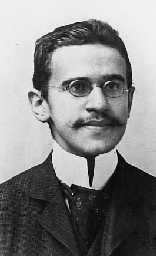
Otto Weininger was born in
After graduating from high school in 1898, Otto enrolled in the Philosophical
Faculty of the
A deeply serious young man, Weininger derived his greatest pleasure from
discussion of the most difficult philosophical subjects with his friends. His
friend Hermann Swoboda wrote: "He was quite indefatigable as he brought up
question after question during our frequent small parties, which lasted late
into the night or into the early morning. Abstract regions, from which others
would turn away with a cold shiver, were his real home. He was, in short, a
passionate thinker, the prototype of a thinker." (H. Swoboda, Otto
Weiningers Tod, Vienna: Deuticke, 1911, pp. 6-7.)
Weininger had little obvious interest in current events: "I never saw him
reading a newspaper", Swoboda recalled. Another friend, Emil Lucka,
observed that happiness was foreign to Weininger's nature, although he did
enjoy the beauty of nature and the music of the great composers. Swoboda,
however, denied this, saying that Weininger, initially, was no stranger to
happiness. It was only later that his personality changed.
In the autumn of 1901, Weininger approached Sigmund Freud with an outline for Sex
and Character. Seemingly unimpressed by Weininger's arguments, Freud
refused to recommend publication, and advised Weininger to spend "ten
years" gathering empirical evidence for his assertions. "The
world", Freud said, "wants evidence, not thoughts". Weininger retorted
that he would prefer to write ten other books in the next ten years. Weininger
once said in a letter to Swoboda: "How could I possibly prove
facts. Facts can only be indicated." What Freud didn't tell Weininger was
that he himself planning to publish on the subject of bisexuality.
Sex and Character was published in 1901. Shortly after the publication of his
book Weininger said to a friend "There are three possibilities for me -
the gallows, suicide, or a future so brilliant that I don't dare to think of
it".
Sex and Character (1901) is an analysis of the alleged constant
characteriological forms Man and Woman, presented within a mixed
Platonic-Kantian framework. The book took
Despite the unpleasant associations Weininger's name must have had for him and
despite his own distaste for Weininger's theories, Freud always acknowledged
Weininger's gifts. After his suicide, Freud described him as a "slender,
grown-up youth with grave features and a veiled, quite beautiful look in his
eyes; I could not help feeling that I stood in front of a personality with a
touch of the genius".
The metaphysics of sexual love and feminine psychology, observed Richard
Nordhausen in the Münchener Neueste Nachrichten, had never been treated
with such monstrous brutality or acuity as in Weininger's book. "But",
he said, "one must must, must read this book".
George Worth, in his book Ways to Love (1940) said that Sex and
Character was "an unparalleled crime against humanity".
August Strindberg contributed twice to Die Fackel's discussion of Weininger.
The first was a letter of July 1903 from Strindberg to his German translator
Emil Schering. Here Strindberg informed Schering that Weininger had sent him a
copy of Sex and Character, which Strindberg had found to be a
"frightening" book that had "probably solved the hardest of all
problems". To Weininger himself, Strindberg sent a postcard offering
heartfelt thanks for at last solving the "Woman Problem". Strindberg's
letters were followed by his obituary of Weininger. In this deeply-felt
tribute, Strindberg said that only the mentally retarded would doubt the
superiority of the male sex over the female: all the spiritual and material
riches of humanity had been created by males. Woman's love for man, Strindberg
opined, was "50% animal heat and 50% hate".
The European literary intelligentsia of the fin de siècle did not always agree
with Weininger but they treated Sex and Character with great respect. Ford
Madox Ford described the English translation of the work as "the most
important, as it is the most singular, of contributions to the modern
literature on the sex question". Ford reminisced that around 1906, in the
men's clubs of
Weininger's literary influence was not confined to
In her well-known work, The Female Eunuch, the feminist scholar Germaine
Greer describes Sex and Character as "a remarkably rigorous and
committed book by a mere boy". Greer says that "the most chastening
reflection is that Weininger was simply describing what he saw in female
behavior around him . . . All the moral deficiencies Weininger detected
masqueraded in Victorian society as virtues. Weininger is to be credited with
describing them properly". Greer then agrees with Weininger's contentions
on the illogicality and emotionality of Woman but argues that these traits,
instead of being disadvantages, are actually advantageous. Alluding to
Weininger's belief that the absolute female lacks an ego, Greer exclaims:
"If women had no ego, if they had no separation from the rest of the
world, no repression and no regression, how nice that would be!"
Greer illustrates most perfectly
with this comment that even the most masculine of women (herself) have almost
no masculinity in them at all. The truly masculine ego wishes to overcome
itself, but the feminine ego wishes to annihilate itself - or rather, wishes to
be annihilated. Man wishes to go forth and conquer death, but Woman will never
even enter into the world. - K.S
Ludwig Wittgenstein grew up in
Wittgenstein enthusiastically recommended Sex and Character to his
peers. When philosopher G. E. Moore reacted critically, Wittgenstein responded:
"I can quite imagine that you don't admire Weininger very much, what with
that beastly translation and the fact that W. must feel very foreign to you. It
is true that he is fantastic but he is great and fantastic."
The reviewer for the Deutsches Volksblatt (identified only as Dr. H. F.)
was less enthusiastic and censured Weininger for drawing untenable conclusions.
"The rose had its thorns but was still the empress of flowers", he
remarked. Women, too, for all their flaws, were not the amoral, soulless beings
described in Weininger's treatise. After providing a fairly comprehensive overview
of the argument of Sex and Character, the reviewer concluded: "Only
prophets and philosophers can be so gruesome".
A very early notice in the Neues Wiener Tageblatt described Sex and
Character as "very stimulating, educational and despite everything,
full of truths". Another anonymous reviewer in the Wiener Allgemeine
Zeitung described the book as "one of the most noteworthy and most
original books ever written."
The book gives extremely negative characteristics of both women and jews. Woman
was negative and passive, whereas man was positive and active. Sexologist Ivan
Bloch noted that the urge to affirm a "masculine culture" was leading
even some heterosexual men to renounce women in horror. Such people, according
to Bloch, almost belonged to a "fourth sex". He saw the philosophy of
Schopenhauer as the intellectual fountainhead of this pathological fear of the
feminine, and the work of August Strindberg and Otto Weininger as its most
full-blown expressions. Otto Weininger, himself being a half jew, had
rediscovered and reported this "well-known secret" in his
"virile" book. This discovery of the "essence and nature of
woman", Strindberg surmised, had cost Weininger his life. In 1903
Weininger commited suicide.
***
"First I want to define exactly what I mean by Jewishness. One is
not dealing with a race or a people, and even less with a legally acknowledged
profession. One can define it only as a spiritual attitude, a psychic
constitution, which offers an
with which one has nothing in common ... And then: Indeed, when I speak of a
Jew, I never mean the individual or the whole group, but man in general, as far
as he shares the PLATONIC idea of Jewishness. It is my sole intention to define
the meaning of this idea. ...
"The spirit of the modern age is Jewish wherever it is found. ... Our age,
which is not only the most Jewish, but also the most efeminate of all ages; the
age in which the arts are only a rag for wiping its moods, and which attributes
the artistic urge to animal games; the age of the most gullible anarchism; the
age without a sense for the state and justice; the age of sexual ethics; the age
of the most shallow of all historical methods (historical materialism); the age
of capitalism and Maxism; the age in which history, life and science are
reduced to economics and technology."
Otto Weininger, Sex and Character