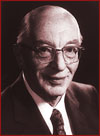
ERIC VOEGELIN
Eric Voegelin, one of the most distinguished interpreters of the non-liberal streams of European thought, was one of the most provocative and durable political philosophers of this century. His thought had a profound influence on contemporary conservatism. Characteristic for his thought was his reliance on metaphysical categories. At the heart of Eric Voegelin's thought is the relationship between the truth of order discovered in experiences of transcendence and the incarnation of that order in particular societies. The tension that exists between the truth of order and its social incarnation and the failure of any given society to fully embody this order are recurrent themes in this preeminent philosopher's work.
Eric Voegelin was born in 1901 in Köln and grew up in Vienna, where he came professor on the juridical faculty. There he teached social and political science until 1938, when Austria was united with National Socialist Germany. Voeglin fled to Switzerland and then to the United States, where he worked for several universities. From 1942 he teached at Louisiana State University in Baton Rouge. There he wrote his famous works, founding his reputation as one of the most important political thinkers of the 20th century: The New Science of Politics and the first volumes of Order and History. In 1958 he was appointed professor to the University in Munich, where he built up the institute for political science.
Following his retirement in 1968 he returned to the United States, where he worked as Henry Salvatori Distinguished Scholar from 1969 to 1974 and as Senior Research Fellow at Hoover Institution on War, Revolution and Peace in Stanford, California until his death on January 19th, 1985.
Since the appearance in the 1950s Voegelin's Order and History, conservatives like Russell Kirk, Irving Kristol, and Allan Bloom have increasingly turned to his thoughts to support their attacks on liberalism and the modernist mindset.
Like so many conservatives, Voegelin rebelled against modernity, amorality - personified by Machiavelli, Hobbes, Rousseau, Kant, Hegel, and Nietzsche - and its promotion of individualism and materialism over communal and spiritual responsibility. While he disdained the reductionist "conservative" label, conservatives nevertheless appropriated his philosophy, in part because it restored theology and classical tradition to the moral core of civil society. For Voegelin, modernity's debilitating disorder revealed surprising and disturbing relations among liberal, communist, and Nazi ideologies. In his eyes, modernity's insidious virus, so apparent in the Nazi and communist regimes, lies incubating within liberal democracy itself.
Eric Voegelin contended that certain modern movements, including Positivism, Hegelianism, Marxism and the "God is Dead" movement, are variants of the Gnostic tradition of antiquity. He attempted to resolve the intellectual confusion that has resulted from the dominance of gnostic thought by clarifying the distinction between political gnosticism and the philosophy of politics. Highly provocative, his work is essential for students of modern politics, philosophy, and religion.
Race and state
The young Eric Voegelin judged that in the racist-liberal argument over the existence of an Aryan mind, no one had ever said anything that was scientifically well-founded. The German public, faced on the one hand with a racist affirmation that had never been demonstrated and on the other with liberalism's equally unproven negation, had drifted into a middle position, vaguely supposing that there might be something "to it." Race and State was intended to respond to this situation, to give race science and the racist idea of the state a serious scholarly treatment for the first time. It was published in Germany in early 1933. We don't know if any direct pressure was exerted, but after a few months and a few gleichgeschaltet reviews, sale was discontinued. Race and State hardly had the potential to change many minds anyway. Not that Voegelin had written a weak book; the problem was rather that his musings were extraordinarily difficult, overly-elaborate, and abstract. His conclusions meanwhile, from the perspective of both racists and liberals, were ambiguous.
Voegelin analyzed the works of Professors Fritz Lenz, Walter Scheidt and Hans Guenther, the leading scientists of the racist camp, who contended that racial psychology was biologically determined. In a seventy-page review of the mind-body problem in Plato, Aristotle, Descartes, Kant and Scheler, Voegelin demonstrated the contradictions that arise when one asserts that body simply determines mind, and that these philosophical difficulties, which were, as he considered, beyond the intellectual horizons of these simple-minded nineteenth-century materialists, reduced their science to nonsense. Yet Voegelin obviously considered that scientists with a better understanding of the human person might one day demonstrate the existence of psychological races! Consistent with his Schelerian understanding of the human person as a mind-body unity, Voegelin considered that race was a dual expression, in both biological and psychological form, of cultural "style." His objection to the professors of race hygiene and social anthropology was not that they saw race where it wasn't but that they defined the human being on a purely animal level, which reduced persons to representatives of one or another biological group (whether race or species made little difference) and thus rendered them dispensable.
Voegelin, then, will appear to some to have been a bizarre sort of racist. His expectation of a future racial science is indeed bizarre today, but we should be clear on two things. He was sure that no race was superior to any other--no more than classical style is superior to gothic or baroque. And the reasoning behind his belief was by no means narrow or unintelligent. As to the leading scientists, their simple-mindedness was apparent in their approach to the problem of psychological type formation (in short, since practically any psychological "trait" may have various and even opposed causes--as one person may be adaptable out of ambition, another out of lack of ambition--the problem is how to distinguish secondary characteristics from heritable traits). The scientists were unaware of the problem; they assumed anything could be a heritable trait. Guenther's list of Nordic traits included "a toughminded sense of reality," "mistrust of strangers," "a not very conciliatory nature" and "imperviousness to hackneyed expressions"; Lenz's "inclination to Protestantism," "northern boldness" and "love for the sea," which, Voegelin cracked, the race shared with "the closely related Phoenicians and Polynesians." Even the rare appearance of lice was held to be a trait; "because of its cleanliness, for example, "Sweden probably has the world's highest level of culture" (p. 85).
As to the idea of the racial state, Voegelin theorized that it blocked the "essential social experience" of belonging to humanity. As a result, the racially-defined community experienced a sense of metaphysical fear, forlornness and horror which it was able to overcome only "by claiming for itself the status of 'world' and regarding all others as 'non-world'....We recognize fear as the deepest root of the new idea of community... [o]ut of fear arises the hatred for the counter-worlds, which, by their mere existence, can at any moment cast me back into the experience of fear" (p. 151). The evidence for this is brought out in an analysis of Greco-Roman ancestor worship and the gens-based organization of ancient communities; St. Paul's idea of the Body of Christ and the concept of Christ as the new Adam in the Christian-imperial idea; the transformation of Christian-imperial ideas by the rising nation-states; Fichte, who Voegelin takes as the type of a mad nationalist brigand; and, what is most impressive, a re-interpretation of Schelling's analysis of mythology and Voelkerwanderung. Voegelin ranges far and wide in order to bring home what we might consider only a typical Germanic-existential conclusion.
In his conclusions he relied on metaphysical categories: "How could a minority of such insignificant numbers [Jews] attract so much hatred? Undoubtedly this hate is largely due to a feeling of inferiority on the part of Germans (p. 181)." The hatred was often terrible because Germans were seeking "rootedness" while Jewish success was associated with qualities connected to "mobility." Nineteenth-century Jews were also guilty of regarding others as "non-world."
Race and State was one of Voegelin's early works, written when he was under the overwhelming influence of Scheler's Die Stellung des Menschen im Kosmos, in which the phenomenologist proposed to examine different types and levels of human experience, accepting no understanding of the relations between them that did not account for all of the factors to be explained; and so to develop an idea of the human being that is coherent and non-reductive. Voegelin was pursuing that ambition here, by means of a via negativa intended to demonstrate that reality is shrunken and deformed by biologism and dogmatic enemy-constructions. Members of the Eric Voegelin Society may be of the opinion that Race and State has much to teach us about modern politics. To most historians, and especially to neo-Nietzscheans, it will be unconvincing and strange. This reviewer admires its Schelerian purposes more than its Voegelinian execution.