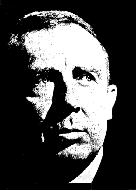
JEAN-FRANCOIS THIRIART
Prophet And Militant
English translation by Carlo Terracini; edited for clarity by Archive staff
"I write for a species of men which does not exist yet, for the Lords of the Earth..."
-F. Nietzsche, The Will To Power>.
The sudden disappearance of Jean Thiriart (in 1993 ed.) was for us like a thunder clap in a serene sky. We, the militant Europeans, during successive decades, learned how to appreciate this thinker of action - especially with his return to active politics in the 1990’s, after a considerable number of years in internal "exile" during which he reformulated his previous positions. For immediate reasons, his death had also surprised us. His Italian friends had personally learnt of it at the time of his journey to Moscow in August 1992, where we formed a Western-European delegation to the forces involved in a National Salvation Front. This Front, thanks to work of the untiring Alexandre DUGIN, organizer of the geo-political and ‘mystical’ review Dyenn (the Day), learned how to appreciate and weigh many aspects of Thiriart’s thought and then diffused it throughout the countries of the former USSR and in Eastern Europe.
I intend in the lines which follow, to honour the memory of Jean Thiriart by stressing the importance that his thought always had, and has, in our country, Italy, from the Sixties and Seventies, in the field of geopolitics. In Italy, his reputation rested primarily on his main book, the one which truly gave organic coherence to his thought in the field of international politics: Europe - An Empire Of 400 Million Men. Published by Giovanni Volpe in 1965, over thirty years ago, its power is still with us.
Only three years had then elapsed since the end of the French experiment in Algeria (France withdrew in 1962, ed.) This dramatic event was the last great mobilization of nationalist right-wing policy, not only within France, but in other countries of Europe, including Italy. The major reasons for the Algerian tragedy were not understood by the anti-Gaullist militants who fought for French Algeria. They did not understand the geo-political stakes of the business at hand or how the victorious powers of the Second World War (especially America) intended to redistribute the cards to their own advantage How many of these militants for French Algeria understood exactly which power was the PRINCIPAL ENEMY of France and Europe? How many of these fighters understood that, on the historical level, the loss of Algeria, preceded by the loss of Indo-China, just like the collapse of all the European colonial systems, were direct consequences of the European military defeat of 1945? The Belgian, Jean-Francois Thiriart, was one who saw this.
Indeed, 1945 signalled not only the defeat of Germany and Italy, but also of EUROPE - Great Britain and France included. Not even a single colony of the old colonial system did not become a victim of a new, but a more modern and more subtle form, of neo-colonial imperialism.
By contemplating the events of Suez (1956) and Algeria (1954-63), the new "national-revolutionaries", as they called themselves, ended up formulating an analysis of the consequences of these two tragic episodes. This analysis differentiated them from the "traditional lines" pursued by the Right in the post-war period: a visceral anti-communism and the slogan of the defence of the ‘West’, white and Christian, against the combined attack of Soviet Communism and the national liberation movements of the people of colour of the Third World.
The old vision of international politics was integrated perfectly into the world economic strategy and geopolitics of the American thalassocracy (rulers of the seas) which, with the Cold War, had succeeded in recasting the issues for Europe. Os so maintained many of the fascists and the post-fascists with their geo-strategic project of ‘world domination’. Everything the U.S. system did, brought us eventually to the "New World Order", already partially fallen through (!!) but which seems to be a reverse-image and satanic caricature of the Hitlerian "New Order". The old vision did not serve the European Right gaining true independence of thought and action.
The new French line, to give only one example of the new national-revolutionary politics, began its advance at the time of the events of Algeria. It started a long-running political and ideological revision, which led to the recent journey of Alain de Benoist to Moscow, an obligatory course for all the revolutionary European opponents of the globalist system. This step by de Benoist, in spite of relapses and later disavowals, was supported by some of his trustworthy associates. Yet many European Nationalists did not yet fully understand the real range of the meetings between Europeans of both the West and Russia at the international level and therefore preferred themselves to remain lost in dead farmyard quarrels, to continue to retain small hatreds over (sometimes nationally specific) doctrine. In this field like so many others, Thiriart had already given his example. While understanding the natural differences existing between the men and the schools of European Nationalist thought, he worked in favour of the supreme interest of the fight against American imperialism and Zionism.
To return to Italy, we must remember the situation which reigned in that remote year 1965, when the work of Thiriart appeared. The forces of national-revolution, were still integrated into the Italian Social Movement (MSI). These forces were victims of a PROVINCIALISM of a vétéro-fascist quality, a provincialism cynically used by the leadership of the MSI, which was completely controlled by the strategy of America and NATO. This political line would be followed thereafter with fidelity, even during the short bracket of management supposedly inspired by the national-revolutionary theses of Pino Rauti around 1989-91. Even this leadership of the MSI supported the intervention of Italian troops in Iraq on the side of the US Army!
The heads of this collaborationist line once used the revolutionary groups as a centre, made up primarily of very young people, supposedly to create militant bases for action. In ultimate practise, the MSI collected the votes necessary to send to the Parliament deputies and "entrists", there to be used as support for the reactionary governments of the Centre-Right.
All that, of course, was not in the interest of Italy or Europe, but only in the interest of the occupying power, the United States. And once more, we witness a small chauvinistic nationalism, used for the profit of foreign and cosmopolitan interests! This was also time when the Extreme-Right side was still able to mobilize in Italy thousands of young people who claimed that Trieste is and would remain Italian, and who commemorated annually the events of Hungary-1956!
The Italian right wing overall, did not see Thiriart’s "revolution" in thought when it was announced. The old vererans of ‘nationalist politics’, were indeed provincial and in practice, philo-American, with no real commitment to a sovereign Europe. As a consequence, during all the years of the late 1960’s and 1970’s, (the "years of lead", or crimes of the State carried out against the Left), they collaborated with a false anti-communist politics. The work of Jean Thiriart had for a great number of nationalists the effect of a bomb; a salutary electric shock which faced the true nationalist position towards solving problems which, had been forgotten by the leaders or had fallen into a type of ideological disuse.
Today, we compelled to take account of the political effects inspired by the Thiriart’s Initially, the impact were extremely modest. Starting with the publication of Thiriart's book, the ‘European’ set of themes gradually became the ideal inheritance of a whole sphere of political effort. In the following years, the European Nationalists developed the current anti-globalist arguments. Without exaggeration, we can affirm that it was in the late 1960’s that the strategy of the European-Nationalists developed towards the ‘line’ of a non-Left anti-imperialist fight, a geo-strategic alliance between European Nationalists and the revolutionaries of the Third World. The adoption of this line was all the more astonishing and significant when it is said that the history of ‘Young Europe’ started with a fight against the Algerian FLN!! Thiriart had, on this level, completely changed camp, without substant-ially changing his vision of the world. A few decades before Thiriart had left the Belgian Extreme Left to pursue ‘collaboration’ if it produced a new Europe. Flexibility in action was necessary for Thiriart. The new politico-ideological line was worth the baseless charges made by the patrons of the old nationalist line, that he was a "double agent" under the command of Moscow!
In Italy, the Italian section of Young Europe (Giovane Europa) was quickly set up. In spite of the political origin of the majority of the militants, Giovane Europa did not have any direct affiliation with Giovane Italia, the organization of the MSI (modelled upon the Giovine Italia de Mazzini in the 19th century). On the contrary, Giovane Europa was practically the antithesis of the MSI youth group, the contrary perspective. So that once the militant experiment of "Giovane Europa" concluded around 1969, the majority of its militants were found carrying on the fight in Movimento Politico Ordine Nuovo (MPON). They remained opposed to the MSI political line which preached parliamentary intervention. It wanted the partisans of Pino Rauti outside of the ‘anti-communist’ MSI of Almirante.
If any account of the singular roles played by movement theorists is undertaken, then the thought of Julius Evola was central to the various cultural and ideological strategies pursued in Italy. However, one should not forget either that Jean Thiriart impelled, for his part, a genuine attempt at the restoration of the national forces in those years and after. Even national-revolutionary activist, Giorgio Freda, recognized the debt to Thiriart.
One very particular and significant aspect of Europe - An Empire Of 400 Million Men, is to have anticipated, by several decades, a fundamental set of themes, which recently resurfaced in the Russian debate, (thanks to the initiatives of Alexandre Dugin and of the Dyenn review), and in the Italian debate (thanks to the reviews ORION and AURORA): geo-politics.
The first sentence of Thiriart's book, in the Italian version, is precisely dedicated to this essential science. This science which had undergone, in our post-war period, a very long ostracism, under the pretext of its having been an instrument of the Nazi expansion! At the very least this is an incongruous charge when it is known that at Yalta the winners of the Second World War shared the skins of Europe and the rest of the world on the basis of truly geopolitical and geo-strategic considerations. Thiriart was perfectly conscious of this and wrote of it in his first chapter, significantly entitled "From Brest To Bucharest. Let Us Erase Yalta". He said: "In the context of geopolitics and a common civilization, as it will be further shown, the European unit and community extends from Brest to Bucharest". By writing this sentence, Thiriart imposed geographical and ideal limits to his Europe, but soon, he exceeded these ‘limits’ and arrived at a unit of design concerned with the great geo-political space which is EURASIA. Once more, Thiriart showed that he was a lucid anticipator of political ideas which only mature very slowly in his readers. But there is more!
Jointly with the great ideal of the Europe-Nation and the rediscovery of geopolitics, the reader is obliged to take a fresh glance at the great spaces on this planet. It was another merit of Thiriart to have gone beyond the European trauma of the era of the decolonization and to have sought, for European nationalism, a strategic world alliance with those governments of the Third World not controlled by imperialism. In particular, he looked to the Arab and Islamic zones in North Africa and in the Middle East. It is true that those who discover geopolitics, cannot fail to see world events in a new light.
And it is in such a context, that it is necessary to note the many trips undertaken by Thiriart to Egypt and Romania, etc, and his meetings with Chou En Lai, Ceaucescu and the Palestinian leaders. Everywhere possible, Thiriart sought to weave an international information network and build anti-imperialist alliances even with the most ‘contrary’ of forces. In addition, let us all note that the original style of the Cuban revolution exerted its own influence on Thiriart. With his synthetic almost telegraphic style, Thiriart had traced in its texts the essential lines of a foreign policy relating to a future Europe: "guidelines of Europe as a unit: with Africa: symbiosis with Latin America: alliance with the Arab world: friendship with the United States: reports/ratios based on equality".
We note that Thiriart’s geo-political vision was perfectly clear. He visualised large continental blocs. He was distanced from any vision which skimped on a small Western Europe with the Atlantic alliance. Today, this EEC Europe is nothing more than the Eastern appendix of the Yankee thalassocracy, which has as its centre the Atlantic Ocean, reduced to the function of an "interior lake" of the United States.
Today, given the political career of Thiriart, some of the geo-political options, as now dis-cussed in the European Nationalist milieu, could seem obvious, even banal for some. But let's put aside the fact that all this is somewhat clear for most 'Nationalists'. It is unfortunate to discuss certain resurgent ‘biological racists’ and 'anti-Islamicists' (those who supported Israel or disliked Moslem nations on racial grounds, ed.), those who represent a pseudo-néo-Nazism, used as instruments by American and Zionist propaganda with an anti-European aim. We are weary to have to refer to them over and over after thirty years of European Nationalist action. We have in their stead this purely geo-political option from Thiriart, void of all (false) ‘racist’ connotations; something very original and courageous when formulated first in a bipolar world. It grew from a reality: opposition to the two-bloc ideological and military antagonisms which offered the prospect of conflict between the USSR and the West under the threat of reciprocal nuclear destruction.
We can affirm that a good number among us in Italy, managed to break with this false two-sided vision of global conflict, and did that well before the collapse of the USSR and the Soviet bloc. It was due in good part to the fascination which the Thiriart theses exerted. Their brilliant intuitions inspired us.
Indeed, one can speak about "genius", in policy as in all the other human fields of know-ledge. This occurs when one can predict and then explain facts or events which are still in shadow, ignored, not very clear for the others and which emerge from their occult phase only gradually into the full light of day.
In this chapter, we want simply to point out the assertions of Thiriart relating to the geo-political dimension of the European State future, consigned in the chapter (10, 1) and entitled "Dimensions Of The European State. Europe From Brest To Vladivostock" (pp. 28 to 31 of the French edition):
"Europe enjoys a great historical maturity. She knows from now on the vanity of the crusades and the wars of conquest towards the East. After Charles XII, Bonaparte and Hitler, we could measure the risks of similar campaigns and their price. If the USSR wants to preserve Siberia, it must make peace with Europe from Brest to Bucharest. I repeat it. The USSR does not have and will have less and less force to preserve at the same time Warsaw and Budapest on the one hand, and Chita and Khabarovsk on the other hand. It will have to choose or most likely have everything to lose".
Further: "Our policy differs from that of General de Gaulle because he made three errors: - to make the border from Europe at Marseilles and not at Algiers; - to make the border of the USSR/Europe bloc on the Urals and not in Siberia; - and finally, to want to deal with Moscow before the liberation of Bucharest" (p. 31).
With these two extracted briefs, one cannot say any longer that Jean Thiriart missed out on perspicacity! However these sentences were written, at a time when the militants who sincerely pro-Europeanist were most daring, when they just managed to conceive a European unit from Brest to Bucharest, i.e. Europe limited to the Western peninsular platform of Eurasia. For Thiriart, this represented nothing more than one stage, a spring-board for launching a vaster project, that of the continental imperial unit. The first one does not inspire us any more. Consequently, the old nationalist line, including those who repeat it today, do nothing but ad infinitum repeat their provincialism, under the benevolent eye of their American owner.
Thirty years ago now, Thiriart went further: he denounced all the geo-political nonsense of behind the gaullist project (de Gaulle being another person directly in charge of the defeat of the European project, done in the name of a chauvinism of a ‘Europe’ extending only from the Atlantic to the Urals). He endorsed, at the same time, this absurd continental vision specific to the small professors of geography, who traced on paper an imaginary border based on the ‘height’ of those Ural Mountains. They never stopped any invader, neither Huns neither Mongols nor Russians.
Europe defends itself on the rivers Amur and Ussuri; Eurasia, i.e. Europe plus Russia, has a destiny clearly drawn by the history and geo-politics in the East, in Siberia, in the Far East of the European culture, and this destiny opposes it to the West and the American age of the capitalism. As for the history of the meetings and confrontations between peoples, it is nothing less than geopolitics in action, just like geopolitics is nothing different but the historical destiny of the people, the nations, the ethnic groups and the empires, even of the religions, in power. In passing, we must add that the design of Jean Thiriart, in so far as it was still related to the "nationalist" models influenced by revolutionary France, was finally more "imperial" than imperialist. He always refused, until the end, to sanction the final hegemony of one people over all the others.
The Eurasia of tomorrow will not be Russian and it will not be Mongolian, Turkish, French or Germanic: because when all these people wanted only to exert their hegemony, they failed. Failures which should have been useful to us as teaching aids. Who could, thirty years ago, envisage with any precision the intrinsic weakness of that colossus, the militaro-industrial USSR, which seemed at the time to have an impetus towards the conquest of ever new spaces, across the continents in rough competition with the United States? Was it apparently going to succeed?
With time, all that appeared a gigantic bluff, a historical mirage probably manufactured by the globalist forces in the West to maintain their people inside a constraint with, the key, a constant blackmail of terror. Were the peoples and the nations of the Earth terrorised for the benefit of the supreme strategic interest, which poses as possessing the only "truth"? I mean the interest of the planetary super-power, the United States, the base for the territorial army of the globalist project.
In the final analysis, in geo-political terms, it was the "policy of the anaconda" which prevailed against the USSR. This was defined in the past in the same words by the German geo-politician Haushofer, and it is so defined today by Russian geo-politicians over whom Colonel Morozov officiates. The Americans and the globalists always seek to move the territorial pivot away from Eurasia and its potential outlets on the hot seas, before gradually nibbling away at the territory of the Soviet "tellurocracy" (rulers of the land). The starting point of this strategy of nibbling was in Afghanistan.
Jean Thiriart had already clarified, in his book of 1965, the motivations which animated international politics. It is no accident that one of his models was Machiavelli, author of The Prince. Admittedly, the pessimists will say to us, that if Thiriart's analysis of politics served to anticipate and envisage the future, Thiriart the militant, the organizer and political head of the first model of transnational European organization, failed. But then, the international situation was not yet sufficiently ripe (or rotted), as we note today, and there was no "starting sanctuary", (a base area) which Thiriart had considered to be essential. Indeed, Jeune Europe had not a free territory, a completely foreign State which could have been used as the base of refuge, as a source for the provisioning of the European militants of the future. A little like Piedmont was for Italy in the struggle for unification.
All the meetings of Thiriart at the international level had this aim. All failed. Realistically, Thiriart gave up political engagement. He waited until the occasion was right. Eventually a better option arrived, that of having a large country to which he could have proposed his strategy: Russia. The destiny of this Belgian citizen by birth but European patriot by vocation was strange: he always was "out of time", surprised by the events. He always envisaged them but was always exceeded by them. When he went to post-communist Russia, there was finally – a real opportunity.
Thiriart’s design of European geopolitics, was a vision which indicated that overall the United States is the absolute objective enemy of traditional culture, of free peoples, nations and identities. But Thiriart was human and had limitations.
His historical and biological materialism, his centralising European nationalism, his non- commitment to ecological themes, his hostility on principle to all religious pathos, his ignorance of any metapolitics, his admiration for the Jacobinism of the French revolution, were stumbling blocks for many anti-globalists.
After all, the "rationalist" ideas, that Thiriart endorsed, were on the contrary, the cultural and political humus on which the globalist ideology germinated over the last two centuries. These aspects of the thought of Thiriart revealed their limits. During the last months of his life, in particular during the conferences and conversations in Moscow in August 1992, this was so. His intellectual development accepted linear historicism and progressivism.
Such a rationalist vision did not permit him to include/understand phenomena as sig-nificant as the new "mysticism" of eurasianist Russia, with its cultural projection which bears a highly revolutionary and anti-globalist content. And let us not even speak about the impact the traditionalists like Evola or Guénon had on the Russians! Thiriart thus con-veyed a "cultural" handicap with the Russians. But this did not prevent us from meeting in Moscow in August 1992 to discuss Thiriart’s geopolitics.
Young European militants did meet the protagonists of the avant-garde Russian "euras-iansm", gathered around the Dyenn review and the movement of the same name and many others from the National Salvation Front and former communists. In the capital of the Soviet ex-empire Thiriart had been recognized as an avant-garde thinker by the new Russian revolutionaries. The geo-political lessons of Thiriart now germinated in Russia.
Is it an irony of history that we can always confirm the ancient proverb: "no one is a prophet in his country"? In Russia, the long "interior exile" of Thiriart seemed finished, He now flooded us with written documents and reports of oral interventions. The flood never seemed to stop! Did he seek to catch up with time that he had lost in a scornful silence?
Driven by a youthful enthusiasm, Thiriart recovered to give orations on history and geopolitics, the exact sciences and political economy, law, and all other conceivable disciplines, to the Generals, the journalists, the members of Parliament, the writers, the politicians of the ex-USSR and the Islamic militants of the CIS. And, of course, with us, the Italians present! All that has occurred in Russia today, where all is now possible and nothing is certain; we have indeed a situation in Russia suspended between a glorious past and a dark future, but also pregnant with unimaginable potentialities.
Moscow survives from day to day between apathy and energy. The Russian situation can rebirth a new power or falter in the total disintegration of a people which was imperial and became miserable and plebeian. Lastly, it is there, and there only, that the destiny of all the European people is played out. The alternative is quite clear: we will have a new empire eurasianist in scope which will guide us in the struggle to liberate ALL the people of the sphere, or we will witness the triumph of globalism and American hegemonism for the next millennium. It is in Russia that the writer and politician Jean Thiriart had found the HOPE to be able to put his visions of the past into practice, this time on a new scale. In Russia, can emerge the Messiah armed with the people of Eurasia, a cycle of civilization.
Current Russia is an immense laboratory, virgin ground which one will be able to fertilize, a virgin land where freedom and power will be sought to try new syntheses: "the path of freedom passes by that of the power", underlined Thiriart in his fundamental book.
"The freedom of the weak is a myth with demagogic or electoral use. The weak ones were never free and will never be. That which wants to be free, must want to be powerful. That which wants to be free must be able to limit other freedoms, because freedom is invading and tends to encroach on that of one’s weak neighbours". Or: "It is criminal from the point of view of political education to tolerate that the masses can be poisoned by weakening lies as those which consist in "declaring peace" with one’s neighbours while thus thinking we can preserve our freedom. Each one of our freedoms was acquired following repeated bloody combat and each one of them will be maintained only if we can make display of a force likely to discourage those which would like to deprive us of them. More than others, we like certain freedoms. But we know how much these freedoms are perpetually threat-ened. As it is with an individual, so it is with a nation. We know the source of freedom and it is power. If we want to preserve the first, we must cultivate the second. They are inseparable " (p. 301-302).
Such thoughts could ensure their author a position in a faculty of history or political science. There was more for this man to say when death cut him cruelly short.
Lastly, it rests with to us to underline the complete work of Thiriart. He had completely systematized his political thought while remaining always fully coherent with his own premises and remaining faithful to the style which he had given to his life. Others will not be able to make him say post-mortem things which he did not say, nor to adapt his texts and theses to the political requirements of the moment. There remains the fact that without Jean Thiriart, we would not have been what we became. Indeed, we are all his heirs in the field of ideas. We must now develop them in action.
Today, we wish to remember a political writer, a man who was quite simply impassioned, impetuous, and possessed of an overflowing vitality. These are the same qualities which must burn in us, if we are to succeed.
The case of Jean Thiriart? He was the incarnation of a man of the elite who glances towards the distant, who saw well beyond the contingencies of the present where the masses remain in captivity. I have traced the portrait of a MILITANT PROPHET.
BACK