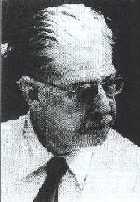
RENÉ ADOLPHE SCHWALLER DE LUBICZ
The name Schwaller de Lubicz is not one which many people have heard and yet if you scratch below the surface of the works of Hancock, Bauvel and other modern writings on Egypt, Esotericism and ancient civilization, you will find him standing there waiting. The source for much of the modern re-appraisal of Ancient Egypt comes from the work of John West, who clearly tells us that Schwaller de Lubicz was his inspiration. Yet who exactly was Schwaller de Lubicz and why haven’t we heard of him ? The first reason why we have not heard of de Lubicz is that much of his work is still only available in the native tongue of French. It seems difficult for us conditioned to believe in the supremacy of English as a world language, to realize that there is a vast library of untranslated material which is great import to modern esotericism. Most of the works of Rene Guenon, Julius Evola and Schwaller de Lubicz are still only available in their native tongue. The second reason why we probably haven’t heard of Schwaller de Lubicz is that he is incredibly difficult to read. Since he believed is the sacredness of language and of number, he used them only with reservation and respect and in a form that demanded slow, meditative consideration. His works cannot be breezed through, they demand digestion. Not something we are used to, being the era of the paperback and streamlined news broadcast with their "two minute" concentration spans. As his works have been slowly translated (Inner Traditions have released many of his titles including the first release of The Temple of Man, his two volume opus in 1998), it is important to consider his unique insight into the nature of Egyptian civilization.
The foundation of De Lubicz’ vision comes from the sacredness of number and language. With the ancient Hebrews De Lubicz saw language not as a simple means of communication, but as an interface between man and the divine. When the Sepher Yetzirah saws that YHVH created man with the fire letters of the Hebrew alphabet and St.Johns Gospel saws that the "Word was God" we have some indication of a deeper understanding of language than our present secular usage. The same applies to number, the greatest secret of the Pythagorean brotherhood was the relationships between number, sound and form. We may wonder why such relationships were important or had any value beyond the purely speculative and this is where De Lubicz’ work is of great significance. De Lubicz understood through his research into alchemy and Hermerticism that in the traditional view of the universe life was part of a "Great Chain of Being". From the lowest particle to the greatest deity, all partook of certain characteristics and were linked together into a great scheme of existence. The foundations of this bridge of resonance were within sacred letters and numbers, with vibrations and harmonics. This had immense practical application, for example, in conjunction with Fulcanelli, De Lubicz was able to use these underlying principles to decode the methods used to create the great windows of Chartes Cathedral. These stained glass windows show the use of certain colours which could not have been created by pigment and which involved a changes in the actual molecular structure of the glass, something which is still considered beyond the state of our present technology. But by understanding the underlying harmonics of the universe, De Lubicz was able to practice the nearly forgotten alchemical arts and decode this Cathedral.
The significance of such an approach is seen his reconstruction of Pharonic Egypt. De Lubicz examined the architecture of Ancient Egypt and found that it had an underlying symbolic code, a magnificent numerical system, which operated as a intiated form of language. By making this deduction he went on to decode the system and find the real, life changing concepts that Egypt was based on. From this research he predicted the true age of Pyramids, the water erosion on the Sphinx and even suggested that the Nile had been redirected years before satellite images proved his hypothesis correct. But the value of his work is not found in such speculation, but in his restoration of the primal language, of the real meaning of perception and the nature of spiritual experience as found in sacred geometry and alchemy.
To fully grasp De Lubicz’ vision we need to consider the Egyptian mindset from within the "Great Chain of Being" and remove our modernist and secular theories from the stage. For a moment consider the Egyptian perception, time, space, direction – all have religious connotations. Time is not simply a clicking of a digital clock, time is measured by the flow of religious festivals, time within the day is correlated to stories about the gods. Every moment hence is sacred and full of spiritual intent. De Lubicz went further and decoded the architecture of many of the temples, for example, he spent years decoding the Temple of Luxor showing that its design was based on the human body and that its dimensions reflected sacred proportions (similar to those found in Chartes and other cathedrals build on Masonic dimensions). Yet what does it mean ? What does it matter that a temple is like a human body. The significance can only be understood when we consider the experience of the average Egyptian within a traditional culture based on an appreciation of the unity between the individual, the state and the divine. As "Jack" the Egyptian approaches the temple, he is not isolated from it. He approaches it at a certain time, correlated to a god or religious concept, from a direction intent with meaning. He is not isolated from the architecture, it is alive. Its form, shape and dimension all communicate to him. He knows they have the same proportions as his body and hence he is part of the architecture, he is connected to the temple and it to him. Further to this, he knows it has been placed in a "sacred location" and hence is connected to his mother land and to his people. So there is no division, there is a harmonic and unity between the individual, time, space, direction, architecture, land and people.
As the temple rite begins "Jack" the Egyptian does not feel that it is only for the priestclass or that they get more than he does. He knows that he is part of a great chain of being, an organic state where he is linked to all others in the country from the lowest worker to the Pharoah himself. As the Pharoah acts he influences the whole state, as he practices the ancient rites all are affected. There is no an artificial division between religion, politics, the divine and the secular, the Egyptian experience is one harmonic, one unity which encompasses all aspects. This unity was the foundation for the Egyptian Harmonic, it sustained Egypt for thousands of years, indeed, Egyptian art did not change for some 2,000 years until the advent of Arkenaten and then returned to its "Old style" until its fall. The great unity of Egypt was its sustaining vision, its essence was not only found in the state or political structure or in the priesthood, but was within every aspect of its expression, from art to architecture, from music to medicine. Like a hologram, even a single artifact can reveal the language of the greater form. Schwaller de Lubicz understood this and used the mathematics of the temples to give us a glimpse of the greater vision that of Egypt.
" The plan and structure of the world, which, through the Middle Ages and down to the late eighteenth century most educated men were to accept without question - the conception of the universe as a " Great Chain of Being", composed of an immense or infinite number of links ranging in hierarchical order from the meagerest kinds of existents.. through every possible grade up to the ens perfectissimum"
Great Chain of Being,
Arthur Lovejoy.
This greater vision was not only found within the Egyptian civilization, while it certainly was its greatest expression. The traditional worldview underlied much of Medieval thought, though its unity was not expressed as clearly as it was in Egypt. Since the reference point for modern man is the material world, he judges life by his perceptions and acts accordingly. His life is hence governed by physical desires and material requirements. This way of life, whether it be Western consumerism or Marxist materialism, was created by the development of the (Western) scientific worldview, whereby man was removed from his place at the center of the universe and reduced to his new status as an "evolved monkey". Beginning in the 19th century (some would argue earlier) prevailing ideologies began to jettison God, spirituality and the Medieval worldview and replace "superstition" with a "scientific" model based on matter, evolution and technology coupled with a blind belief in progress. This new scientific model was and is a direct contradiction of the earlier "traditional" model, which was based on the "Great Chain of Being".
This Great Chain is the traditional view of the universe which is not locked in a simple "nuts and bolts" view, but which encompasses the great span of existence from the very heights of spirit to the depths of the infernal realms. The Great Chain of Being while expressed in many cultures is not doctrinally specific, it can be found in Hindu, Buddhist, Platonic, Christian and Mystical cosmology, it is found throughout literature from myth and legend to the visions of Dante.
Modern mans vision of reality can be seen like those locked into Plato's cave, he perceives only shadows and presumes these to be real. This is far more dangerous than we admit, for if we limit our reality to our sense alone then we remove all possibility of ethical or spiritual insight and reduce existence to material banality. While psychology may wish to somewhat expand our horizons by positing spiritual equivalents within the mind, it is still reductionist and everything is referenced back to the senses and the material world. If it is from matter we come, then to matter we shall return. The Harmonic of Ancient Egypt and the sacred mathematics of Pythagoras, the blazing power of language and the divine proportions of architecture reflect a worldview where all was sacred and from the labourer to the Pharoah or king, all partook of the essence of the organic whole. It is only today with the advent of so-called individual freedom, the scientific method and man-centered political systems that this union has been shattered and modern man is left alienated and lost in a hostile world. Perhaps DeLubicz work is the glimpse of just how much we have lost.