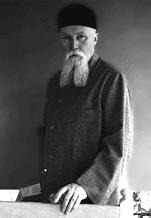
NICHOLAS ROERICH
EARLY YEARS
THE THEATRICAL YEARS
In 1906, in the first of many entrepreneurial efforts that were to bring Russian art and music to the attention of Europeans, Sergei Diaghilev arranged an exhibition of Russian paintings in Paris. These included sixteen works by Nicholas Roerich. The next year, Diaghilev introduced Fyodor Chaliapin to Paris audiences, along with the music of Mussorgsky, Rimsky-Korsakov, Borodin, Rachmaninov, Scriabin, Glazunov, Stravinsky, and others. In 1909 he presented Chaliapin in Rimsky-Korsakov's Ivan the Terrible, with costumes and sets designed by Roerich. In the Polovtsian Dances from Borodin's Prince Igor, also designed by Roerich, and in other ballets, Diaghilev introduced a corps of Russian dancers that later became famous as the Ballets Russes, which included Pavlova, Fokine, and Nijinsky. Roerich's designs furthered his reputation for the telling depiction of ancient cultures and their practices.
Diaghilev pioneered an art form that involved the collaboration of the designer as "auteur." Thus Alexandre Benois influenced the creation of the ballet Petrouchka, and Nicholas Roerich was the prime mover and, with Igor Stravinsky, the co-creator of the ballet Le Sacre du Printemps, or, The Rite of Spring.
At first entitled The Great Sacrifice: a Tableau of Pagan Russia, the motif for the ballet grew out of Roerich's absorption with antiquity and, as he wrote in a letter to Diaghilev, "the beautiful cosmogony of earth and sky." In the ballet Roerich sought to express the primitive rites of ancient man as he welcomed spring, the life-giver, and made sacrifice to Yarilo, the Sun God. It was a story unlike that of any ballet before it. Stravinsky's score and Nijinsky's choreography were equally unexpected, and provoked controversy that was to continue for many years.
At the opening in Paris on May 29, 1913, one of the audience described the scene: "Nothing that has ever been written about the battle of Le Sacre du Printemps has given a faint idea of what actually took place. The theater seemed to be shaken by an earthquake. It shuddered. People shouted insults, howled and whistled, drowning out the music. There was slapping and even punching...the ballet was astoundingly beautiful."
Interpreting what could have been described as negative, barbaric behavior, Roerich later wrote: "I remember how during the first performance the audience whistled and roared so that nothing could even be heard. Who knows, perhaps at that very moment they were inwardly exultant and expressing this feeling like the most primitive of peoples. But I must say, this wild primitivism had nothing in common with the refined primitiveness of our ancestors, for whom rhythm, the sacred symbol, and refinement of gesture were great and sacred concepts."
Sacre represented the culmination of Roerich's collaboration with Diaghilev. He recognized in the impresario a true champion of Russian art, and after Diaghilev's death in 1929 wrote: "We may regard the...achievement of Diaghilev as that of a great individual, but it would be still more exact to regard him as the true representative of an entire movement of synthesis, an eternally young representative of the great moment when modern art shattered so many conventions and superficialities."
THE CLOUDS OF WAR
In the years immediately preceding World War I, Roerich sensed an impending cataclysm, and his paintings symbolically depicted the awful scale of the conflict he felt descending upon the world. These works marked the birth of Roerich the "prophet."
In Battle in the Heavens Roerich used the violent contrast of light and darkness to suggest the terrible events that would soon overtake Russia and all Europe.
By this time, in his depiction of both historical and natural themes, symbolism and the use of allegory had become essential ingredients in his work. As one critic wrote: "He populated his world not with participants in transitory dramas and comedies, but with spokesmen for the most steadfast ideas about the truth of life, the millennial struggle of good and evil, the triumphal procession of a bright future for all."
TRAVEL TO OTHER SHORES
In 1915 Roerich became ill with pneumonia, and was sent by his doctor to recuperate with his family in Sortavala, Finland. This was a period of great unrest the world over, and no less so in the lives of the Roerich family. In Roerich's paintings of the period, such as Karelia -- Eternal Expectation and The Waiting Woman the cold, austere countryside of rocks and uninhabited shores of the north seems to express a sense of poignant longing. In The Waiting Woman, her gaze is fixed on the horizon as if she awaits some sign of the return of long-gone voyagers.
By 1917 the revolution was raging in Russia and returning there would have been dangerous. The family began making plans to visit India, whose magnetic appeal had been felt increasingly during these years. This became a possibility in 1918 when Roerich was invited by a Swedish entrepreneur to exhibit his paintings in Stockholm. From there the family proceeded to London, where Sir Thomas Beecham had invited Roerich to design a new production of Prince Igor for the Covent Garden Opera.
AMERICA
Meanwhile, an invitation to come to America was extended by the Chicago Art Institute. It was accepted, and the tour opened successfully at the Kingore Gallery in New York in 1920. In addition to exhibiting over 400 paintings there and in many cities throughout the United States, Roerich designed the scenery and costumes for productions of The Snow Maiden, and Tristan and Isolde for the Chicago Opera Company. During his travels in America, Roerich painted a series in New Mexico, and the Ocean Series in Monhegan, Maine, where the family spent a summer. He responded to the spirit of enterprise he found in America and frequently wrote about the positive influence its developing technology would have on the world. Seeds were planted and the lives of individuals influenced by Roerich's magnetism and sense of mission.
In 1921, in New York, he founded the Master Institute of United Arts, in which he planned to realize the educational concepts he had incorporated into the curriculum in St. Petersburg. He attracted a talented group of instructors. They included Deems Taylor, teaching musical theory and composition, Robert Edmund Jones and Lee Simonson, teaching theater design, and top quality instructors in courses that included all musical instruments, aspects of painting and drawing, design and illustration, sculpture, architecture, ballet, drama, journalism, and languages -- and lectures were presented by noted individuals such as George Bellows, Claude Bragdon, Norman Bel Geddes, and Stark Young.
The Master Institute flourished, but it did not survive beyond 1937. While the country was in the grips of the Great Depression and the Roerich family was on expedition in the Far East, funds ran out and events caused a complete collapse of the organization that Roerich and his supporters had labored to build.
It was not until 1949 that, under the direction of Sina Fosdick, one of the founding board members and an Institute faculty member, the institution was reborn as Nicholas Roerich Museum, in a brownstone on West 107th Street, where it has remained until the present. Many paintings from the original collection can now be seen there, and in the intervening years major works have been added, making it one of the most comprehensive collections of the artist's work in the world.
During their stay in America the Roerichs continued to plan for the voyage to India. An orientation toward Eastern spiritual values is reflected in much of Roerich's creative work of the time. This is seen in his Ocean Series -- the three paintings, Himself Came, The Bridge of Glory, and Miracle demonstrate the spiritual power that was beginning to characterize his work. In The Bridge of Glory, Saint Sergius of Radonezh walks in contemplation before a blue bridge formed by the aurora borealis, Roerich's metaphor for the future spiritual bridge that will connect heaven and earth.
Between 1916 and 1919 Roerich had written a collection of sixty-four blank verse poems that were published in Berlin, in Russian, under the title Flowers of Morya, and subsequently published in English as Flame in Chalice. In them we find Roerich's inner journey charted and his commitment to spiritual search stated. These poems evoke some of the images that Roerich later used in his paintings, and in a way help us to understand the symbols and meanings that lie behind some of them.
In her essay Flowers of Morya: the Theme of Spiritual Pilgrimage in the Poetry of Nicholas Roerich, Irina Corten writes: "At the core of Roerich's belief system is the Hindu concept of a beginningless and endless universe which manifests itself in recurring cycles of creation and dissolution of material forms caused by the pulsation of divine energy. On the human plane, this means the rise and fall of civilizations and, in terms of individual life, the reincarnation of a soul..." As Roerich, the poet, writes, in the poem About the Eternal:
Brother, let us abandon
all that rapidly changes.
Otherwise we will not have time
to turn our thoughts to that
which is changeless for all.
To the eternal.
In May, 1923, the Roerichs were at last on their way to India, where, in that ageless land, amid the snows of the Himalayan range, they sought to turn their thoughts to the Eternal.
INDIA
The Roerichs landed in Bombay in December, 1923, and began a tour of cultural centers and historic sites, meeting Indian scientists, scholars, artists, and writers along the way. By the end of December they were already in Sikkim on the southern slopes of the Himalayas, and it is clear by the speed with which they reached the mountains that the Himalayas were where their interest lay.
They initiated a journey of exploration that would take them into Chinese Turkestan, Altai, Mongolia and Tibet. It was an expedition into untracked regions where they planned to study the religions, languages, customs, and culture of the inhabitants.
Roerich wrote about this first Central Asiatic Expedition in his book Heart of Asia, and he creates for the reader a vivid account of the wonder of the land and its people. However, the images are nowhere as vivid as in the five hundred or so paintings that resulted from the trek. In Kanchenjunga, Sikkim Pass, His Country, The Great Spirit of the Himalayas, and the Banners of the East series, we can see philosophical concepts and ideas giving birth to visual images, and the splendor of Northern India providing the physical setting.
In The Path, the figure of Christ leads the way along a tortuous path through crags and peaks of the Himalayas, a metaphor for the hazardous obstacles confronting the spiritual journeyer. Eastern religious figures and concepts appear in the paintings, important among these being the images of the Lord Maitreya -- the Buddhist Messiah, the Kalki-Avatar of the Puranas, Rigden Jyepo of Mongolia, or the White Burkhan of Altai -- all of whom are described in legends that link them with the Ruler of Shambhala, who is "destined to appear on earth for the final destruction of the wicked, the renovation of creation and the restoration of purity."(quoted from The Theosophical Glossary, by H. P. Blavatsky)
The trek was at times arduous. Roerich tells us that thirty-five mountain passes from fourteen to twenty-one thousand feet in elevation were crossed. But these were the challenges he felt born for, believing that the rigor of the mountains helped a man to find courage and develop strength of spirit. And in spite of obstacles, wherever they went the Roerichs' belief in the essential goodness of life and the spirituality of man was reinforced. Roerich's Banners of the East series of nineteen paintings depicting the world's religious teachers, Mohammed, Jesus, Moses, Confucius, and Buddha, and the Indian and Christian saints and sages, was a testimonial to the unity of religious striving and the common roots of man's faith.
At counterpoint to these themes in Roerich's painting is the image of Woman and her destined role in the coming era, and we can assume that what Helena Roerich wrote to a friend in 1937 reflects Nicholas' own point of view: "...woman should realize that she herself contains all forces, and the moment she shakes off the age-old hypnosis of her seemingly lawful subjugation and mental inferiority and occupies herself with a manifold education, she will create in collaboration with man a new and better world... Cosmos affirms the greatness of woman's creative principle. Woman is a personification of nature, and it is nature that teaches man, not man nature. Therefore, may all women realize the grandeur of their origin, and may they strive for knowledge." (published in Letters of Helena Roerich 1935-1939, vol. II)
Nicholas Roerich depicted the great female deities in such paintings as She Who Leads, Madonna Laboris, and The Mother of the World. This latter conception, equivalent to the Lakshmi and Kali of India, is one of Roerich's most inspiring images, rendered with majesty in deep tones of blue and violet. Helena Roerich's contribution in the life and work of Nicholas cannot be overestimated. Their union could be best described as a lifetime collaboration in fields of mutual endeavor. Her philosophy, comprising a living ethic, was shared by Nicholas and motivated him in his work and his life. At some time in their late years an anniversary approached and he wrote in his diary: "Forty years -- no less than forty. On such a long voyage, meeting many storms and dangers from without, together we overcame all obstacles. And obstacles turned into possibilities. I dedicated my books to Helena, my wife, friend, traveling companion, inspirer! Each of these concepts was tested in the fire of life. And in Petersburg, Scandinavia, England, America, and in all Asia we worked, we studied, we broadened our consciousness. Together we created, and not without reason is it said that the work should bear two names -- a feminine and a masculine."
At the end of their major expedition, in 1928, the family settled in the Kullu Valley at an elevation of 6,500 feet in the Himalayan foothills, with a magnificent view of the valley and the surrounding mountains. Here they established their home and the headquarters of the Urusvati Himalayan Research Institute, which was organized to study the results of their expedition, and of those explorations that were yet to come. The Institute's activities included botanical and ethnological-linguistic studies, and the exploration of archeological sites. Under the direction of their father the two Roerich sons, George and Svetoslav, established a collection of medicinal herbs, and made extensive studies in botany and ancient medical lore, as well as in Tibetan and Chinese pharmacopoeia.
In the following year, on a trip back to New York for the opening of the Roerich Museum's new premises, Roerich raised an issue that had been close to his heart for many years. Using the Red Cross as an example, he proposed a treaty for the protection of cultural treasures during times of both war and peace -- a proposal he had unsuccessfully tried to promote in 1914. In consultation with lawyers versed in international law, he drafted a Pact, and suggested that a flag would be flown over all places under its protection. This flag he called the Banner of Peace. The design of the Banner shows three spheres surrounded by a circle, in magenta color on a white background. Of the many national and individual interpretations of this symbol, the most usual are perhaps those of Religion, Art and Science as aspects of Culture, which is the surrounding circle; or of past, present, and future achievements of humanity guarded within the circle of Eternity. The symbol can be seen in the seal of Tamerlane, in Tibetan, Caucasian, and Scandinavian jewelry, and on Byzantine and Roman artifacts. The image of the Strasbourg Madonna is adorned with it. It can be seen in many of Roerich's paintings, most notably Madonna Oriflamma, in which Woman is depicted as the carrier and defender of the Banner. In this sign and the motto, Pax Cultura, that accompanies it, is symbolized Roerich's vision for humanity. As he wrote: "Let us be united -- you will ask in what way? You will agree with me: in the easiest way, to create a common and sincere language. Perhaps in Beauty and Knowledge." Roerich's efforts to promulgate such a treaty resulted, finally, on April 15, 1935, in the signing by the nations of the Americas -- members of the Pan American Union -- of The Roerich Pact, in the White House in Washington. This is a treaty still in force. Many individuals, groups, and associations around the world continue to promote awareness of the Pact, the Banner, and their underlying principles.
It is in his Himalayan paintings that one most easily finds evidence of the loftiness of spirit and sense of mission that led Roerich to attempt the tasks he set for himself. In them can be seen the sense of drama, the urgency of a message to send or receive, a traveler to greet, a mission to perform, a path to travel. The towering mountains stand for the spiritual goals that humanity must set for itself. Roerich urges people on to their spiritual destiny and reminds them of their duty to prepare for the New Era in which Rigden Jyepo will gather his army and under the Banner of Light defeat the host of darkness. Roerich the warrior was already armed and mounted; he sought to muster his army for the battle, and bid that their breastplates bear the word "culture."
The pursuit of refinement and beauty was sacred for Roerich. He believed that although earthly temples and artifacts may perish, the thought that brings them into existence does not die but is part of an eternal stream of consciousness -- man's aspirations nourished by his directed will and by the energy of thought. Finally, he believed that peace on Earth was a prerequisite to planetary survival and the continuing process of spiritual evolution, and he exhorted his fellow man to help achieve that peace by uniting in the common language of Beauty and Knowledge.
Nicholas Roerich died in Kullu on December 13, 1947. His body was cremated and its ashes buried on a slope facing the mountains he loved and portrayed in many of his nearly seven thousand works.