JOSE ANTONIO PRIMO DE
RIVERA
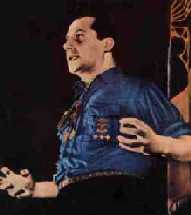
A spiritual Patriot
by Radbod
"Fascism was born to
inspire a faith not of the Right
(which at bottom aspires to conserve everything, even injustice)
or of the Left (which at bottom aspires
to destroy everything, even goodness),
but a collective, integral, national faith." (Jose
Antonio Primo de Rivera)
José Antonio Primo de Rivera y Saenz de Heredia Marques de Estella or
'Jose Antonio' (as he is more commonly called) was born on April 24, 1903 in
Madrid to grow up in a healthy aristocratic family environment as the eldest
son of General Miguel Primo de Rivera, who was the Leader of Spain from 1923 to
1930. His family was socially prominent in Andalusia,
having intermarried with large landholders and merchants around Jerez de la
Frontera. From his father José Antonio inherited the title marqués de Estella.
His father, after a rapid and brilliant military career in Cuba,
the Philippines,
and Morocco,
became governor of Cádiz
(1915), then in turn captain general of Valencia,
Madrid,
and Catalonia.
From Catalonia
he staged a coup d'etat in September 1923, dissolving the Cortes and then
establishing, with the full approval of King Alfonso XIII, a military
directory. The constitution of 1876 as well as civil liberties were suspended.
The military dictatorship was replaced by a civil one (1925); both ruled quite
moderately, without the brutalities and extreme repression that characterized
later dictatorships. Miguel Primo de Rivera ended the war in Morocco (1926),
introduced many measures aimed at economic modernization and administrative
reform, and launched an ambitious program of public works, but his rule aroused
the opposition of anarcho-syndicalists, Catalan regionalists, and all liberals.
His regime was in more than one instance misguided, clumsy, and naive, but it
was a basically generous and inclusive one. Spain
under him would develop economically, and all Spaniards would share the
benefits. There were public works, greater employment, more schools, sanitary
improvements, and attention given to worker's rights. An uprising in 1929 by
the liberals did not succeed, but various political and economic failures of
the regime soon led to his resignation (Jan., 1930). He died in exile in Paris,
reportedly of a broken heart.
José Antonio was an intense intellectual and studied the works of
philosophers and political thinkers such as Spengler, Keyserling, Marx, Lenin,
Ortega, Mussolini, and Trotsky. He went to the University
of Madrid
to study law and after military service he began a career as a lawyer in 1925.
When his father’s memory was being made a mockery of in the Cortes (parliament),
he involved in politics when he held speeches defending the policies of his
father and finally decided to run for parliament. The more they attacked and
ridiculed his father, the more antagonistic he became toward their insistence
on middle-class liberal democracy and parliamentary forms. His disdain for the
political realm would inspire in him a theory for a political system that would
retain the positive aspects of his father’s regime and create others that would
fix the faults. José Antonio also edited the right-wing journal, El Fascio.
After it was shut down by the Republican government he wrote for the periodical
ABC.
The Republic was set up in Spain
on April 14,
1931 with the end of General Primo de Rivera’s
dictatorship. The country was therefore not looking for another authoritarian form
of government, and definitely not a monarchy since Alfonso XIII had shown that
he was utterly incompetent at ruling the Spanish people. The Left finally had
the opportunity to govern Spain
their way. Yet, disgust with the way things were going was evident just a few
months after the Republic was created. In the years that followed emotions
became stressed and nerves taut. Promises of change were being broken faster
than they were made. The Cortes was plagued with the constant bickering of
members concerned only with their propaganda and affairs. Spanish liberalism
started to rise and the possibility of creating an political alternative began
to be discussed.
World War I had left Europe
in a state of disarray. National spirits had risen like heavy perfume on a cold
night, sweetening what was left of putrid Europe.
Underneath this cloud, however, was still the problem of class struggle and the
question of social justice. These two components – national interest and the
social question - eventually sparked a new movement, one that called for the
nation irrespective of class – nationalistic and socialist. Spain
was in a far worse condition than any other country with the possible exception
of Portugal,
after World War I. The country was in a semi-medieval rut. Around the
beginning of the twentieth century about ninety-eight percent of the land was
owned by about three percent of the total population. The society was mainly
agrarian and organized labor seemed unheard of. Although Spain
was improving, thanks to the help of the constitutional monarchy that began in
1875 and the dictatorship of General Primo de Rivera, its growth was unusually
slow. And to make matters worse, the regions that did see economic growth were
isolated, though more culturally than geographically. Class struggle became
increasingly exacerbated. Perhaps the only thing that the middle class, which
would be the main component of the Fascist movement, was passionate about at
the time was the abatement of the proletarian rebellion, if not avoiding it
altogether.
The conditions were finally right for the growth of a national socialist
movement. Differing levels of the new movement developed in two other countries
beside Spain.
Germany
would take part in a national socialist movement that suppressed the socialism
under the bloated pride of nationalism. Italy
apparently had a pragmatic reconciliation of socialist and nationalist
aspirations. Spain’s
national socialist, or Fascist, movement, however, took on a more personal, or
individual, patriotic role. The stage was being prepared for the beginning of a
Spanish national socialist party, Jose Antonio Primo de Rivera’s party.
Jose Antonio offered a fresh look at the system of government. He
sympathized with the Republic in feeling disdain for a capitalist system. Like
the Left, Jose Antonio believed that Spain
had been suffering from the capitalist plague "that turns the worker into
a dehumanized cog in the machinery of bourgeois production." However, he
also believed that the solution was not the communism that the Left offered.
Jose Antonio argued that while a capitalist system "dehumanized" a
person, communism "absorbs the individual personality into the
State." He spent some time during
the early months of 1933 looking for someone to lead a new national socialist
movement. He deemed himself unable, claiming that he had "too many
intellectual preoccupations to be a leader of the masses" and his possible
financiers did not wish to back "another Primo de Rivera".
Fortunately, Jose Antonio found "a solid collaborator" in Ruiz de Alda.
Alda was a renowned aviator who himself had been attracted by nationalistic
appeals and distrusted the established parties. They got to work together about
creating their idealistic brand of national syndicalism. Now all they had to do
was wait for a moment when the political atmosphere would be more favorable.
The wait was not long for in the fall of that year elections were to be held.
On October
29, 1933 in the Teatro Comedia Jose Antonio Primo de
Rivera gave a speech where he announced his election into the Cortes and the
creation of the Falange Española. Jose Antonio announced that Sunday evening in
the Teatro Comedia to a crowd of about 3,000 persons what the Falange stood
for: The faith of the Falange was in Spain,
that is in the total synthesis of all individuals and classes, which thus
synthesized into a new individual had a divine destiny. Within this synthesis,
there could not be political parties: religion would be tolerated so long as it
did not interfere in undefined affairs not of its competence: there could be no
drones nor parasites in the new society: all men would have the right but also
the duty to work for the community. To achieve the new society, violence might
be necessary, but it was not an end in itself. He launched the Falange as a
movement committed to overthrowing the government if the political parties of
the left should manage to impose their policies on the country. It was part
militia, part political party, and part movement, inspired by Mussolini's
fascism, and started preaching about the need for a greater national interest
that would be above all the particular or group interests then claiming for
attention, and that the answer was not in either the Right or the Left, but in
an amalgamation of the best of both.
The parties initials F.E. for Falange Española make the Spanish word for
"faith", summarizing the feeling of what Jose Antonio held for Spain.
He expounded his Revolutionary views in his periodicals F.E. (1934) and Arriba
(1935), and when these publications were suppressed by the state, he addressed
meetings across the country and made speeches in the Cortes (parliament), to
which he had been elected in 1933. In its manifesto the Falange condemned
socialism, Marxism, republicanism and capitalism and proposed that Spain
should become a Fascist state. Professing generally the principles of fascism,
the Falange distinguished itself from other fascist groups by its great
emphasis on national tradition, particularly the imperial and Renaissance
Christian traditions of Spain.
The first months of the Falange showed great success. Already they had
acquired more members than the National Syndicalists (Juntas de Ofensiva
Nacional-Sindicalist - J.O.N.S.), the
national syndicalist organization , which was headed by Ledesma Ramos. Among
the new followers were many university students impressed with Jose Antonio’s
rhetoric. The J.O.N.S. was similar in style, and quoted roughly one thousand
members. There was an immense pressure for the two parties to merge, if they
want to stay afloat in the political pool. On March 14, 1934 the
J.O.N.S. joined the Falange to become one (FE-JONS) under José Antonio as its
leader. Jose Antonio agreed to the union; he disliked Ledesma, the party’s
leader, and the party’s "crudeness". Yet, violence was nothing new to
the Falange party. The violence among Falangists and the Left was intense. Just
a few days after the party had formed, its first member was killed. Jose
Antonio had asserted that violence would be necessary, and he was absolutely
realistic. Many attempts were made at his life, including once when a bomb was
thrown at his vehicle. Jose Antonio reacted by getting out of his car and
attempted to shoot the assailants. He did not shudder at the price of freedom
of speech. Night after night there were reports of "suspect Fascists"
being arrested or gunned down. In the speech of the founding of the Falange
Jose Antonio declared, "We are not going to that place [the Cortes] to
squabble with the habitues over the insipid scraps of an unclean feast. Our
place is outside…our place is in the open air, under the clear night sky, sword
in hand and stars above". A different type of violence was occurring in
the party. Many were fearful of the party growing too conservative. While Jose
Antonio was strengthening his control, Ledesma abandoned the party at the beginning
of 1935. Later that year, Jose Antonio put his party at the service of the
Italian government, from which he received a monthly subsidy until June 1936.
In 1935 the parties of the left formed the Popular Front, which came to
power after the elections of February 1936, whereas the Falange won only 0.7
per cent of the vote. José Antonio was elected to the Cortes. Being a legally
elected official mattered little to the Leftist ruled government in Madrid.
To them José Antonio was a symbol of everything they feared - Patriotism,
Discipline, Morality and Spirituality. At that time the Falange had neither the
numbers nor the money to make a difference. There was no way the Republican
government were going to allow the Falangists to gain any kind of power in
Spain, in a formally legal way or otherwise.
For a while he managed to keep his followers from responding to the
increasing violence in the streets. After the victory of the Popular Front the
Falange Espaola grew rapidly and by July had a membership of 40,000. Then he
too was swallowed in the gunpoint battles which were the regular form of
intercourse at the street level. The situation having deteriorated further he
ended up, after other options had failed, Primo de Rivera joined a conspiracy
to overthrow the Popular Front government. Primo de Rivera fully supported the
military rebellion in July 1936 against the republican government and after the
outbreak of the Spanish Civil War the Falange became the dominant political
movement of the Nationalists. The Falange militia joined the Insurgents in the
Spanish civil war of 1936–39.
When word got back to the Republican government that Falangists were
beginning to arm themselves, they set about arresting the leaders of the
Falangist movement throughout Spain.
The so called Republican government never did a thing to stop the Communists
and Socialists from arming themselves or the criminal acts perpetrated by these
two groups.
Violence soared through the streets of Madrid.
Falangists were being arrested and shot, and vice versa in retaliation. The
tensions finally peaked when on the night of July 12, 1936 Jose Calvo Sotelo,
the leading spokesman of the organized Right, was supposedly taken into
custody. The next morning his body was found at the gates of a cemetery. This
was the incident that sparked the fire. Riots broke out, rebellions were
implemented, and on July
17, 1936 the Spanish Civil War began. With the outbreak
of the Spanish Civil War, shortly after losing his seat in the Cortes at that
time, the Spanish Falange was declared an illegal organization by the
Republicans. They banned the party, arrested its leaders and closed down its
press. Primo de Rivera was arrested on June 5th 1936 and
incarcerated in Alicante Prison by the puppet mercenaries of the State
(police), in the power of his opponents. The Falange grew into one of the most
powerful movements in Spain
while José Antonio was in prison.
Primo de Rivera was tried for his part in the rebellion. He was given a
summary trial for conspiring against the Republic and leading a Fascist-based
organization and condemned to death. On November 18th 1936, José Antonio wrote,
"Condemened to death yesterday, I pray God that if He does not still spare
me from coming to that last trial, He may preserve in me up to the end the
seemly submission with which I contemplate it, and that in judging my soul He
may apply to it not the measure of my merits but that of His infinite Mercy''.
The circumstances surrounding Jose Antonio’s death are very peculiar.
The Republican government had grown anxious of the rise in power of the
Fascists. A Fascist crackdown was implemented. Fearful of what Jose Antonio
might impress upon his followers to do, the Republican government kept him in
jail for several months. In his Last Will and Testament Jose Antonio notes that
it was not until five to six days before he wrote this statement that he was
informed of the charges upon his indictment. On November 20, 1936, Jose
Antonio Primo de Rivera was marched out of his cell in Alicante
prison and with a crucifix in his hand and "prayer on his lips" and
forgiveness for the enemies about to murder him was executed by a firing squad.
José Antonio died like a Man, he died a Hero, a Martyr and a Saint. His death
was not reported until one year later and his remains were unknown.
News of his death was suppressed until a year later. The unknown location
of his body inhibited relocation from the Alicante
prison cemetery until his brother Miguel, being released from prison, was able
to provide information. Before Miguel’s statement of the events, the Republican
government had tried to cover up the execution by claiming that there had been
a mob that broke into the jail and that is was the mob which killed Jose
Antonio.
The death of Jose Antonio led to the death of his Falange. The Falange
that would precede him would go through vast changes . There was much bickering
over who would succeed Jose Antonio. A man, most unworthy of the position,
named Hedilla led the organization for only brief period of time. For Franco
was looming in the background, growing more victorious. Eventually the
Generalissimo declared himself the jefe nacional and, on April 19, 1937,
changed the organization into the Falange Espanola Tradicionalista y de las
Juntas de Ofensiva Nacional-Sindicalist.
Finally, after three years of lies, Jose Antonio was given his due
respect in 1939. His remains were excavated and moved to the Escorial
Monastery. Planes dropped wreaths on the Alicante
cemetery, and Franco broadcast a tribute to the dead leader. A huge funeral
mass was held that lasted for 10 days and included a 284-mile procession with his
coffin on Fascist shoulders. Mussolini had Italian Fascists personally carry a
bronze wreath to his grave. Jose Antonio was buried at the Escorial Monastery
in the Guadarrama
Mountains
among Spain’s
king and queens. After Franco had built the Valley of the Fallen his remains
were moved there on March
30, 1959 for the last time.
General Franco's party treated José Antonio as a martyr to gain the
support of the National Revolutionary movements followers. Merged with the
Carlist militia by Francisco Franco in 1937, the organization was renamed
Falange Española Tradicionalista and was made the official party of the
Nationalist state. It was a much less independent force than Italian fascism,
however, and was exploited and manipulated by Franco. From the middle of World
War II on, the party grew steadily weaker, and Franco sought to make it a kind
of bureaucratic nationalist front. The Falange movement itself was diluted and
any vestiges of the old revolutionary spirit were eradicated in order to
appease the Roman Catholic Church and the military. By the early 1970s it had
virtually no influence. Jose Antonio Primo de Rivera's articles and speeches
help to form some of the doctrine of Franco's Nationalist movement; but like
any and all mainstream political organisations, they could not truly bread
beyond conventionalism and institute the truly Revolutionary aspects of the
doctrine that would have made Spain
a true Nation of the People.
Hence with everything thus stated it is difficult to image that even
today people carelessly throw around a word as powerful as ‘Fascist’. This term
has been loosely used to label anyone person or organization of the Right that
is seen as revolutionary, anyone who loves their country above all else, and
anyone who approves of an authoritarian government. Today, patriotic middle
class Christians that believe in individual responsibility seemed to be labeled
Fascists or Fascist sympathizers. Julius Evola has commented that "fascism
has undergone a process which can be called mythologization, and the attitude
which many adopt towards it is of a passionate and irrational kind rather than
a critical, intellectual one". In a note that was eventually published in
the Spanish Press on the
10th of December 1934, Jose Antonio clearly states that
the "Falange Espanola de las J.O.N.S. is not a Fascist movement. It has
certain coincidences with Fascism in essential points which are of universal
validity; but it is daily acquiring a clearer outline of its own, and is
convinced that by following this path and no other it will find its most
fruitful possibilities of development". Even at the end of his life he was
intensely frustrated with the political name-calling and bullying. "It
astounds me that after three years the immense majority of our countrymen
should persist in judging us without having begun to show the least sign of
understanding us, and indeed without having even sought or accepted the
slightest information".
It is no wonder that in this day and age of immorality and anti-heroes,
that José Antonio stands out like a Beacon of Light with an ever growing
popularity and following throughout, not only Spain
but the rest of the World as well.
Rivera's Obras completas ("Complete Works") appeared in 1944.
BACK